
Almost every home baker assumes the same thing about a starter that’s been forgotten: once it’s sat neglected for weeks, it must be dead, and the only real option is to toss it and build a fresh culture. That assumption is wrong more often than it’s right — and I learned this the hard way, standing in my kitchen at six in the morning on a Saturday, staring at a jar I’d nicknamed Harold like he was some kind of pet. Four years of keeping this culture alive through my busiest microbakery weekends, and there he was, foaming up over the rim of his jar like a homemade science-fair volcano gone rogue. Not the charming kind of eruption. The kind that makes you reconsider every decision that landed you in this exact spot.
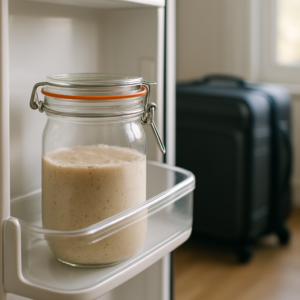
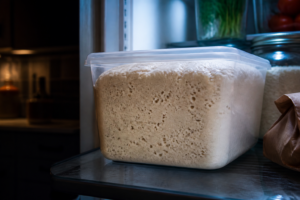
Here’s what had actually gone on: Harold had been sitting completely untouched in the back of my fridge, and I’d told myself it had only been a week, maybe two. Once I actually did the math, it turned out to be closer to a full four weeks.
| Problem | Appearance | Smell | Action |
|---|---|---|---|
| Mold | Fuzzy patches in white, green, blue, or pinkish-orange | Musty odor | Discard the whole jar and start fresh |
| Hooch | Dark grey-to-black liquid on top | Boozy or sour | Scrape off discolored layer and feed |
The Morning Everything Went Sideways (aka The Great Starter Blowout of 2019)
By the time I remembered him and dug the jar out, it looked like a prop from a low-budget monster movie. A layer of dark liquid had separated and pooled on the surface. The smell hit hard and sharp, somewhere between vinegar and nail polish remover — classic hooch. This is genuinely useful to know if you ever find yourself in the same spot: hooch shows up as a dark grey-to-black liquid sitting on top, and it smells boozy or sour. It doesn’t mean the culture is ruined — it just means your starter is running on empty. The living organisms are still down there; they’ve simply used up their food supply. Mold is a different animal entirely — fuzzy patches in white, green, blue, or pinkish-orange, paired with a musty odor — and that’s the scenario where you genuinely dump the whole jar and start fresh. What Harold had was hooch, not mold, which meant he could still be saved. I just hadn’t figured that out yet.
I went ahead and fed it anyway, banking on years of experience to bail me out. No discard first, no easing it back in slowly — I just poured a full feeding straight onto a starving, over-acidified culture crammed into a jar with zero breathing room. Harold erupted. He tore right through the loosely-tied cloth cover I’d carelessly left on, sprayed across the countertop, and ran down the cabinet face below.
Somewhere around the hundredth swipe of starter off my kitchen tiles, it hit me: back when I was running my microbakery on heavy weekend rotations, I’d kept a rigid feeding routine purely out of necessity — and the second I slid back into casual, low-key baking, that whole system quietly fell apart. Worse, I had no real idea how to bring a starter back from that level of neglect.
The Real Way to Revive a Starter You’ve Neglected
Once the mess was cleaned up, I actually researched how to do this properly instead of panic-feeding my way through it. Here’s the sequence that genuinely works when your starter has sat unfed for weeks:
- Take it out of the fridge and let it sit at room temperature for 3–4 hours before touching it at all.
- Give it an honest look: mold — fuzzy, colored spots with a musty smell — means starting over with a new culture. Hooch and a grayish or darkened top layer are completely normal for a neglected-but-living starter; just scrape that discolored layer off and move forward.
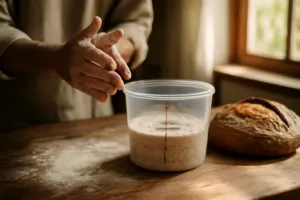
- Discard down to a small portion and feed a modest ratio rather than dumping a huge feeding onto an empty stomach — something around 1:4:4 works well for that first revival feed.
- Keep repeating that discard-and-feed pattern roughly every 12 hours. Expect it to take several feeds spread across 2–3 days before you’re seeing consistent doubling and that pleasant tangy smell return.
- Resist the urge to rush and don’t bake with it until it’s reliably active again. A starter still limping back from neglect will disappoint you in the dough, not just in the jar.
This is exactly where jar headroom becomes non-negotiable — a revival feed can froth up aggressively as the culture wakes back up, and a jar that’s already packed to the brim is a guaranteed repeat of the countertop disaster. More on that in a bit.
The Weekly Check-In That Keeps This From Happening Twice
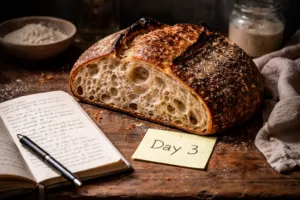
The real solution here had nothing to do with a smarter feeding ratio — it was building in a habit so I’d never again “lose track” of a starter for a month straight. Every Sunday night, I take ten minutes to look ahead at my week and ask myself one question: how many times am I actually going to bake? If the answer’s two or more, Harold stays out on the counter getting fed daily. If it’s once, or nothing at all, he goes back into the fridge on a once-a-week feeding, and I note down whichever mode he’s in. (If you want the full rundown on counter-versus-fridge feeding ratios and timing, I go deep on that in my sourdough starter feeding schedule guide.)
I genuinely write this down now — not because I’m some kind of neat-freak (well, maybe a little), but because putting it on paper heads off exactly the kind of absent-minded slip-up that caused the whole Harold explosion in the first place. A starter logged in “fridge mode” on a calendar doesn’t quietly get forgotten for a month, because I’m no longer trusting my memory to handle it alone.
The Jar Upgrade That Stopped Harold From Erupting All Over the Kitchen
Once your starter starts doubling — especially mid-revival, when things get unpredictable — a jar that only holds around 24 ounces puts you one missed feeding or one enthusiastic comeback away from another sticky mess on the counter. Harold taught me that lesson the hard way, and moving to a properly sized jar with genuine headroom completely changed how comfortably I can feed, occasionally neglect, and revive him without breaking a sweat.
Where it delivers
- That 40-ounce capacity gives your starter genuine room to rise and expand without endangering your cabinet — especially useful during a revival feed, when it’s at its least predictable.
- The wide-mouth design makes feeding and general upkeep noticeably simpler; I can actually scrape the sides clean and get an honest read on volume without twisting my hand into some kind of starter-surgery position.
- Straight sides mean the volume markers actually mean something — you can see clearly the moment your starter has peaked, so feeding or using it stops being a guessing game.
Where it falls short
- 40 ounces takes up real space on a kitchen shelf — if your apartment is tight or your fridge is already crammed, this isn’t a jar that tucks away quietly anywhere.
- The glass itself weighs more than smaller jars, so if you’re feeding several times a day and shuttling it in and out of the fridge constantly, your wrist is going to feel it.
I was skeptical that bigger would actually solve my scheduling chaos—I thought the problem was me, not the jar—but the first time I revived a neglected starter in it, there was zero overflow, just a starter with room to misbehave safely. 2 Pack Premium Pro Sourdough Starter Jar Kit – 40oz Large Wide Mouth Sourdough Bread Jar
Frequently Asked Questions
How do I tell if my neglected starter has mold or just hooch?
Mold appears as fuzzy patches in white, green, blue, or pinkish-orange with a musty odor — discard the whole jar and start fresh. Hooch is a dark grey-to-black liquid on top with a boozy or sour smell. Hooch means your starter is still alive but hungry; it can be saved by scraping off the discolored layer and feeding it properly.
What is the correct way to revive a neglected sourdough starter?
Let it sit at room temperature for 3–4 hours, then scrape off any discolored top layer. Discard down to a small portion and feed around 1:4:4. Repeat this discard-and-feed pattern every 12 hours for 2–3 days until you see consistent doubling and a pleasant tangy smell, then wait until it’s reliably active before baking.
Why did my starter overflow when I fed it after neglect?
A revival feed can froth up aggressively as the culture wakes back up. If your jar lacks headroom, overflow is guaranteed. A 40-ounce jar with straight sides gives your starter genuine room to rise and expand safely during unpredictable revival feeding without endangering your kitchen.
How do I prevent forgetting my starter for a month again?
Every Sunday night, plan how many times you’ll bake that week. If two or more, keep your starter on the counter with daily feeding. If once or less, move it to the fridge on once-a-week feeding and write down which mode it’s in. Writing it down prevents the absent-minded slip-up that caused neglect in the first place.
About This Article

Written by Sam Whitaker. Sam Whitaker has been baking sourdough for over a decade, including three years baking commercially, and now works out of a home kitchen in the Pacific Northwest. Sam's eleven-year-old starter, Harold, is the foundation for every recipe and troubleshooting guide on Sourdough Rising — real bread tested over and over until it works. More about this site.
Scope and limits. Sam is a home baker with no formal culinary training. Follow current food safety guidance for storage and handling, particularly with enriched or filled doughs.
Verify this against a primary source
Specifics change, and your situation may differ from the one described here. These are the authorities worth checking directly:
- USDA FoodData Central — flour and ingredient composition data
- FoodSafety.gov — safe handling and storage