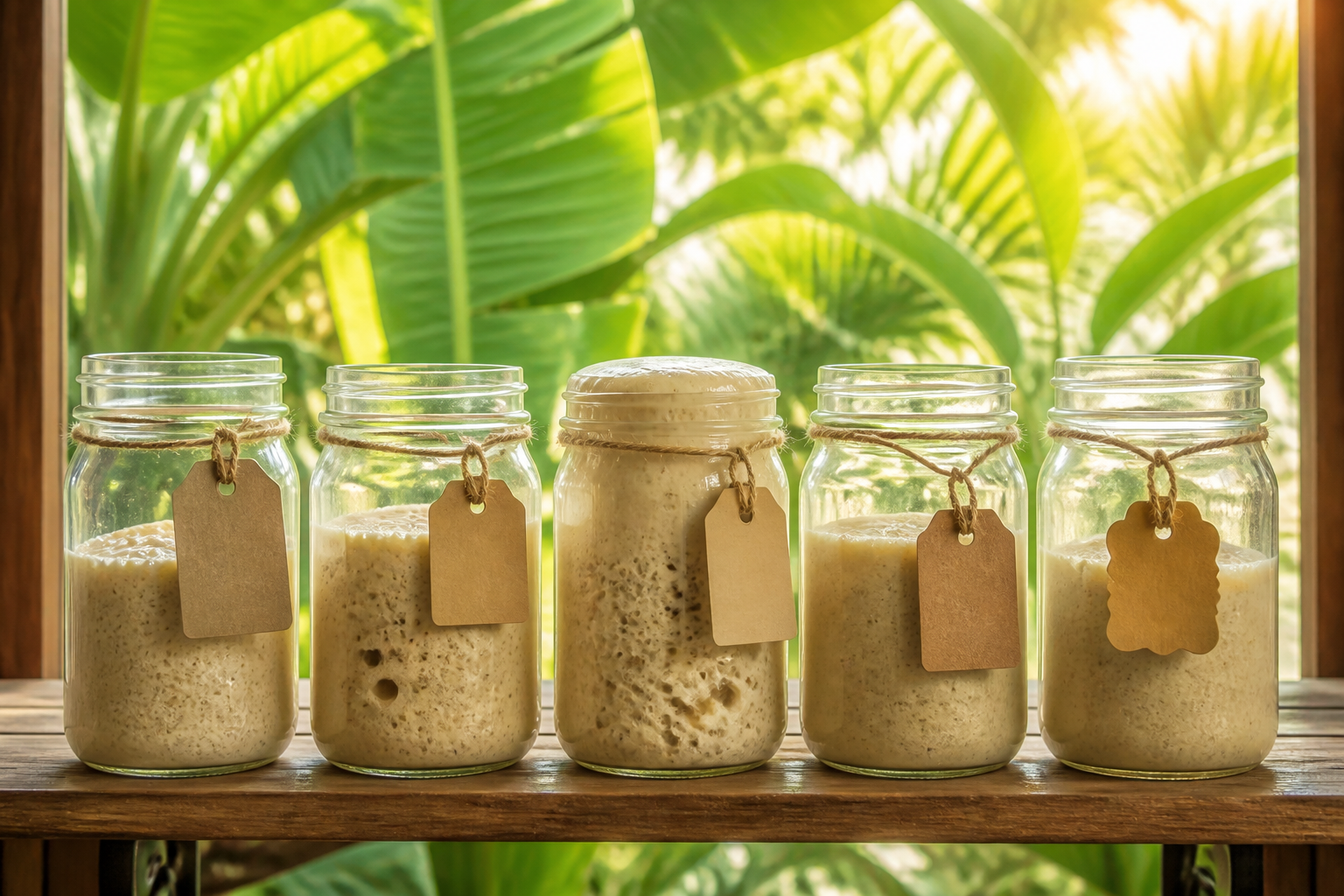

A note from Sam: every fermentation experiment I’ve ever run has stayed firmly inside Pacific Northwest weather, so when longtime reader Mei Lin Koh offered up her own wild-yeast terroir project from Singapore, I said yes before she’d even finished the sentence — tropical fermentation runs on a clock I’ve simply never had to learn. Handing this one over to Mei Lin now.
Half the advice floating around sourdough forums says any jar of flour paste left out will eventually catch something usable; the other half insists you need a spotless, “clean” location — no drains, no rubbish bins, nothing organic nearby — or the whole thing is doomed before it starts. That second piece of advice is flat-out wrong, and I’ve got proof: on Day One of this whole endeavor I was crouched behind a drain in Tiong Bahru at seven in the morning, jar of flour paste in hand, quietly coaxing “come on, little guys” into the humid air, while a passing auntie gave me a look I will be thinking about for the rest of my thirty-six years on this planet. That was the true starting point of my wild yeast starter Singapore neighborhoods project, and things only got odder from there.
Some context first. I’d been baking sourdough for roughly two years when a late-night Reddit spiral introduced me to the idea of terroir in starters — the notion that wild yeast and bacteria populations shift from one location to the next, so a culture grown on one street corner might behave nothing like one grown a kilometer away. My reaction was: Singapore may be small, but we pack in an absurd amount of variety across environment, greenery, and history. So what would happen if I went out and captured wild yeast from five completely different pockets of the island? I couldn’t let that question sit unanswered. What follows is the unscientific, occasionally mortifying, but ultimately delightful record of how it all played out.
| Neighborhood | Days to Activity | Aroma Profile | Doubling Speed | Baking Result |
|---|---|---|---|---|
| Tiong Bahru | Day 3 | Tangy, faintly fruity | 6–8 hours | Mild, balanced sour |
| Lau Pa Sat | Day 5 | Sharper, vinegar-forward | Not specified | Worked well in rye |
| Bukit Timah Nature Reserve | Day 2 | Wild, yeasty-floral | 4 hours | Most energetic, needed reining in |
| Geylang | Not specified | Funky, then savory and earthy | Not specified | More flavor depth, good for whole wheat |
| East Coast Park | Day 4 (after recovery) | Ripe mango, warm and yeasty | Not specified | Gentle sourness, faint sweetness |
The Equipment Behind This Slightly Ridiculous Yeast Hunt
Before the chaos properly begins, let’s talk gear. Nothing exotic is required to build a starter, but the right jars paired with a scale you actually trust take a lot of the stress out of the process.
On the jar front, I rotated between a few kinds: the 32 oz Mason Jars with Stainless Steel Split Lid, 2-Pack earned their keep because the split lid vents fermentation gas while still keeping contaminants out. Since five separate jars were needed, I also grabbed the ComSaf 32 oz Wide Mouth Mason Jars 2 Pack — the wide mouths make feeding and scrubbing so much less fiddly. Rounding things out was the Paksh Novelty Wide Mouth Mason Jars 32 oz 2-Pack, which seal impressively well and, lined up on a shelf, look genuinely good. I care about that more than I’d like to admit.
For measuring, two scales carried me through this whole project. The Etekcity Food Kitchen Scale is my daily go-to — precise, simple to read, and it’s survived two years of flour dust storms in my HDB kitchen without complaint. As backup, and for taking on the road, I use the Food Scale 33lb Digital Kitchen Scale, which charges over USB-C, so there’s no scrambling for fresh batteries when you’re deep into an experiment at eleven at night.
Wild Yeast Starter Singapore Neighborhoods: Where I Went Hunting
I settled on five spots that each felt like their own little world. The method stayed identical at every stop: 50g of unbleached bread flour whisked with 50g of filtered water, the paste left loosely covered in an open jar at that location for about two hours in the early morning before the heat set in, then carried home to start the feeding cycle. None of this is lab-grade science, and I have zero certainty about which specific microbes actually caught a ride each time. Still, in practice, even small shifts in environment seem to shape starters with genuinely distinct personalities. Here’s what turned up.
1. Tiong Bahru (Site of the Great Side-Eye)
This was stop number one, and where that unforgettable look from a stranger happened. Tiong Bahru brings old colonial-era flats, mature trees, and that particular damp, leafy smell I’ve always loved. My starter from here was already active by Day 3 — aggressively so, given how fast Singapore’s heat pushes things along. Inside a week it developed a pleasantly tangy, faintly fruity aroma and was reliably doubling every 6 to 8 hours at roughly 29 to 30 degrees Celsius, which tracks with my kitchen’s usual temperature. I baked a batard with it that came out mild and nicely balanced on the sour front. A genuine favorite.
2. Lau Pa Sat, in the CBD
This capture felt refreshingly low-stakes. Office workers near a heritage building don’t blink at someone crouched over a jar — they just assume it’s some kind of startup thing. The Lau Pa Sat starter took its time waking up, likely because the surroundings were drier and more concrete-dominated, with far less organic material drifting through the air. By Day 5 it had kicked into gear, and what stood out was a sharper, more vinegar-forward tang than the Tiong Bahru batch. I can’t say whether that difference means anything scientifically, but it worked beautifully in a rye loaf where I wanted the acidity turned up.
3. The Edge of Bukit Timah Nature Reserve
I had big expectations here — primary rainforest, dense biodiversity, trees that have clearly seen a lot. The Bukit Timah starter was fizzing enthusiastically by Day 2 and carried a wild, almost yeasty-floral scent unlike any of the others. It also turned out to be the most energetic of the five, capable of doubling in just 4 hours on a warm afternoon. That kind of speed isn’t always a gift in Singapore’s climate, since an overeager starter can peak and crash before you’ve even noticed. I ended up refrigerating this one more often and feeding it at a higher flour ratio — 1:2:2, sometimes 1:3:3 — just to rein it in. Extra fuss, but worth it.
4. Geylang
I did, in fact, show up in Geylang at 7am carrying a jar of flour paste while the durian vendors were setting up shop. It was noisy, absurd, and about as on-brand for the neighborhood as it gets. This starter developed the most layered aroma of any of the five — a bit funky early on, which honestly felt fitting, before mellowing into something deeply savory and earthy by the end of week two. It bakes into loaves with more flavor depth than the rest, and I’ve found it’s especially at home in whole wheat bread.
5. East Coast Park
Salt air, casuarina trees, joggers eyeing me with mild suspicion. This last starter turned out to be the one that nearly did me in — and the source of the awkward plot twist I mentioned earlier.
Where It Went Wrong, What I Discovered, and How It All Worked Out
By Day 4, my East Coast Park starter looked completely lifeless and smelled less like tangy fermentation and more like nail polish remover. I panicked, naturally, and posted about it in a sourdough Facebook group at midnight. Three people replied — two from the US, and one whose entire contribution was a thumbs-up emoji.
I very nearly tossed the whole jar. Here’s the mortifying twist, though: I didn’t save it because of good judgment — I saved it because I got lazy and simply forgot about it for two days straight. It got pushed to the back of the counter behind a tub of kaya and slipped my mind entirely. When I rediscovered it, it had climbed almost to the lid, was thick with bubbles, and smelled fantastic — ripe mango mixed with something warm and yeasty. That nail-polish note, which I now understand is ethyl acetate and signals a hungry, stressed starter rather than a dead one, had vanished completely once the culture found its footing. It simply needed more time and the kind of ambient warmth only a tropical kitchen provides.
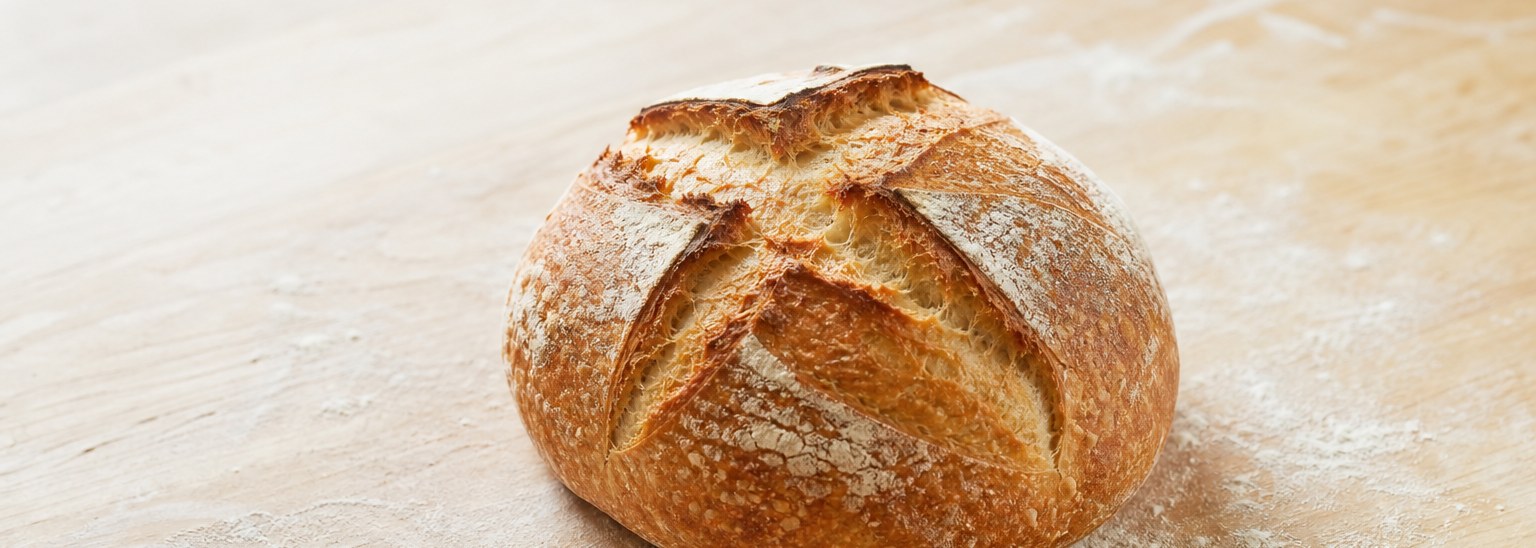
Four months on, that East Coast starter has become my favorite of the bunch. There’s a gentle sourness paired with a faint sweetness that I suspect comes from something in that sea-and-casuarina air. It produces the most beautiful plain white sourdough loaves I’ve made, and I’ve since handed portions of it to three friends. Two of them are now fully hooked on sourdough baking, which I count as a personal win.
A handful of practical lessons came out of this whole project, all specific to baking in Singapore’s climate:
- With ambient temperatures sitting at 28 to 32 degrees Celsius, starters here ferment far quicker than the timelines you’ll find in most Western recipes — track the starter’s behavior, not the clock.
- If a starter keeps peaking and crashing too quickly, bump up the flour ratio during feeding — try 1:3:3 or even 1:5:5 starter to flour to water — so the yeast has more to chew through.
- In a humid HDB kitchen, cover the jar loosely instead of sealing it tight while fermentation is active — the split-lid mason jars mentioned earlier work perfectly for this.
- Don’t panic over an acetone or alcohol-like smell in a young starter’s early days — just keep feeding it, keep it warm, and let time do its work.
- Weigh every single ingredient. Eyeballing flour and water ratios makes troubleshooting nearly impossible, which is exactly why a reliable scale isn’t optional.
If capturing your own wild yeast starter Singapore neighborhoods-style has ever crossed your mind — whether from your own void deck, a nearby park, or somewhere stranger still — I’d genuinely push you to try it. Every neighborhood’s microbial mix seems to yield something distinct and worth the effort, and the process itself — the waiting, the watching, that small instant a jar suddenly springs to life — is rewarding in a way that’s hard to explain until you’ve lived it.
Frequently Asked Questions
How long did wild yeast starters take to become active?
Activation times varied by location. The Tiong Bahru starter was active by Day 3, Lau Pa Sat kicked in by Day 5, Bukit Timah was fizzing by Day 2, and East Coast Park took until Day 4 before recovering from an initial setback. Tropical temperatures between 28 to 32 degrees Celsius significantly speed fermentation compared to Western timelines.
What temperature should Singapore sourdough starters ferment at?
Mei Lin’s starters fermented reliably at roughly 29 to 30 degrees Celsius in her kitchen, though ambient temperatures in Singapore range from 28 to 32 degrees Celsius. At these temperatures, starters ferment far quicker than timelines found in most Western recipes, so tracking the starter’s behavior rather than the clock is essential.
How do I fix a starter that peaks too quickly?
If a starter keeps peaking and crashing too quickly in Singapore’s heat, bump up the flour ratio during feeding. Try 1:3:3 or even 1:5:5 starter to flour to water, giving the yeast more to chew through and slowing the fermentation cycle.
Is a nail polish remover smell in starter normal?
Yes. The acetone or nail polish remover smell signals ethyl acetate, which appears in young starters that are hungry or stressed rather than dead. Keep feeding it, keep it warm, and let time do its work—the smell typically vanishes once the culture finds its footing.
About This Article

Written by Mei Lin Koh. Mei Lin Koh bakes sourdough from her HDB kitchen in Singapore, adapting techniques for tropical heat and humidity. She has been experimenting with wild yeast and regional fermentation traditions like tapai for the past two years, and occasionally contributes her tropical-climate perspective to Sourdough Rising. More about this site.
Scope and limits. Sam is a home baker with no formal culinary training. Follow current food safety guidance for storage and handling, particularly with enriched or filled doughs.
Verify this against a primary source
Specifics change, and your situation may differ from the one described here. These are the authorities worth checking directly:
- USDA FoodData Central — flour and ingredient composition data
- FoodSafety.gov — safe handling and storage