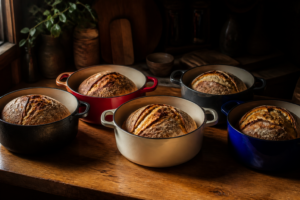
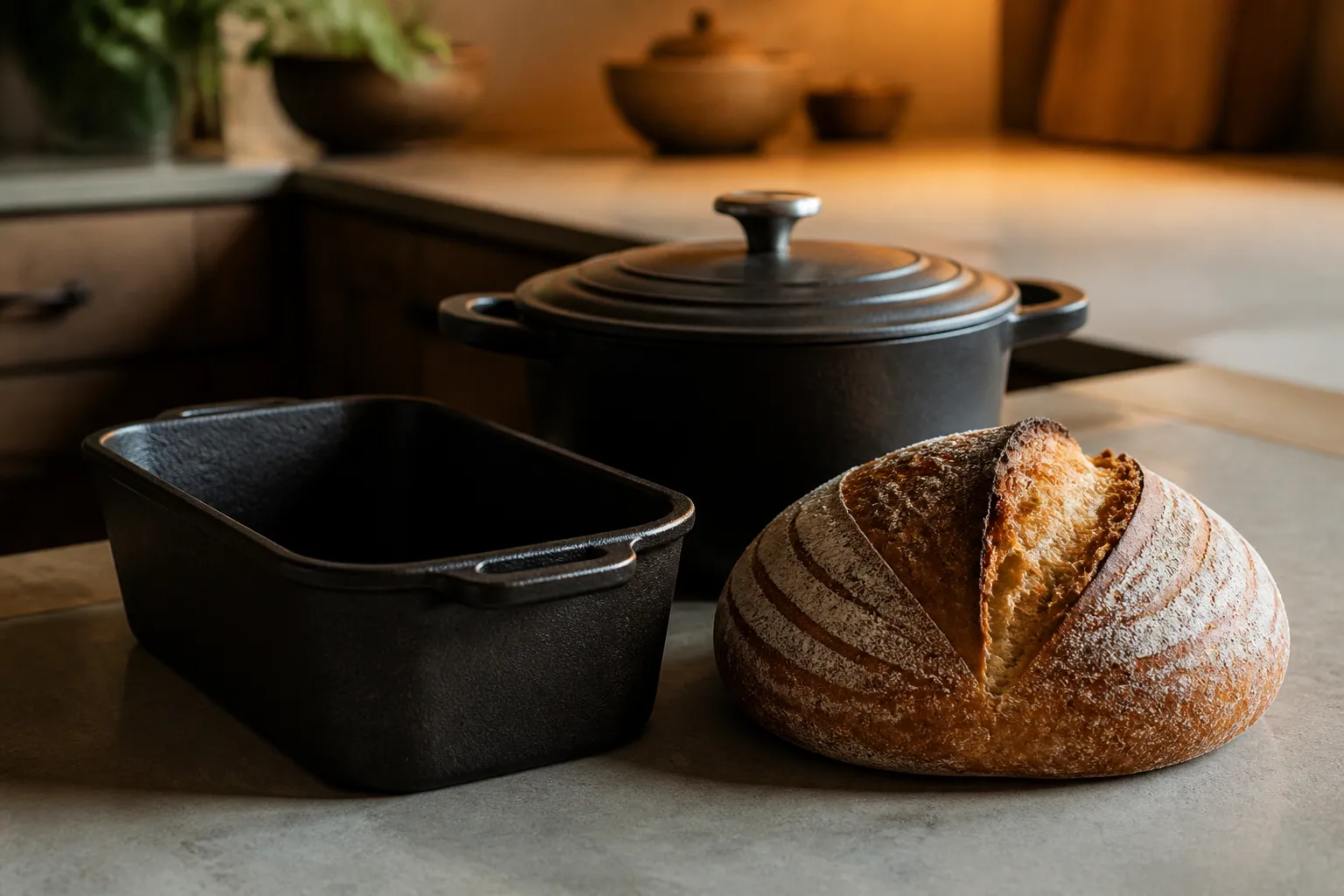
No recipe card warns you about the specific 6 AM moment when you’re staring down 30 balls of cold dough with zero clue which vessel is going to pull its weight. My kitchen looked like a flour-dusted crime scene that morning. A Dutch oven claimed one counter. A brand-new Challenger Bread Pan claimed the other. And there I stood, right between the two, wearing my husband’s old sweatshirt, flour dusted through my hair, nursing a coffee that had gone stone cold, genuinely questioning what I’d signed myself up for.
Eleven years deep into sourdough, I figured I’d more or less heard every question there was. But one kept popping up in my inbox again and again, and I couldn’t shake it: “Which one’s actually better for a home baker — a Challenger Bread Pan or a Dutch oven?” Opinions were everywhere. Actual proof was nowhere. So I did the only reasonable thing a slightly obsessive sourdough person could do — I committed to baking 30 loaves, one after another, until the question had a real answer.
What follows is the full rundown of what that borderline-obsessive experiment taught me, including the mishap that nearly brought the whole thing to a screeching halt, and why weighing the Challenger Bread Pan against a Dutch oven turned out to matter far more than I originally assumed.
| Attribute | Dutch Oven | Challenger Bread Pan |
|---|---|---|
| Loaf shape | Squat, wide | Tall with better height-to-width proportion |
| Oven spring | Gorgeous but outward spread | Real upward growth |
| Crust | Solid | Deep, crackling with minimal steam-monitoring |
| Heat distribution | Not specified | Even with no hot spots |
| Maximum loaf size | Handles 2-pound boules | Tighter diameter; requires scaling down from 2-pound boules |
| Scoring difficulty | Not specified | Noticeably harder; awkward blade angle |
| Steam control | Requires monitoring | Lid seats tightly; moisture contained before setup |
How This Whole Test Even Got Started
Rewind roughly three months. My same reliable Dutch oven had been carrying me through nearly ten years of baking without a hitch — solid oven spring, a crust I loved, and never a single complaint from me or anyone who’d eaten the results. Then, seemingly overnight, the Challenger Bread Pan started showing up everywhere sourdough people gather online. Instagram feeds were saturated with it. New YouTube videos kept surfacing. And my inbox turned into a steady stream of readers asking me point-blank to compare the two.
Gear isn’t usually my obsession. In my mind, great bread traces back to knowing your starter, dialing in fermentation, and treating the dough with a little respect — not to whatever shiny tool you bought. That said, I’m not naive about sourdough equipment either; the vessel you bake in genuinely shapes the outcome. Steam control, how heat spreads, how easy scoring is, what cleanup looks like afterward — none of that is a minor footnote.
That’s when I drew the line: enough speculating. Time for an actual test.
I bought both pieces of equipment, wiped my calendar clean for two weeks straight, and dove in.
The Moment Things Went Sideways
This is the part where I have to admit I look a little foolish.
By the fourth day, I’d already turned out around 12 loaves. I had a notebook full of observations, real data building up, and I was feeling more than a little pleased with my own dedication. That’s exactly when I did something remarkably dumb — I reached for the Dutch oven with nothing but a damp kitchen towel, skipping my heat-resistant mitts entirely, while it was sitting at a blistering 500 degrees.
Steam hissed off that wet towel instantly. My hand never actually burned, but it sure felt close. I let out a yelp — fine, it was closer to a full scream — leapt backward, sent my current dough tumbling into the sink, and scared myself badly enough that I ended up sitting on the kitchen floor for a solid fifteen minutes, half-convinced the universe was sending me a message to quit.
My husband walked in on me there, hand shoved under the cold tap, watching my dough slowly disappear down the drain, and he did exactly what he always does in these situations: he cracked up laughing. Not unkindly — that specific “you’re a mess and I adore you anyway” laugh that only happens after years of marriage.
“How many loaves are left to go?” he asked.
“Eighteen,” I muttered, thoroughly deflated.
“Well, sounds like you’d better get back to it,” he said. “Maybe this time try the heat gloves I got you last year — the ones you refuse to touch because you decided they’re too ugly.”
He had a point. I finally put the gloves on (they’re honestly not that bad-looking), mixed up more dough, and pushed forward with the test.
The Vessel That Finally Kept My Loaves From Going Flat and Wide
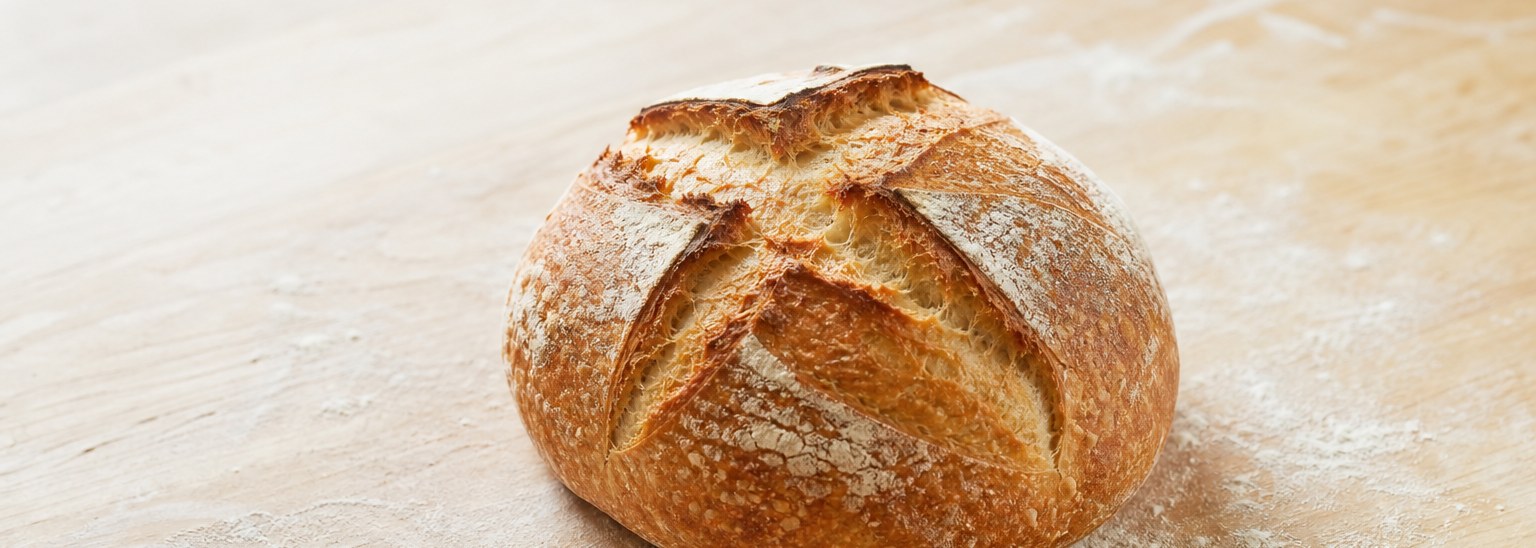
Year after year with my Dutch oven, I’d get gorgeous oven spring paired with an annoyingly squat, wide loaf instead of anything tall. The Challenger Bread Pan’s steep, narrow sides pitched a different outcome entirely: real upward growth rather than dough spreading sideways.
Where it earns its price tag
- Those tall, tight walls genuinely rein in the dough’s outward spread, delivering a visibly taller loaf with a much better height-to-width proportion than you’d typically get from a Dutch oven.
- That sealed-in space traps steam remarkably well — think deep, crackling crust with minimal effort on your part, and the lid seats tightly enough that moisture doesn’t escape before the loaf has fully set up.
- Since the cast iron holds and distributes heat so evenly, the base browns consistently with no hot spots, no matter if you’re working with a lean dough or something enriched.
Where it falls short
- That tighter diameter caps how big your loaf can get — if 2-pound boules are your norm, plan on either scaling your dough down or settling for a squatter, wider shape to fit the pan properly.
- The confined space and awkward blade angle make scoring noticeably harder; the first time I used this pan, I hesitated over my angle and ended up with a much weaker ear than I usually manage.
I nearly ditched it after that awkward third bake, convinced I’d wasted money on a gimmick. But once I adjusted my scoring technique and dough sizing, the results spoke for themselves. Grab the Challenger Bread Pan Cast Iron Loaf Pan with Lid if you’re serious about vertical oven spring.
Frequently Asked Questions
Did you really bake 30 loaves comparing these two pans?
Yes. I committed to baking 30 loaves back-to-back over two weeks to get a real answer instead of relying on online opinions. By the fourth day, I’d already turned out around 12 loaves with a notebook full of observations before a mishap with my Dutch oven temporarily derailed the test.
Why does the Challenger Bread Pan make taller loaves?
The Challenger’s tall, narrow sides rein in the dough’s outward spread, delivering real upward growth instead of dough spreading sideways like it did with my Dutch oven year after year. The confined space traps steam remarkably well for deep, crackling crust with minimal effort.
What size loaves fit in a Challenger Bread Pan?
The tighter diameter caps how big your loaf can get. If 2-pound boules are your norm, plan on either scaling your dough down or settling for a squatter, wider shape to fit the pan properly.
Is scoring easier in a Challenger Bread Pan?
No. The confined space and awkward blade angle make scoring noticeably harder. On my first use, I hesitated over my angle and ended up with a much weaker ear than usual, but once I adjusted my scoring technique and dough sizing, the results improved significantly.
About This Article

Written by Sam Whitaker. Sam Whitaker has been baking sourdough for over a decade, including three years baking commercially, and now works out of a home kitchen in the Pacific Northwest. Sam's eleven-year-old starter, Harold, is the foundation for every recipe and troubleshooting guide on Sourdough Rising — real bread tested over and over until it works. More about this site.
Scope and limits. Sam is a home baker with no formal culinary training. Follow current food safety guidance for storage and handling, particularly with enriched or filled doughs.
Verify this against a primary source
Specifics change, and your situation may differ from the one described here. These are the authorities worth checking directly:
- USDA FoodData Central — flour and ingredient composition data
- FoodSafety.gov — safe handling and storage