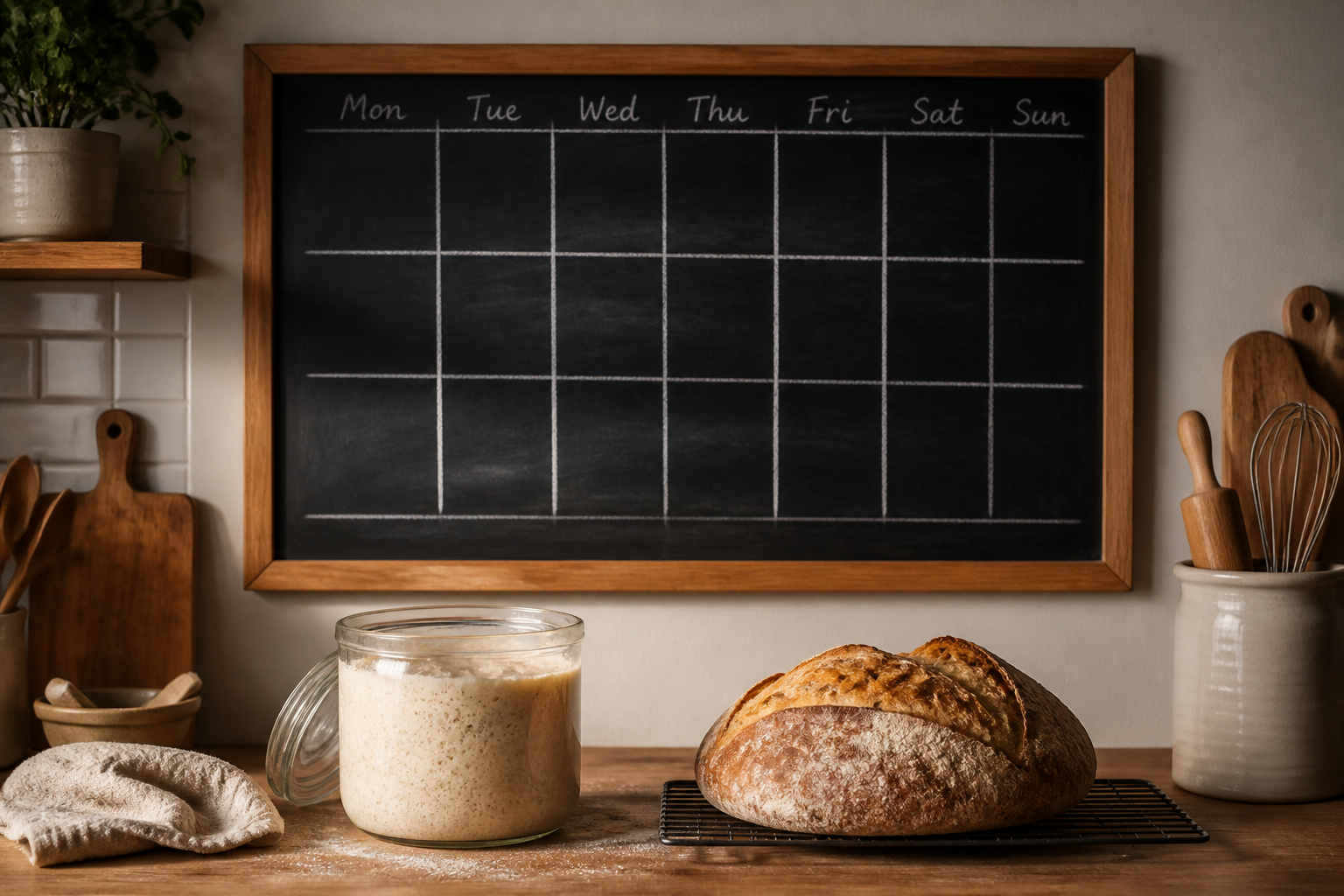
I stood in my kitchen at 6 a.m. on a Saturday morning, staring at my sourdough starter jar with the kind of bewildered expression usually reserved for defusing bombs. My beloved starter—the one I’d named Gerald and nurtured for three years through my microbakery days—was bubbling over the counter like a science fair volcano. Not the good kind of volcano. The kind that makes you question every life choice that led to this moment.
The problem? I’d completely abandoned my sourdough starter schedule.
After closing my microbakery, I’d transitioned back to home baking with what I thought was a casual, free-spirited approach. “I’ll just feed it when I feel like it,” I’d announced confidently to my patient husband. Eleven years of baking experience, three years running a business, and I’d somehow forgotten the one non-negotiable rule: consistency is everything.
But that kitchen disaster became the catalyst for developing the sourdough starter schedule system I still use today—and it’s saved me countless times since. Let me walk you through it.
The Day Everything Changed (aka The Great Starter Overflow of 2019)
Here’s what happened that morning: I’d left Gerald the starter in the back of my fridge for what I thought was “just a week or two.” In reality, it had been closer to four weeks. When I finally remembered him and pulled out the jar, it looked like something from a creature feature. The dark liquid (hooch) had separated into layers. The smell was… let’s say “aggressively funky” in a way that transcended normal sourdough funk into something approaching biochemical warfare.
I fed it anyway, assuming my years of experience would kick in and save the day. Nope. Gerald exploded. Literally burst through the cloth cover I’d foolishly left loosely tied, sprayed across my countertop, and dripped down the cabinet below.
While I was cleaning up what felt like the hundredth batch of starter from my kitchen tiles, I had an embarrassing realization: I’d been running a microbakery, meaning I’d maintained strict feeding schedules for months, and the moment I went back to casual home baking, I’d completely abandoned the system that made everything work.
That’s when I decided to reverse-engineer the perfect sourdough starter schedule—one that would work whether I was baking twice a week or once a month.
My Sourdough Starter Schedule System
Over the next few months, I tested different approaches, tracked what worked, and eventually landed on a system that’s become the backbone of my home baking life. Here’s exactly how I plan my baking week now.
The Active Baking Week Schedule (Feeding from Room Temperature)
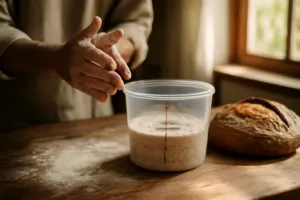
When I’m actively baking—which for me means 2-3 bakes per week—I keep my starter on the counter. I feed it once daily, always in the morning around 8 a.m. This is non-negotiable. That one daily feeding, same time every day, creates a rhythm that my starter responds to beautifully.
My feeding ratio during active baking weeks is 1:1:1 (starter to flour to water, by weight). I use about 50 grams of each, which keeps things simple and ensures my starter is strong and reliable for baking later in the day or the next morning.
The timing looks like this:
- Monday-Friday: Feed at 8 a.m., use at 5 p.m. or the next morning
- Saturday: Feed at 8 a.m., assess if I’m mixing dough that day or the next
- Sunday: Flexible—I might bake or transition to fridge storage
The Fridge Schedule (My Game-Changer)
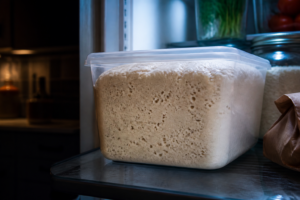
Here’s where my system really shines: the feeding from the fridge schedule. This is what saved my bacon after the Great Starter Overflow.
When I know I won’t be baking for more than a few days, I move my starter to the back of the fridge. Cold temperatures slow fermentation dramatically, which means my starter needs feeding far less frequently. I feed my refrigerated starter once per week—typically on Friday afternoons, even if I’m not baking that week.
That’s it. One feeding per week, and Gerald stays happy and stable for months.
The process is simple:
- Scoop out most of the starter, leaving about 50 grams in the jar
- Feed with 50 grams flour and 50 grams water
- Stir well
- Seal loosely (important—it needs to breathe) and return to the back of the fridge
- Repeat every 7 days, no matter what
The beautiful part? When I want to bake, I pull my starter out the night before, let it come to room temperature, feed it, and by the next morning it’s ready to party.
Planning Your Week: The Real Secret
The actual sourdough starter schedule I use isn’t complicated, but it requires one thing: planning ahead. Every Sunday evening, I spend ten minutes looking at my week and asking myself: “How many times will I bake?”
If the answer is “at least twice,” my starter stays on the counter with daily feedings. If it’s “maybe once or not at all,” into the fridge it goes with weekly feedings. This simple decision point eliminates about 95% of my starter stress.
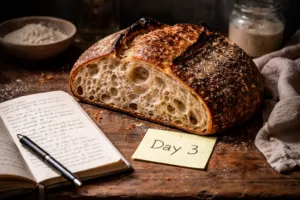
I actually write this down now—not because I’m obsessive (okay, maybe a little), but because seeing it written out prevents the kind of absent-minded negligence that led to the Great Gerald Explosion.
The Jar That Finally Kept Gerald From Exploding All Over My Kitchen
When your starter is doubling in size and you’re using a jar that’s barely 24 ounces, you’re one missed feeding away from a sticky disaster on your countertop and your pride. I learned this the hard way with Gerald, and switching to a properly sized jar with actual headroom changed everything about how I could schedule my bakes without anxiety.
What works
- The 40oz capacity means your starter can actually rise and expand without threatening your cabinet when you’re running late or fridge-storing for the week—I went from cleaning drips weekly to never.
- Wide mouth opening makes feeding and maintenance genuinely easier; I can actually scrape the sides and get a clean read on volume without contorting my hand like I’m performing starter surgery.
- The straight sides mean volume markers are actually useful—you can clearly see when your starter has peaked and know exactly when to feed or use it without guessing.
What doesn’t
- 40 ounces is genuinely large for a kitchen shelf—if you’re in a tight apartment or your fridge is already packed, this isn’t the subtle jar you can hide anywhere.
- The glass is heavier than smaller jars, so if you’re feeding multiple times daily and moving it in and out of the fridge constantly, your wrist will notice.
I was skeptical that bigger would actually solve my scheduling chaos—I thought the problem was me, not the jar—but within two weeks of switching, my Monday-through-Friday feeding rhythm finally felt sustainable instead of stressful. 2 Pack Premium Pro Sourdough Starter Jar Kit – 40oz Large Wide Mouth Sourdough Bread Jar
This post contains affiliate links. As an Amazon Associate, I earn from qualifying purchases at no extra cost to you.