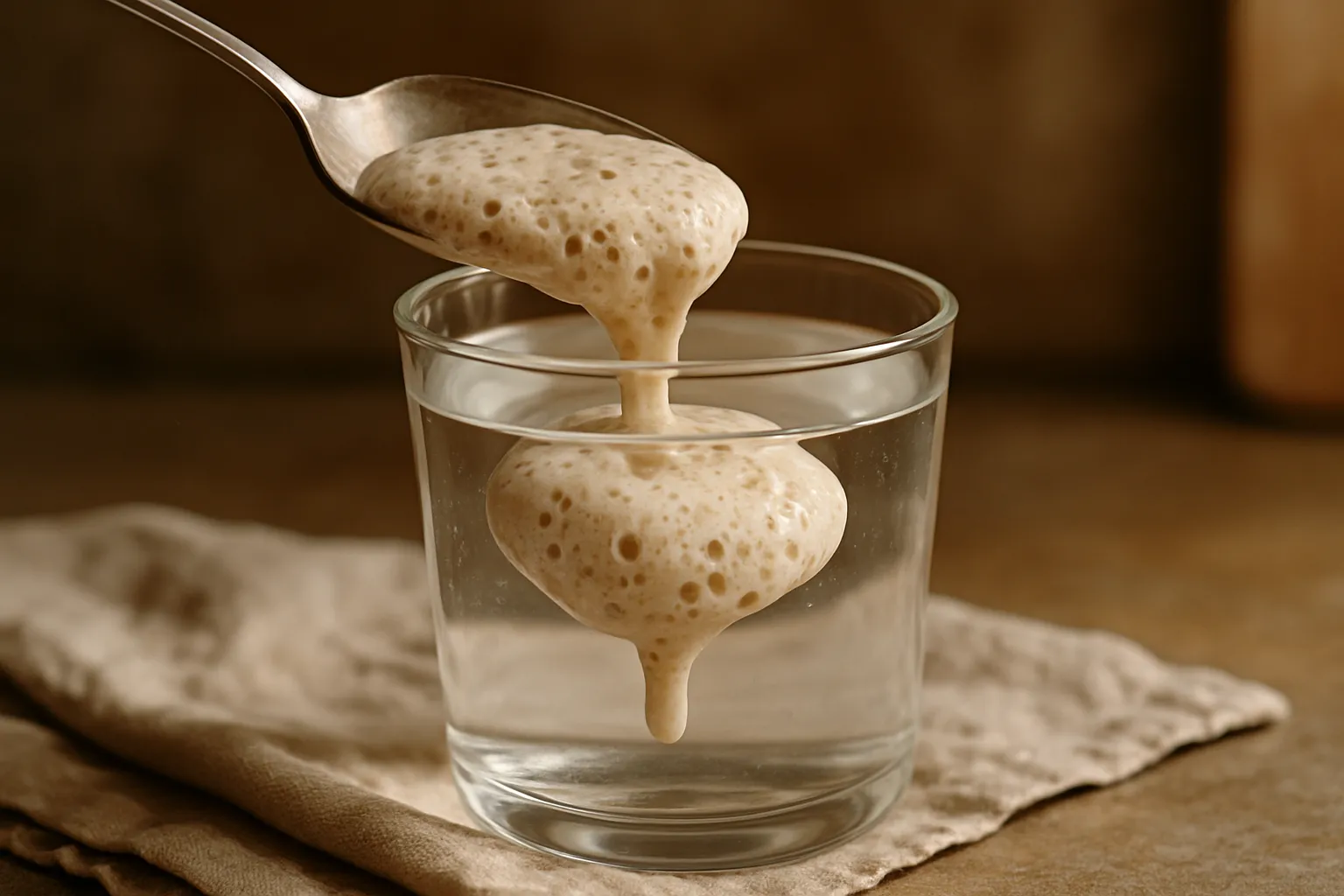
Does a sunk spoonful of starter mean your fermentation is broken? Nine times out of ten, no — and that’s worth saying plainly before we dive into the weeds. Years back I hovered over my kitchen sink with a small dollop of starter suspended in a glass of water, treating the outcome like it would reveal some cosmic truth about my baking future. I’d read about the sourdough starter float test in half a dozen places, each one practically declaring it the final word on whether your starter was ready to work. Mine dropped straight to the bottom of the glass. Cue the mild panic. I gave it another hour, fed it again, and started convincing myself I’d somehow ruined fermentation for good. Does any of that ring a bell? If you’ve ever hovered over a glass waiting for your starter to bob to the surface, you’re in good company — and I want to walk you through the fuller, messier truth of what that little test can and can’t tell you.
| Variable | Effect on Float Test | Example |
|---|---|---|
| Hydration | Lower hydration (60–75%) naturally denser, may sink even when active | 65%-hydration starter almost never floats |
| Timing at peak | Float at true peak; sinks one hour later as gas escapes | Same starter floats then sinks despite being extremely active |
| Water temperature | Cold water denser than warm; harder to float | 75–80°F water vs. chilly tap water |
| Scooping technique | Rough scooping knocks air out; gentle skim preserves bubbles | Digging roughly vs. skimming from top or side |
So, What Exactly Is the Float Test?
The float test is about as straightforward as it sounds: you scoop a tiny bit of your starter into a glass of room-temperature water and see what it does next. Floats, and the usual thinking says your starter is lively, gassy, and primed to leaven a loaf. Sinks, and supposedly you’re not there yet. Sounds tidy — and it sort of is, but only sort of.
There’s real logic underneath it. While your starter ferments actively, wild yeast churns out carbon dioxide. That gas gets caught inside the starter’s gluten structure, puffing it up enough to stay on top of the water. A starter that sinks, the theory goes, hasn’t built up enough gas to stay light. On paper, that’s a clean little readiness gauge. In real kitchens, though, things get murkier.
The Limits of Trusting a Sink-or-Swim Test
Here’s the lesson that took me embarrassingly long to absorb: a starter can be completely bake-ready and still sink like a rock. Meanwhile, a starter can bob happily on the surface long after its real peak has passed. What the float test actually measures is buoyancy — not the strength of fermentation, not flavor development. Those things overlap, sure, but they’re not interchangeable.
A handful of variables can skew what you see in that glass:
- Hydration: A tighter, lower-hydration starter (roughly 60–75%) is naturally denser and might refuse to float even when it’s firing on all cylinders. My own 65%-hydration starter almost never passes the float test, yet it turns out fantastic loaves without fail.
- How close to peak you catch it: Drop a sample in right when your starter hits its true peak and it may well float. Wait one more hour, though, and it’ll start collapsing — gas escapes, and it sinks again, despite having been extremely active not long before.
- Temperature of the water: Cold water carries more density than warm water. A spoonful dropped into chilly tap water has a harder time floating than the same spoonful dropped into water sitting around 75–80°F.
- Your scooping technique: Dig a spoon roughly into the jar and you’ll knock the air out of those bubbles — the same gas that would’ve kept it afloat. Skim gently off the top or along the side instead.
So what’s a better gauge? Honestly, watching your starter’s patterns over time beats any single dunk-in-a-glass test, hands down. I pay attention to how it rises and falls in the jar, the bubble pattern throughout (small, even bubbles scattered everywhere signal healthy activity), the aroma (sharp, faintly fruity, pleasantly sour), and the shape (a dome at peak, flattening or caving at the edges once it’s past that point). Together, those clues tell a far more complete story than a simple sink-or-float verdict.
Situations Where the Float Test Actually Earns Its Keep
I’m not ready to toss the float test out entirely — it does pull its weight in specific situations. If you’re newer to sourdough and haven’t yet trained your eye to read the starter’s visual signals, the float test hands you one extra data point worth having. It’s also legitimately handy right after pulling your starter out of the fridge following a long rest, when you’re unsure it’s been fed enough times to bounce back to strength. In that scenario, a float is a decent green light.
Bottom line: treat the float test as one instrument among several, not your only gauge. When your starter floats and also looks, smells, and acts like it’s peaking — go ahead and bake. When it sinks but every other sign checks out, trust what your eyes and nose are telling you. Chances are your starter is completely ready.
A See-Through Jar That Actually Shows You What’s Going On
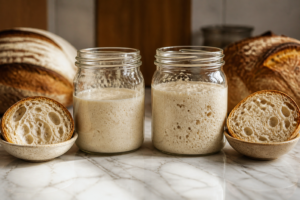
Running the float test — or honestly any part of your feeding routine — works far better with a jar clear enough to track the rise and fall without popping the lid every few hours and messing with fermentation. I lost months squinting through cloudy, semi-see-through containers, never quite sure if my starter had truly doubled or if I was just seeing what I hoped to see.
What actually works
- Fully transparent glass lets you watch the rise from the side without cracking the lid open — no more shocking your starter with a temperature swing mid-ferment.
- The tulip-shaped body gives you straight, even sides for measuring height accurately, making that reliable doubling pattern the float test relies on much easier to spot.
- The lids close snugly enough to stop evaporation during long feeding stretches, without sealing airtight — your starter still breathes the way it needs to.
Where it falls short
- It’s glass, plain and simple — one accidental bump against the counter and you’re out a jar. I’ve lived through that particular headache, and it stings both financially and emotionally.
- Tuck it away in a cabinet and it’ll eat up real shelf space; it’s nowhere near as compact as the plastic options out there.
I almost gave up on the float test entirely when I realized I couldn’t even see my starter’s activity clearly in my old jar—it felt pointless to test what you can’t observe. The Weck Tulip Jars (1 Liter, set of 2) changed that completely.
Frequently Asked Questions
Can my sourdough starter be ready if it sinks in the float test?
Yes, absolutely. A starter can be completely bake-ready and still sink like a rock. The float test measures buoyancy, not fermentation strength or flavor development. If your starter shows other signs of readiness—good rise in the jar, healthy bubble patterns, pleasant sour aroma, and a dome shape at peak—trust those visual and olfactory clues over a sinking spoon.
Why does my 65% hydration starter never float?
Lower-hydration starters around 60–75% are naturally denser and may refuse to float even when actively fermenting and producing great loaves. Hydration directly affects buoyancy independent of fermentation strength. A tighter starter can be firing on all cylinders and still sink in water, so the float test becomes unreliable for denser starters.
What temperature should water be for the float test?
Use water around 75–80°F for the float test. Cold tap water carries more density than warm water, making it harder for your starter spoonful to float even when it’s active and ready. Warmer water gives you a more accurate buoyancy reading of your starter’s actual gas content.
When is the float test actually useful for starter?
The float test works best if you’re newer to sourdough and haven’t yet trained your eye to read visual starter signals, giving you one extra data point. It’s also genuinely handy right after pulling your starter from the fridge following a long rest, when a float provides a decent green light that it’s bounced back to strength.
About This Article

Written by Sam Whitaker. Sam Whitaker has been baking sourdough for over a decade, including three years baking commercially, and now works out of a home kitchen in the Pacific Northwest. Sam's eleven-year-old starter, Harold, is the foundation for every recipe and troubleshooting guide on Sourdough Rising — real bread tested over and over until it works. More about this site.
Scope and limits. Sam is a home baker with no formal culinary training. Follow current food safety guidance for storage and handling, particularly with enriched or filled doughs.
Verify this against a primary source
Specifics change, and your situation may differ from the one described here. These are the authorities worth checking directly:
- USDA FoodData Central — flour and ingredient composition data
- FoodSafety.gov — safe handling and storage