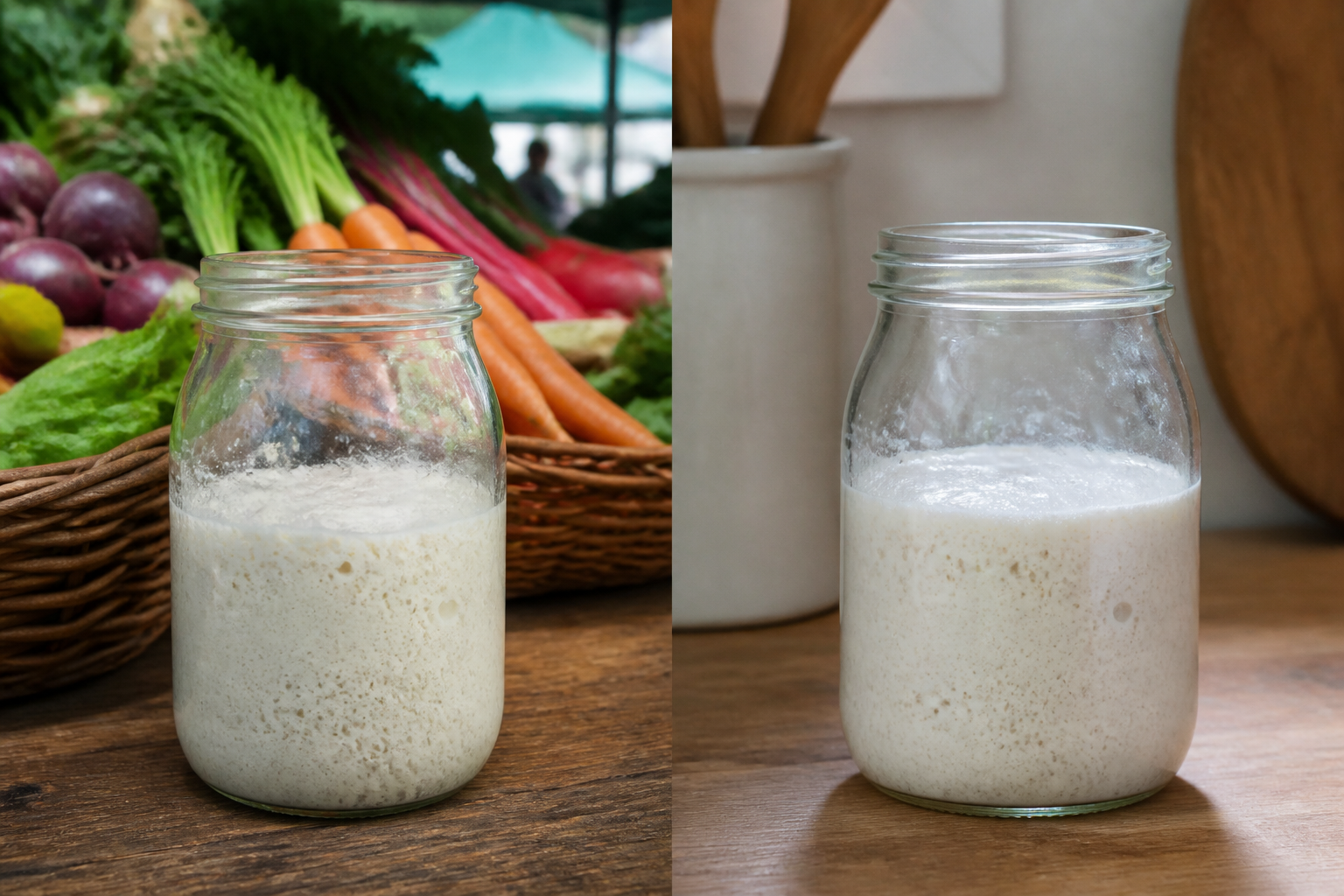
I want to tell you about the time I accidentally started a sourdough experiment that I had absolutely no intention of running. It was a Tuesday morning, I was standing in my HDB kitchen in a sweaty t-shirt, and I had just smugly declared to my husband that my new wet market wild yeast starter was going to be “scientifically superior” to my regular home kitchen one. He looked at me the way he always does when I say something like that: with the patience of a man who has eaten many, many experimental loaves.
| Variable | Impact on Starter | Article Recommendation |
|---|---|---|
| Temperature | Biggest variable affecting starter behavior | Keep away from direct sun and AC vents |
| Flour source | Tends to matter more than environment | Use same flour for consistency |
| Fermented foods nearby | Won’t significantly change starter behavior | No harm if stored close by |
| Feeding ratio in heat (above 30°C) | Standard 1:2:2 risks over-fermentation | Use 1:5:5 ratio instead |
| Feeding ratio in cooler temps | Standard approach works | Use 1:2:2 ratio |
| Singapore climate | Starter ready in 4 to 5 days | Compared to 7 to 10 days in European winter |
Frequently Asked Questions
Does location near fermented foods affect my starter?
Fermented ingredients nearby won’t significantly change your starter’s behavior. Your flour and feeding consistency matter far more than ambient fermented air. Temperature is the biggest variable affecting your starter in a home kitchen, so focus on keeping it away from direct sun and air conditioning vents instead.
How fast do sourdough starters develop in Singapore?
In Singapore’s tropical climate, a starter can become bubbly and ready in 4 to 5 days, compared to 7 to 10 days in a European winter. The warm, humid baseline supercharges fermentation. Keep your starter away from direct afternoon sun and air conditioning vents to maintain predictable temperatures above 30 degrees Celsius.
What feeding ratio should I use in peak Singapore heat?
When kitchen temperatures hover above 30 degrees Celsius, use a 1:5:5 ratio of starter to flour to water instead of 1:2:2. This reduces the risk of over-fermentation and buys you more time between feeds during Singapore’s hottest periods.
How do I accurately track my starter’s rise?
Mark your jar with a rubber band or tape flag at the start of each feed so you can track the rise accurately. This single habit will teach you far more about your starter’s actual behavior than relying on guesswork or general appearance.
Here is the thing. I had read somewhere that the wild yeast environment around you matters for your starter. And since I had just moved my feeding station next to a bag of ingredients I had hauled back from Tekka Market, including some fermented beancurd, dried shrimp, and a suspicious bunch of pandan, I started wondering: does where your starter lives actually change how it behaves? Does a wet market wild yeast starter develop differently from one bubbling away in a sterile, air-conditioned kitchen far from fermented anything? I had no real plan. I had two jars, too much flour, and a very uninformed hypothesis. What followed was three weeks of chaos, one genuinely embarrassing moment, and a discovery that actually changed how I think about my starter forever.
What the Science Actually Says (In Plain Language, I Promise)
Before I tell you what happened to my jars, let me share what I have read and understood about wild yeast and how starters form, because it genuinely helps make sense of all of this. When you mix flour and water and leave it out, you are not creating yeast from scratch. You are inviting wild yeast and lactic acid bacteria that are already present in your flour, on your hands, and yes, in the surrounding air, to move in and set up home. The flour itself carries the majority of the microbial community that eventually dominates a mature starter. Studies on sourdough microbiology have found that the flour source tends to matter more than the environment in establishing which yeast strains take hold.
That said, your environment is not a silent bystander. Ambient temperature, humidity, and yes, the microbial clouds drifting around your kitchen can all play supporting roles. In Singapore, our tropical climate means we are already working with a warm, humid baseline that supercharges fermentation compared to bakers in colder countries. A starter that takes 7 to 10 days to establish in a European winter might be bubbly and ready in 4 to 5 days here. The heat here is not your enemy; it is your slightly impatient sous chef.
But here is what I had never really tested in my own kitchen: does being physically near a highly fermented environment, like a bag of wet market ingredients sitting on the same counter, nudge your starter in any meaningful direction? I want to be very clear that what I did was not a controlled scientific study. Not even close. This is informal, personal, home-kitchen observation from someone who bakes for fun and gets carried away. Take it in the spirit it is offered.
My Wet Market Wild Yeast Starter Experiment (And the Embarrassing Part)
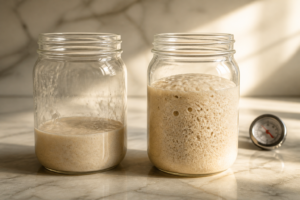
So here is what I set up. Two fresh starters, both made with the same bag of whole wheat flour and tap water. One jar lived on the kitchen counter nearest the window, next to where I had left my Tekka Market haul before I put it away (I am a chaotic unpacker, do not judge me). The other jar sat on the opposite counter near the kettle, about two and a half metres away. I fed them both at the same time, same ratios, same hands. Very casual, very unscientific, very me.
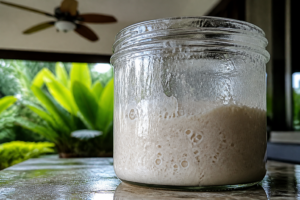
By day three, both were bubbling. By day five, I noticed that the jar near the market bag seemed slightly more active, slightly more aggressive in its rise. I was thrilled. I immediately took a video and sent it to my friend with the caption “my hypothesis is correct.” This was my embarrassing moment. Because what I had completely forgotten was that the window near that counter gets afternoon sun. Direct, fierce, Singapore afternoon sun. My “wet market effect” was almost certainly just a temperature difference of a few degrees, which in a tropical kitchen is more than enough to accelerate fermentation noticeably.
I discovered this when I actually measured both spots with a simple thermometer and found the market-side counter was running about 3 degrees Celsius warmer in the afternoons. I had to go back to my friend and send a follow-up video titled “never mind.” She responded with a single crab emoji. I deserved it.
But here is where it gets interesting. I repositioned both jars to the same spot and kept feeding them for another two weeks. And what I found after that, once the temperature variable was removed, was that they behaved remarkably similarly. Same rise time, same smell, same texture. Which is actually the happy twist of this whole story, because it told me something genuinely useful.
What This Actually Means for Your Singapore Kitchen Starter
What I took away from my accidental experiment and the reading I did alongside it is this: in your HDB kitchen, temperature is almost certainly the biggest variable affecting your starter’s behaviour, and it is one that is easy to overlook and easy to manage once you are paying attention to it. Here are the practical things I now do differently:
- I keep both my starters away from direct afternoon sun and away from the aircon vent. Both extremes push your starter into unpredictable territory.
- In peak Singapore heat, when kitchen temps hover above 30 degrees Celsius, I reduce my feeding ratio or feed more frequently to avoid over-fermentation. A 1:5:5 ratio (starter to flour to water) instead of 1:2:2 buys me more time between feeds.
- I use filtered water at room temperature rather than cold, because even cold tap water here warms up fast and I like to know what I am starting with.
- If you do shop at the wet market and store fermented ingredients nearby, there is no harm done. But do not expect miracles. Your flour and your feeding consistency will do far more work than ambient fermented air ever could.
- Mark your jar with a rubber band or tape flag at the start of each feed so you can track the rise accurately. This is the single habit that taught me the most about my starter’s actual behaviour.
My Gear: What I Use to Keep My Starters Happy
After running two starters side by side, I have some strong opinions about containers and tools. Here is what I actually use and recommend:
For starter jars, I love the Weck Tulip Jars 1 Liter. The wide mouth makes stirring easy and the straight sides mean you can actually see the rise level properly. The glass lids are perfect for our climate because you can leave them slightly ajar to let gas escape without exposing your starter to too much of whatever is drifting around your kitchen.
If you are just starting out and want something that comes with more bits included, the INOBYO Sourdough Starter Jar Kit, 24 OZ Wide Mouth is a great pick. It comes with a separator and markings that help beginners track their starter’s progress without guessing.
When I need extra storage for discard or for keeping a backup starter in the fridge, the ComSaf 32 oz Wide Mouth Mason Jars 2 Pack are reliable, affordable, and the wide mouth means no cursing when you are trying to scoop discard out at 6am.
For weighing your flour and water, please do not use measuring cups. A digital scale changed everything for my baking consistency. I use the Etekcity Food Kitchen Scale, which is accurate, compact enough for a small HDB counter, and has a nice clear LCD display. If you want something with a few more unit options and a slightly larger platform, the Ultrean Food Scale with Tare Function is another solid choice that many home bakers I know swear by.
The Happy Ending (And What I Baked With Both Starters)
After three weeks of feeding, repositioning, mild humiliation, and a lot of flour, both starters were healthy, active, and ready to bake with. I used them both in the same focaccia recipe on the same afternoon, and honestly? Both loaves were gorgeous. Chewy, bubbly, golden. My husband ate two pieces before I could photograph the second loaf properly and I chose to see this as a sign of success rather than sabotage.
What I learned is that the magic of a good sourdough starter is less about where it lives and more about how consistently you care for it. Whether your starter is hanging out next to lap cheong and fermented tofu or sitting primly next to your coffee machine, what it really needs from you is regular feeding, a stable temperature, and your attention. The wet market wild yeast starter idea is genuinely fun to explore, and I would never discourage the curiosity that leads you to try things like this. Just maybe measure your counter temperatures before you text your friends about your results.
About This Article

Written by Sam Whitaker. Sam Whitaker has been baking sourdough for over a decade, including three years baking commercially, and now works out of a home kitchen in the Pacific Northwest. Sam's eleven-year-old starter, Harold, is the foundation for every recipe and troubleshooting guide on Sourdough Rising — real bread tested over and over until it works. More about this site.
Scope and limits. Sam is a home baker with no formal culinary training. Follow current food safety guidance for storage and handling, particularly with enriched or filled doughs.
Verify this against a primary source
Specifics change, and your situation may differ from the one described here. These are the authorities worth checking directly:
- USDA FoodData Central — flour and ingredient composition data
- FoodSafety.gov — safe handling and storage