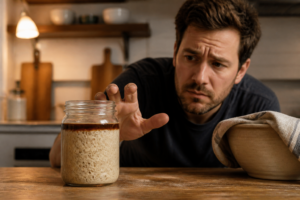
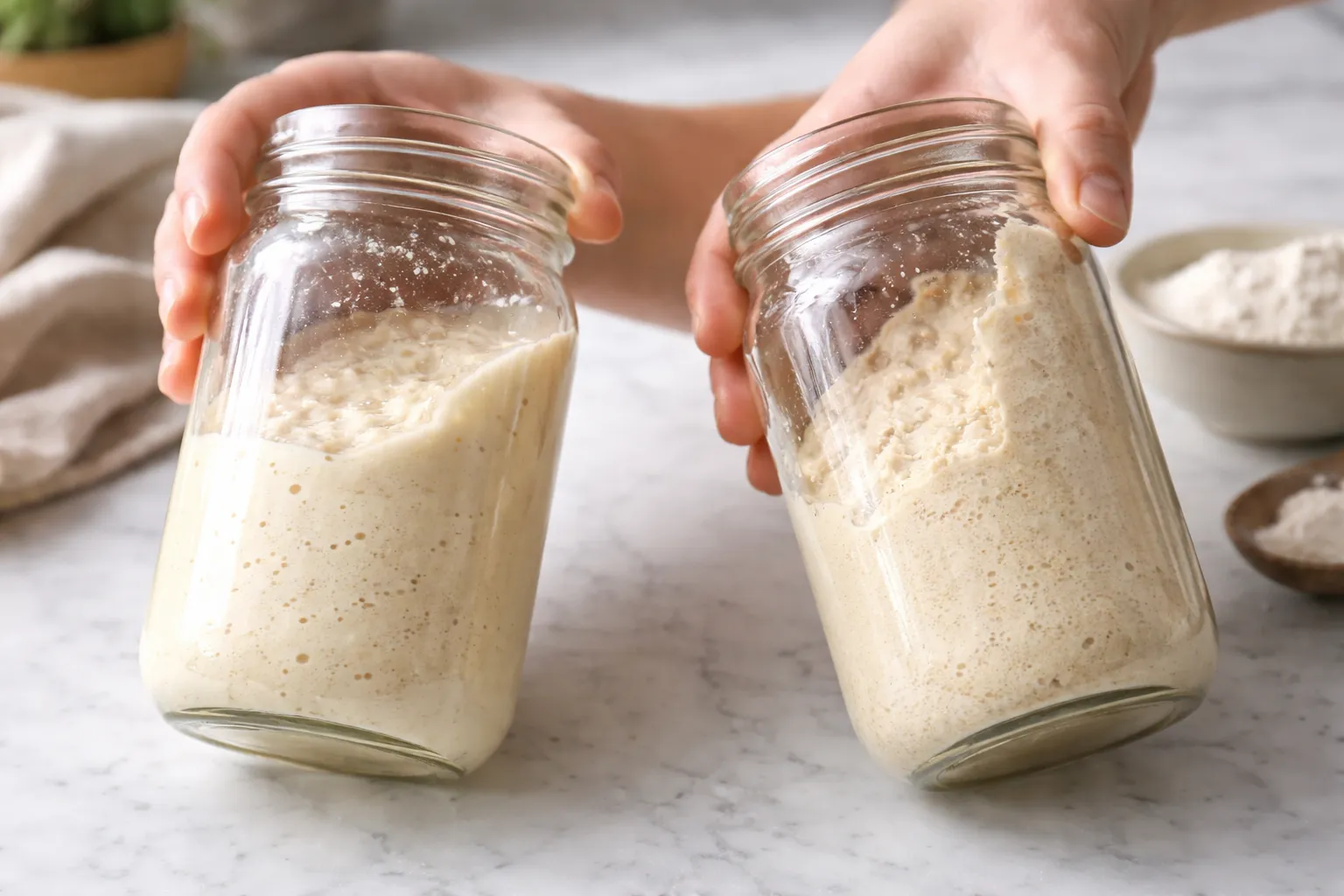
150% hydration — that’s the real number hiding behind the disaster I’m about to confess to. Picture this: I’d just told my husband that Harold, my starter, had finally “hit his stride,” and about ten seconds later I tipped the jar and watched half its contents slide down the front of my pajamas. The stuff had the texture of thin gray pancake batter and a smell that leaned hard into nail-polish-remover territory, and I genuinely had no idea what I’d done wrong. If you’ve ever squinted at your own jar, unsure whether your starter is running too loose, too stiff, or somehow flip-flopping between the two, this one’s for you.
| Hydration Level | Texture | Fermentation Speed | Smell | Peak Behavior |
|---|---|---|---|---|
| 100% | Thick, spoonable paste | Moderate | Nicely sour | Predictable rise |
| 125% | Loose, thick pancake batter | Faster | Normal | Catchable peak |
| 150% | Thin gray pancake batter | Very fast | Sharply acetone-like or vinegary | Shoots up then collapses quickly |
The Real Reason Starter Texture Matters So Much
Nobody explained this to me early on: how your starter feels isn’t just about looks. It changes how fast fermentation runs, what flavor develops, and ultimately how your bread turns out. When a starter is on the loose side, it ferments quickly and can tip into overly sour, sharp territory in a hurry — that harsh, vinegary smell I knew all too well. A stiffer starter, on the other hand, moves slower, can hold pockets of gas unevenly, and sometimes never quite reaches its full rise. Neither problem is a dead end, and neither one means you’ve killed your starter. I promise you that.
The term you’ll run into constantly is hydration percentage — basically the weight ratio of water to flour in your starter. At 100% hydration, you’ve got equal weights of water and flour, which gives you a thick, spoonable texture, somewhere between stiff peanut butter and a paste that holds its shape when dropped off a spoon. Push it to 125% hydration (more water than flour) and you get something looser and pourable, closer to a thick pancake batter. Plenty of bakers swear by each style, and both can turn out fantastic bread. What matters most is picking a target and sticking with it.
Runny or Thick? Figuring Out Which One You’re Actually Dealing With
You can’t fix a problem you haven’t identified yet. And I say that as someone who spent three whole weeks eyeballing ratios and wondering why every single loaf came out different: start weighing your ingredients. Seriously. It changed everything for me. But first, let’s break down what each issue actually looks like in the jar.
Tell-Tale Signs of an Overly Loose Starter
- It slides right out of the jar instead of plopping or stretching
- The smell turns sharply acidic, almost acetone-like, especially a few hours post-feeding
- It shoots up fast and collapses just as fast, so catching the peak is nearly impossible
- Bubbles come out big and patchy rather than small and evenly spread
- Liquid (hooch) collects on the surface more often than it should
Tell-Tale Signs of an Overly Stiff Starter
- It resembles dough more than batter — stiff and a workout to stir
- Growth is sluggish or unpredictable with no obvious peak
- The top layer cracks or dries out between feedings
- It smells nicely sour but rarely seems truly lively or active
- Mixing it into dough is a struggle — it clumps instead of blending in
Fixing Hydration Doesn’t Have to Be Complicated
Here’s the reassuring part: dialing in hydration is honestly one of the more straightforward fixes in sourdough baking. There’s no need to toss your starter or begin again from zero. You simply adjust your feeding ratios on purpose across two or three feedings and give the starter time to settle into the new normal.
Bringing a Loose Starter Back to Stiff
At the next feeding, cut back on water and bump the flour up a bit. If you’ve been feeding equal weights, try switching to 80g of water for every 100g of flour. That lands you around 80% hydration, and you’ll feel the difference immediately — noticeably firmer. Hold that ratio for two or three feedings and watch the texture shift. Once you land on a consistency that feels right, lock in that ratio and stay with it. Being consistent matters far more than the specific hydration number you land on.
Loosening Up a Starter That’s Too Stiff
Head the other way here. Add a little extra water with each feeding. Coming from equal parts, push your water up to 120g per 100g of flour. Mix it well enough that everything’s fully combined — a stiff starter tends to fight the mixing process, and you don’t want dry pockets hiding inside. Give it two or three feedings at this new ratio and you should notice your starter becoming livelier and easier to handle.
The Non-Negotiable: Get a Kitchen Scale
I really can’t say this enough. Measuring flour and water by volume — cups, tablespoons — introduces so much wobble that you’ll never actually know your starter’s real hydration. A tightly packed cup of flour versus a loosely sifted one can differ by 30 grams or more, and that gap matters enormously here. Weigh everything, every single time, and your starter will show its gratitude.
Ditch the Guesswork: Weigh Your Starter’s Hydration
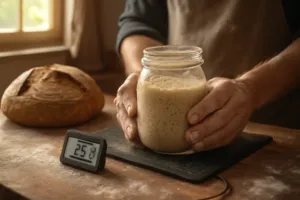
The whole runny-versus-thick puzzle stops being a puzzle the second you know your actual hydration number instead of trying to eyeball texture. Once I started weighing my feedings, I found out my “pancake batter” starter was sitting at 150% hydration when it should’ve been at 100% — no mystery involved, and no more pajama casualties.
What I Like
- The display is big enough to check without squinting, and it holds the reading long enough for you to actually register your starter’s weight before it vanishes.
- It’s compact and flat enough to slide inside a standard jar ring without hogging counter space, so weighing straight into your feeding container is easy.
- Gram readings accurate to 1g let you nail down consistent hydration ratios — 50g starter plus 50g water plus 50g flour, every single time, no guesswork.
Where It Falls Short
- The plastic base feels a bit flimsy if you’re used to sturdier commercial scales, and more than once I’ve worried it might crack under a jar of wet dough.
- It’s battery-only with no USB charging option on this model, so you’ll want spare AAA batteries on hand or risk a dead scale right in the middle of a feeding.
I almost returned mine after the first week when the display flickered, but it turned out to be a low-battery warning — a cheap fix that completely changed how I think about starter consistency. Etekcity Food Kitchen Scale with LCD Display
Frequently Asked Questions
What does 150% hydration starter look like?
At 150% hydration, your starter has the texture of thin gray pancake batter and slides right out of the jar instead of plopping. It ferments quickly, can smell sharply acetone-like or vinegary, and shoots up fast before collapsing just as quickly, making it nearly impossible to catch the peak.
How do I fix a starter that’s too runny?
Cut back on water and bump up flour at your next feeding. Try switching to 80g of water for every 100g of flour, which lands you around 80% hydration. Hold that ratio for two or three feedings and watch the texture shift to something noticeably firmer.
How do I loosen up a starter that’s too stiff?
Add extra water with each feeding. Push your water up to 120g per 100g of flour, mix thoroughly to avoid dry pockets, and give it two or three feedings at this new ratio. Your starter should become livelier and easier to handle.
Why should I weigh my starter instead of eyeballing it?
Measuring by volume introduces huge inconsistency—a tightly packed cup of flour versus a loosely sifted one can differ by 30 grams or more. Weighing everything, every single time, lets you actually know your starter’s real hydration and achieve consistent results.
About This Article

Written by Sam Whitaker. Sam Whitaker has been baking sourdough for over a decade, including three years baking commercially, and now works out of a home kitchen in the Pacific Northwest. Sam's eleven-year-old starter, Harold, is the foundation for every recipe and troubleshooting guide on Sourdough Rising — real bread tested over and over until it works. More about this site.
Scope and limits. Sam is a home baker with no formal culinary training. Follow current food safety guidance for storage and handling, particularly with enriched or filled doughs.
Verify this against a primary source
Specifics change, and your situation may differ from the one described here. These are the authorities worth checking directly:
- USDA FoodData Central — flour and ingredient composition data
- FoodSafety.gov — safe handling and storage