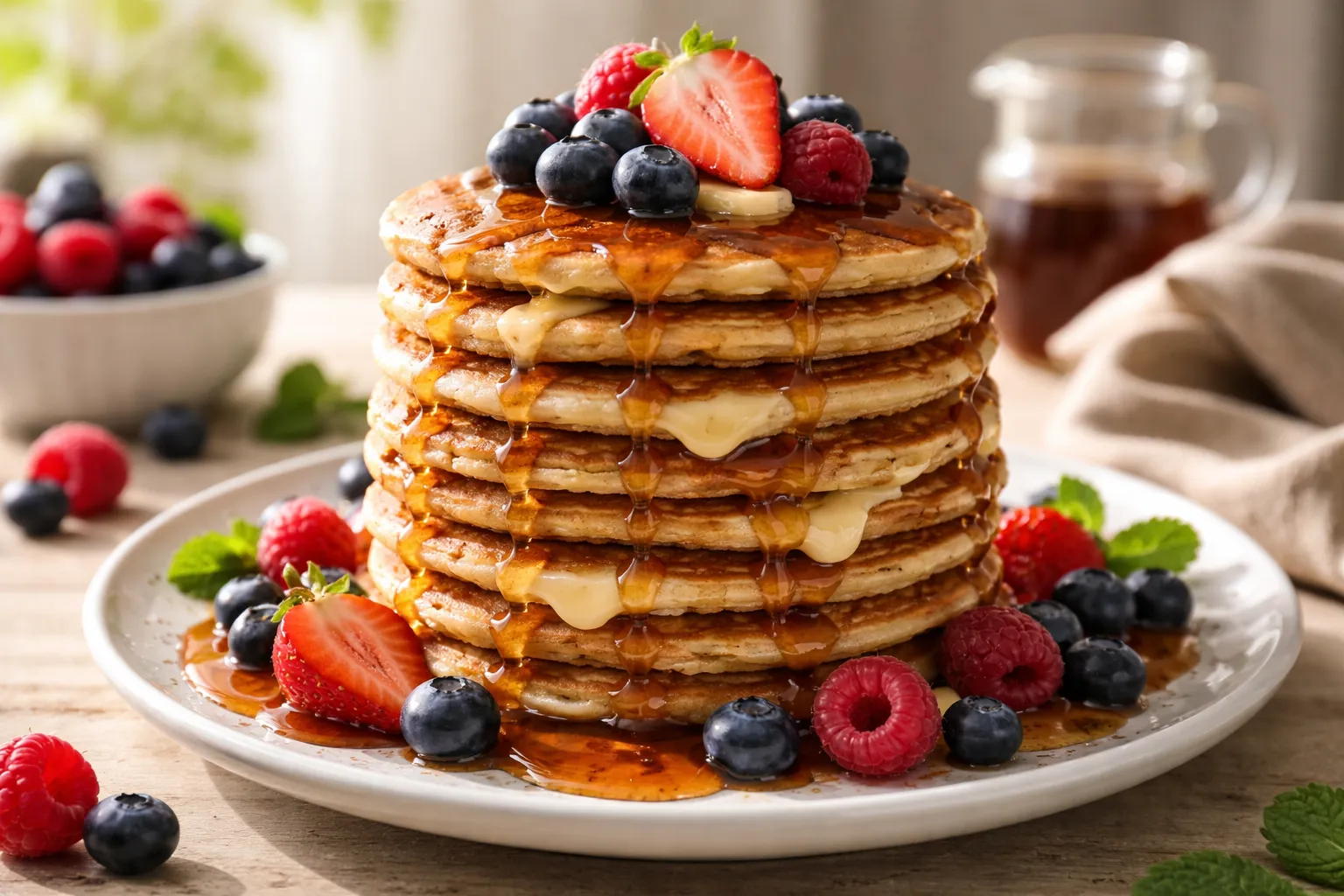
Here’s a claim I’d bet money on: most bakers treat their sourdough discard like a chore ingredient, something to guiltily dump into a recipe just so it doesn’t go to waste. That’s backwards. The truth is those wild yeasts and natural acids sitting in your discard are doing real work — they’re what turns an ordinary pancake batter into something that puffs up tall and stays impossibly tender on the inside. Feed your starter a few times a week and you’ll have plenty of discard on hand for exactly this purpose, or just let it build up naturally between bakes. Either way, what comes off the griddle isn’t a consolation-prize breakfast — it’s the reason my whole household treats Saturday mornings as sacred.
Let me tell you about the weekend I unknowingly plated what my family now refers to as “the frisbee incident.” What came off my griddle that morning were flat, chewy discs with all the spring of a rubber mat — my husband, ever diplomatic, called them “interesting,” while my kids just quietly nudged theirs around like science experiments. I’d felt so accomplished, finally putting discard to use instead of tossing it, and instead I got to watch my seven-year-old attempt to fold his into a taco shape out of sheer confusion. Humiliating as that morning was, it’s the exact reason I started obsessing over getting discard pancakes right — and looking back, I’m grateful for the disaster.
Here’s the thing I understand now that I absolutely did not understand on frisbee morning: discard pancakes aren’t a workaround for leftover starter — they’re a legitimately superior pancake. The tang runs deeper, the flavor gets more layered, and the crumb has a tenderness that no boxed mix could dream of replicating. Once I sorted out where I’d been going wrong (and trust me, the list was longer than I’d like to admit), these pancakes locked themselves permanently into our weekend rhythm. Every Saturday. No exceptions.
Where I Kept Messing Up (And What Finally Fixed It)
Consider this your shortcut past all the pancake failures I had to learn the hard way.
Blunder number one: reaching for discard that had gone way past its prime. Mine had sat neglected in the fridge for close to two weeks, unfed, until it smelled sharp enough to make my eyes water. That much acidity fought against my leavening and gave me a batter that couldn’t get its act together. What you actually want is discard somewhere in the range of a few days old to about a week — it should carry a pleasant tang, not smell like nail polish remover or vinegar straight up.
Blunder number two: mixing far too much. I kept stirring, chasing down every last lump, which built up gluten and left my pancakes with a tough, chewy bite. With any pancake batter, the rule is simple — stir just until it comes together. Those lumps aren’t a problem to solve; leave them be.
Blunder number three, and the one that mattered most: my cookware. I’d been cooking on a flimsy nonstick pan that heated inconsistently and ran scorching hot right in the middle. The result was pancakes with burnt exteriors and raw centers, and because the heat wasn’t even across the surface, some pancakes rose into perfect domes while their neighbors basically collapsed in defeat. Swapping in a cast iron griddle solved this completely, and I’ll walk through why below.
The Griddle That Actually Keeps Up With Saturday-Morning Pancake Volume
Cooking pancakes for a whole family isn’t a one-and-done affair — it’s batch after batch on the same hot surface, and any pan that develops hot spots or loses heat between rounds will tank your results fast. What I needed was a griddle wide enough to handle several pancakes at once without the heat drifting or fading as the morning went on.
Where it earns its keep
- It flips to give you two different cooking surfaces — a flat griddle on one side and grill ridges on the other — so pancakes don’t have to be the only thing on the menu; bacon or sausage can go right alongside.
- Cast iron holds and spreads heat with remarkable consistency, so every pancake lined up across the surface cooks at the same pace — no more edges lagging behind while the middle races ahead.
- There’s enough room for 4 to 6 pancakes at a time, which turns Saturday breakfast from a stand-and-flip marathon into something I actually get to sit down and enjoy.
Where it comes up short
- This thing is genuinely heavy, and it needs a full 10 minutes on medium-high heat before it’s properly preheated — so spontaneous pancake cravings with a five-minute turnaround just aren’t in the cards.
- Because it’s reversible, you’re dealing with a bulkier piece of equipment in storage, and trying to flip it over mid-meal if you actually want to use both sides is clunky at best.
I had my doubts about cast iron for pancakes at first—I worried the weight and preheat time would make me lazy and skip breakfast altogether—but this Lodge griddle proved me wrong. Grab the Lodge Double Play Reversible Cast Iron Grill/Griddle and stop settling for uneven pancakes.
Ingredients
- 200g sourdough discard
- 120g all-purpose flour
- 240g milk
- 1 large egg
- 30g melted butter
- 20g sugar
- 5g baking powder
- 3g baking soda
- Pinch of salt
Step by Step
- Whisk the wet ingredients. Whisk together the discard, milk, egg, melted butter, and sugar until smooth.
- Add the dry ingredients. Sprinkle the flour, baking powder, baking soda, and salt over the wet mixture and fold gently just until combined – a few lumps are fine.
- Rest briefly. Let the batter sit 5 minutes while your griddle heats – this gives the baking soda time to react with the discard’s acidity for extra lift.
- Cook. Heat a lightly oiled griddle or nonstick pan over medium heat. Pour 1/4 cup portions and cook 2-3 minutes, until bubbles form across the surface, then flip and cook 1-2 minutes more.
Discard somewhere in the range of a few days old to about a week works best. It should carry a pleasant tang, not smell like nail polish remover or vinegar straight up. Discard that sat neglected and unfed for close to two weeks will have too much acidity and fight against your leavening. Overmixing builds gluten and creates tough, chewy pancakes. The rule is simple: stir just until the batter comes together. Those lumps aren’t a problem to solve; leave them be. Also, uneven cookware with hot spots will cause some pancakes to rise into domes while others collapse. I use a Lodge Double Play Reversible Cast Iron Grill/Griddle. Cast iron holds and spreads heat with remarkable consistency, so every pancake cooks at the same pace with no hot spots. There’s enough room for 4 to 6 pancakes at a time, which makes Saturday breakfast manageable. Let the batter sit 5 minutes while your griddle heats. This gives the baking soda time to react with the discard’s acidity for extra lift, which helps your pancakes puff up tall and stay tender on the inside.Frequently Asked Questions
How old should sourdough discard be for pancakes?
Why did my discard pancakes come out flat and chewy?
What griddle do you use for sourdough pancakes?
How long should pancake batter rest before cooking?
About This Article

Written by Sam Whitaker. Sam Whitaker has been baking sourdough for over a decade, including three years baking commercially, and now works out of a home kitchen in the Pacific Northwest. Sam's eleven-year-old starter, Harold, is the foundation for every recipe and troubleshooting guide on Sourdough Rising — real bread tested over and over until it works. More about this site.
Scope and limits. Sam is a home baker with no formal culinary training. Follow current food safety guidance for storage and handling, particularly with enriched or filled doughs.
Verify this against a primary source
Specifics change, and your situation may differ from the one described here. These are the authorities worth checking directly:
- USDA FoodData Central — flour and ingredient composition data
- FoodSafety.gov — safe handling and storage