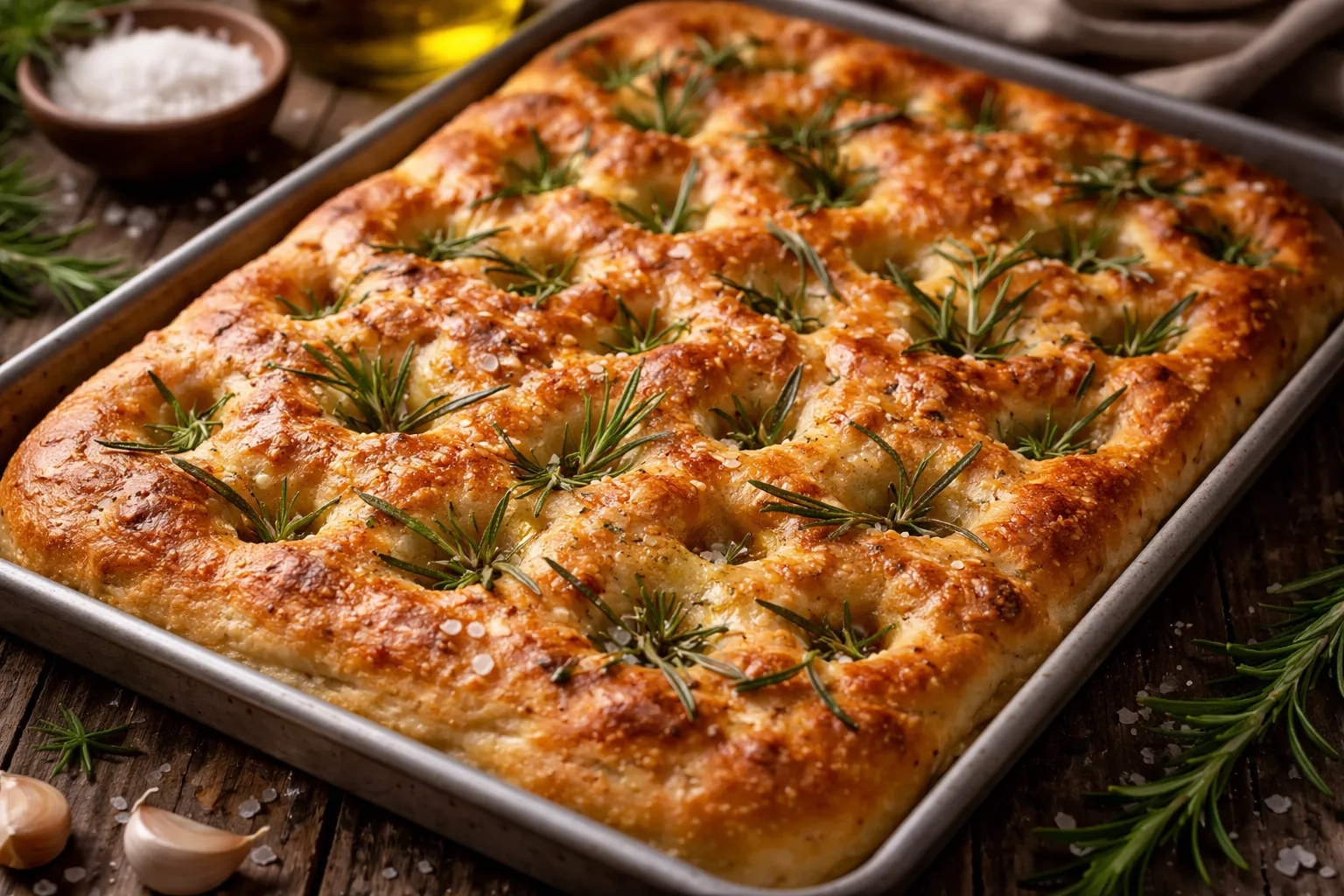
This sourdough discard focaccia is honestly one of the smartest uses for leftover starter I’ve come across in over a decade of feeding jars — nothing wasted, nothing to feel guilty about, just a golden, dimpled slab of bread with a crackly bottom and a soft, cloud-like inside. If you’ve been pouring your discard straight into the sink, consider this your official permission to knock it off. That tangy, slightly sour edge from the discard is what turns a plain focaccia into something people actually stop and comment on.
What I love most about this particular focaccia is how forgiving it is with quantities. Got 100g of discard hanging around, or closer to 200g? Either works — you just nudge the flour and water to compensate. It’s just as flexible on top: go the traditional route with flaky salt and rosemary, or pile on olives, cherry tomatoes, or a heap of caramelized onions. No matter which direction you take it, you’re only a couple of hours removed from the best loaf you’ll eat all week.
Somewhere in my phone’s camera roll sits a photo of a focaccia so deeply bubbled and glossy on top that it genuinely looks staged — like something styled for a cookbook shoot rather than thrown together in mild, sock-footed panic on a random Tuesday. That picture is the proof: dinner was two hours out, I’d promised to bring bread to a last-minute gathering at my neighbor’s, my starter wasn’t active, all I had was a jar of neglected discard sitting in the back of the fridge, and my dog was watching me with zero sympathy. What came out of the oven that afternoon was so golden and so garlicky that my neighbor flat-out asked if I’d picked it up from a bakery. Reader, I had not.
If there’s a jar of discard sitting in your own fridge right now, drop whatever you’re doing and make this. It comes together quicker than almost any other sourdough bake I know, it doesn’t ask for a drop of active starter, and it hands you back a thick, dimpled, pillowy loaf that tastes like it took the whole day to make. Below, I’ll walk through exactly how I put it together, tell you the slightly embarrassing backstory of how this recipe came to exist, and pass along every tip I’ve picked up since.
Why This Might Be the Best Use for the Discard Sitting in Your Fridge
Focaccia is already one of the more forgiving breads out there, and stirring sourdough discard into the dough takes it somewhere genuinely different. The discard contributes a mild tang and a layer of flavor you just won’t get from a plain commercial-yeast dough. Since we’re relying on discard rather than an active levain to do the leavening, this recipe leans on a small amount of instant yeast too, just enough to keep the timeline realistic and get bread on the table at a reasonable hour. Still, the discard is what gives this loaf its character — it’s the reason people lean over the pan and ask “wait, what is that?”
The texture is the other thing that keeps me coming back to this recipe. Focaccia bakes in a generous pool of olive oil, which gives you a bottom crust that’s crisp, almost fried, while the crumb above stays airy and impossibly soft. Add the faint acidity from the discard and you end up with a bread that’s more layered and satisfying than a straightforward white focaccia could ever be. And, as I learned during that frazzled Tuesday, it’s fully doable in the window before dinner.
What You’ll Need on Hand for This Bake
Ingredients
- 150g sourdough discard
- 350g bread flour
- 250g water
- 7g instant yeast
- 10g salt
- Olive oil, for the pan and topping
The Process, Step by Step
- Mix it up. Stir together the discard, water, and yeast, then work in the flour and salt until you’ve got a wet, shaggy mass of dough — the instant yeast is what lets you skip the active starter and shaves real time off the whole process.
- Let it bulk ferment. Cover the bowl and leave it at room temperature for 2-3 hours, until it’s roughly twice its starting size.
- Move it into the pan. Coat a sheet pan generously with olive oil, then slide the dough in, being careful not to knock the air out of it.
- Give it a second proof. Cover again and let it rest for 45-60 minutes, until it looks noticeably puffed.
- Dimple and dress it. Press dimples all over the surface with oiled fingertips, drizzle on more olive oil, then finish with flaky salt and whatever topping you’re going with — rosemary, olives, or cherry tomatoes.
- Bake it off. Bake at 425F (220C) for 20-25 minutes, until the top turns golden and the bottom crisps up.
Finding a Sheet Pan That Doesn’t Let Oil Pool in the Corners
Focaccia lives or dies on oil — the oil in the dough itself and the oil you use for dimpling — but a warped or lopsided sheet pan will undo you before the oven door even shuts. I spent months blaming my technique for pooling oil and unevenly baked edges before realizing the real culprit was my beat-up old pan.
Where it delivers
- Holds its shape through cycle after cycle of heating — no oil creeping to one corner while the far side sits bone dry.
- Rolled edges keep the dough rising evenly instead of climbing the sides or baking unevenly around the perimeter.
- Heat spreads across it evenly, which means a properly golden, crisp bottom without scorched edges the way cheaper pans tend to deliver.
Where it comes up short
- Being stainless steel, it can grab onto the dough if you’re stingy with oil, particularly during dimpling when you’re pressing into wet dough.
- It isn’t non-stick, so you’re looking at real scrubbing afterward — not a big deal, but don’t expect it to clean itself like some pans claim to.
I almost ditched this pan after my first bake because I forgot how much oil-to-stainless-steel friction matters, but one extra drizzle and a proper preheat changed everything. Grab a Nordic Ware Naturals Half Sheet Pan and stop letting your pan control your focaccia.
Frequently Asked Questions
Can I make sourdough focaccia with discard instead of active starter?
Yes. This focaccia uses 150g sourdough discard plus a small amount of instant yeast to leaven the dough, so you don’t need active starter at all. The discard contributes mild tang and character while the instant yeast keeps the timeline realistic for a same-day bake ready before dinner.
How long does sourdough focaccia with discard take to bake?
Total time is roughly two hours. After mixing, bulk ferment for 2-3 hours until doubled, then give it a 45-60 minute second proof in the pan before baking at 425F for 20-25 minutes until golden on top and crispy on the bottom.
What toppings work best on sourdough focaccia?
Flaky salt and rosemary are traditional, but the recipe is flexible. Olives, cherry tomatoes, or caramelized onions work equally well. The key is finishing with olive oil and your chosen toppings before baking.
Does the discard amount need to be exactly 150g?
No. You can use between 100g and 200g of discard. You simply nudge the flour and water amounts to compensate, making the recipe forgiving with quantities while keeping the results consistent.
About This Article

Written by Sam Whitaker. Sam Whitaker has been baking sourdough for over a decade, including three years baking commercially, and now works out of a home kitchen in the Pacific Northwest. Sam's eleven-year-old starter, Harold, is the foundation for every recipe and troubleshooting guide on Sourdough Rising — real bread tested over and over until it works. More about this site.
Scope and limits. Sam is a home baker with no formal culinary training. Follow current food safety guidance for storage and handling, particularly with enriched or filled doughs.
Verify this against a primary source
Specifics change, and your situation may differ from the one described here. These are the authorities worth checking directly:
- USDA FoodData Central — flour and ingredient composition data
- FoodSafety.gov — safe handling and storage