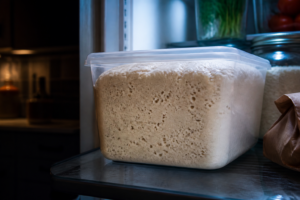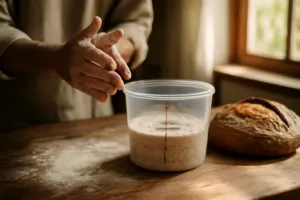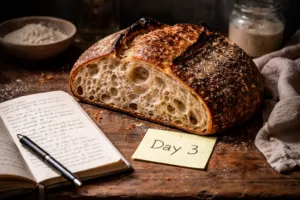

It was 5:47am on a Tuesday, I was still in my pajamas, flour was somehow on my ceiling, and I had to leave for work in exactly 43 minutes. My sourdough loaf was sitting on the counter looking absolutely perfect and absolutely unbaked. I had completely miscalculated my timeline. Again.
If you’ve ever tried to bake sourdough before work morning routines started making sense to you, you already know the particular chaos I’m describing. The good news? That flour-on-the-ceiling disaster was the moment everything finally clicked for me. And today I’m going to share the exact 5am starter routine that saved my mornings, my bread, and honestly, my sanity.
Why I Became Obsessed With Baking Sourdough Before Work (And Nearly Lost My Mind)
Let me back up to the real beginning of this story. I am not a morning person. I want to be very clear about that. I am the kind of person who sets four alarms and still hits snooze on all of them. So when I decided that I was going to become someone who bakes fresh sourdough before heading to the office, my friends thought I had lost the plot entirely. My husband just quietly started going to bed earlier in solidarity.
The problem was that I had fallen deeply, embarrassingly in love with sourdough baking. I wanted fresh bread. I wanted that crackly crust and the open crumb and the smell that fills your whole kitchen at 7am and makes your neighbors suspicious. But weekends weren’t enough anymore. I wanted it on a Tuesday. I wanted it on a random Thursday. I wanted it like a person who has their life together.
So I started experimenting, failing spectacularly, and eventually landing on a routine that genuinely works around a normal work schedule. The ceiling flour incident was part of the learning curve. A dramatic, inexplicable part, but part of it nonetheless.
The Secret Is All in the Night Before
Here is the thing nobody tells you when you’re trying to bake sourdough before work: the real work happens the evening before, not at 5am. Once I understood this, everything changed. Your 5am self will thank your 9pm self endlessly if you set things up correctly.
The Night Before Timeline
- 8:00pm: Feed your starter. Use a 1:5:5 ratio (starter:flour:water) so it rises slowly overnight rather than peaking too fast.
- 8:30pm: Mix your dough (autolyse your flour and water for 30 minutes first if you like a more extensible dough).
- 9:00pm to 10:30pm: Perform 3 to 4 sets of stretch and folds, spaced 30 minutes apart.
- 10:30pm: Shape your loaf, place it in your banneton, cover it, and put it straight into the fridge for a cold retard overnight.
The cold retard is your best friend here. A cold, slow ferment in the fridge overnight means you’re not racing against a clock at 5am. The dough is patient. It will wait for you. Unlike your starter, which once peaked and then collapsed into a sad, deflated puddle while I was binge-watching a cooking show. But we move on.
One Game-Changing Tip for Consistent Starter Timing
If your kitchen runs cold, which mine absolutely does in the winter months, your starter might not be active enough by 8pm to add to your dough. This is where a seedling heat mat completely transformed my baking. I know, I know. It sounds like something for a greenhouse. But bakers have been using them for years because they provide a gentle, consistent warmth that wakes your starter up reliably and keeps your bulk ferment on schedule.
I use the BN-LINK Durable Seedling Heat Mat and it has been an absolute revelation. It keeps the temperature around 70 to 75 degrees Fahrenheit right at the base of my jar, which means my starter is reliably ready when I need it. If you want another solid option, the VIVOSUN Durable Waterproof Seedling Heat Mat is UL and MET certified and works just as beautifully. Both are waterproof, which matters because sourdough baking is a messy, splashy business and you know it.
Your 5am Morning Bake Sourdough Before Work Routine
Now here is where the magic happens. Because you did the hard work last night, your 5am routine is genuinely simple. You just need to be awake enough to operate an oven, which, fair warning, requires at minimum one full cup of coffee for me personally.
Step by Step from Alarm to Oven
- 5:00am: Wake up. Start coffee immediately. This is non-negotiable.
- 5:05am: Place your Dutch oven into the oven and preheat to 500 degrees Fahrenheit (260 Celsius). Your cold dough goes straight from fridge to hot Dutch oven. Do not let it sit on the counter first.
- 5:45am: Your Dutch oven is fully preheated. Score your dough straight from the fridge, flip it into the pot, score it confidently, and lid it up.
- 5:50am: Bake covered at 500 degrees for 20 minutes, then remove the lid and reduce to 450 degrees for another 20 to 25 minutes until deep golden brown.
- 6:35am: Pull your loaf out. Try not to cry at how beautiful it is. Let it cool for at least one hour before cutting, even though this will feel impossible.
The whole active work of your morning is maybe 15 minutes. The oven does everything else while you shower and get dressed and pretend to be a person who has it all together.
The Heat Mat That Stops Your 5am Dough from Overshooting Bulk Fermentation
When you’re racing the clock before work, the last thing you need is your bulk fermentation finishing in 3 hours instead of 4—or worse, overnight in the fridge with an under-proofed loaf waiting. A seedling heat mat gives you actual control over fermentation speed instead of hoping your kitchen happens to be the right temperature.
What works
- Keeps your dough at a predictable 75–78°F, which means bulk fermentation happens on your schedule, not the season’s whim or your drafty kitchen’s mood.
- Compact enough to slide under a proofing box or bowl, so it doesn’t take up counter space during your morning chaos.
- The thermostat actually holds steady—I’ve checked it obsessively, and the temperature doesn’t drift the way I was afraid it would.
What doesn’t
- It’s one more device plugged in during your morning routine, and if you forget to turn it on before bed, you’ve just lost your temperature consistency for the whole timeline.
- If your kitchen is already warm (summer baking), the mat can overshoot even on the lowest setting—you’ll need to monitor it or use it strategically.
I almost ditched mine after the first week because I wasn’t turning it on consistently, but once I made it part of my evening prep routine (flip the mat on, set a phone reminder), the 5am math actually started working. If you’re serious about pre-work baking, grab a BN-LINK Durable Seedling Heat Mat.
This post contains affiliate links. As an Amazon Associate, I earn from qualifying purchases at no extra cost to you.