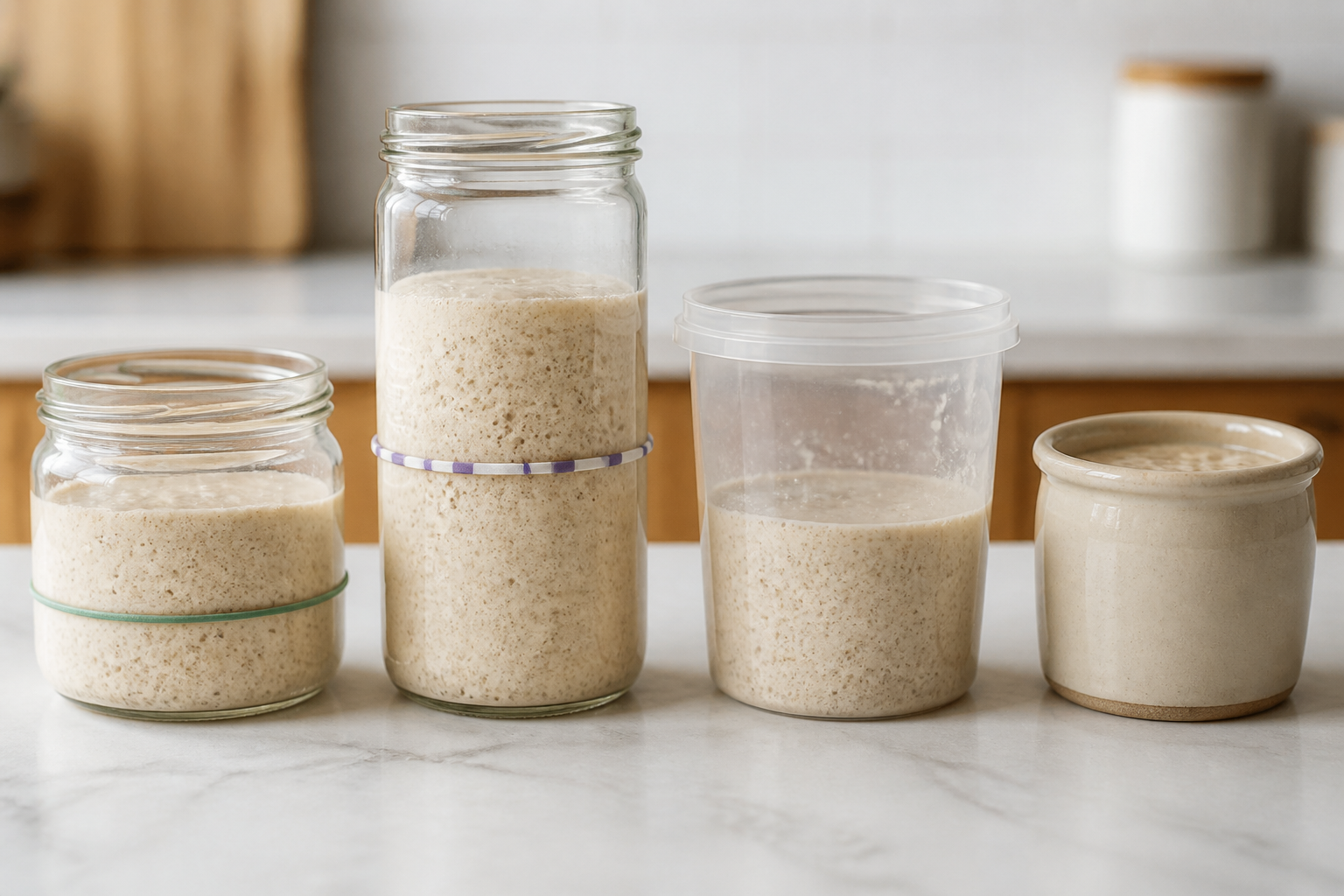
I’ll never forget the Tuesday morning I found my sourdough starter container shattered across my kitchen floor.
It was 6 a.m., and I was reaching into the cabinet above my stove to grab what I thought was a sturdy glass jar. Instead, a thin-walled mason jar came tumbling down, exploding on impact and sending two years’ worth of bubbly, active starter—mixed with glass shards—across my tile. I stood there in my pajamas, staring at the mess, feeling the weight of wasted flour, time, and the sentimental loss of a starter I’d been nurturing since my daughter was born. That moment, as frustrated as I was, became the catalyst for my eleven-year journey of learning what actually makes a good sourdough starter container.
After a decade of home baking and three years running a microbakery, I’ve tried nearly every vessel you can imagine. Today, I want to share what I’ve learned about finding the right sourdough starter container—because that one broken jar taught me that not all containers are created equal.
What I Learned From That Kitchen Disaster
After the Great Starter Spill of 2013, I didn’t just pick up a new jar and move on. Instead, I became obsessed with understanding why that container failed. It was a regular wide-mouth mason jar—the kind I’d been using casually without much thought. The glass was thin, the seal wasn’t secure enough to prevent condensation buildup in my warm kitchen, and honestly, I’d been treating it like an afterthought rather than what it actually was: the home of a living, breathing culture that deserved respect and protection.
That’s when I realized I’d never actually considered what a sourdough starter container really needed to do. It wasn’t just about holding liquid. A proper starter vessel needed to:
- Withstand thermal stress and daily temperature changes
- Accommodate expansion during feeding without overflow
- Allow gases to escape without letting contaminants in
- Give me visibility to see fermentation activity
- Be durable enough to last through years of daily use
With those criteria in mind, I began experimenting with different containers in earnest.
Finding the Right Sourdough Starter Container: My 11-Year Journey
The Early Years: Trial and Error
After losing my original starter, I had to begin again from scratch. I started with basic quart-sized mason jars, but covered them loosely with coffee filters held on with rubber bands. This worked, sort of, but I constantly worried about contamination. Within a year, I upgraded to mason jars with cloth covers—better, but I was still paranoid about mold.
Then came the ceramic crocks phase. I bought a beautiful, rustic crock that looked perfect in my kitchen. It was charming but impractical. I couldn’t see my starter activity clearly, and the narrow opening made feeding messy. After six months, I abandoned it.
The Microbakery Years: Learning What Actually Works
When I started my microbakery in 2017, I had to think differently about containers. I was keeping multiple starters now—three or four at a time—and needed something professional, reliable, and scalable. I couldn’t afford another failure or contamination incident.
That’s when I discovered purpose-built sourdough starter jars, and my entire approach changed. These weren’t mason jars repurposed for starter keeping. They were designed specifically for this work, with wide mouths for easy feeding, marked feeding bands to track expansion, proper ventilation systems, and durable glass that could handle thermal stress.
During those three years running my bakery, I tested containers obsessively because consistency directly affected my bread quality. A starter kept in the right vessel fermented more predictably. Temperature gradients were more stable. I had fewer contamination issues. And honestly, it made the daily work feel more professional and intentional.
The Breakthrough: What Changed Everything
About five years ago, I switched to dedicated starter jars with integrated temperature strips and proper ventilation lids. This single decision eliminated almost all my starter-keeping headaches. I could monitor temperature at a glance, the lids allowed for proper gas exchange without requiring me to loosely cover jars with cloth, and the wide mouths made feeding intuitive.
More importantly, my starters became more stable. The fermentation timeline became more predictable. I stopped losing batches to unexpected contamination. And psychologically, keeping my starter in a proper container helped me treat it with the care it deserved—as a living culture, not just leftover dough in a jar.
The Jar That Actually Survives the Cabinet Fall
After that shattered-jar disaster, I became obsessed with finding a container that could handle both the weight of an active, fed starter and the occasional fumble. A thin-walled mason jar was never going to cut it—I needed something built to last.
What works
- The thick glass walls don’t sweat condensation all over your shelf, so you can actually see your starter’s activity level without wiping the jar down every morning.
- The measurement markings on the side are genuinely useful when you’re scaling up or down your feeding ratios—no more guessing or dirtying a separate measuring cup.
- The included loose-fitting lids let gas escape naturally without you having to remember to “burp” the jar or prop it half-open, which I always forgot to do anyway.
What doesn’t
- The kit comes with two jars when realistically most home bakers only need one active starter container at a time—unless you’re maintaining backups, which adds shelf clutter.
- The glass is heavy when full, so if you’re storing it high up like I do, lifting it down one-handed while half-asleep is still a bit risky.
I did drop this jar once from waist height onto concrete, and my heart nearly stopped—but it survived with just a small chip on the rim. 2 Pack Premium Pro Sourdough Starter Jar Kit
This post contains affiliate links. As an Amazon Associate, I earn from qualifying purchases at no extra cost to you.