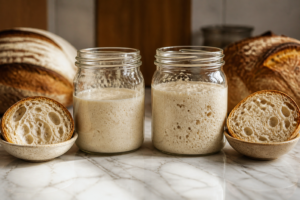
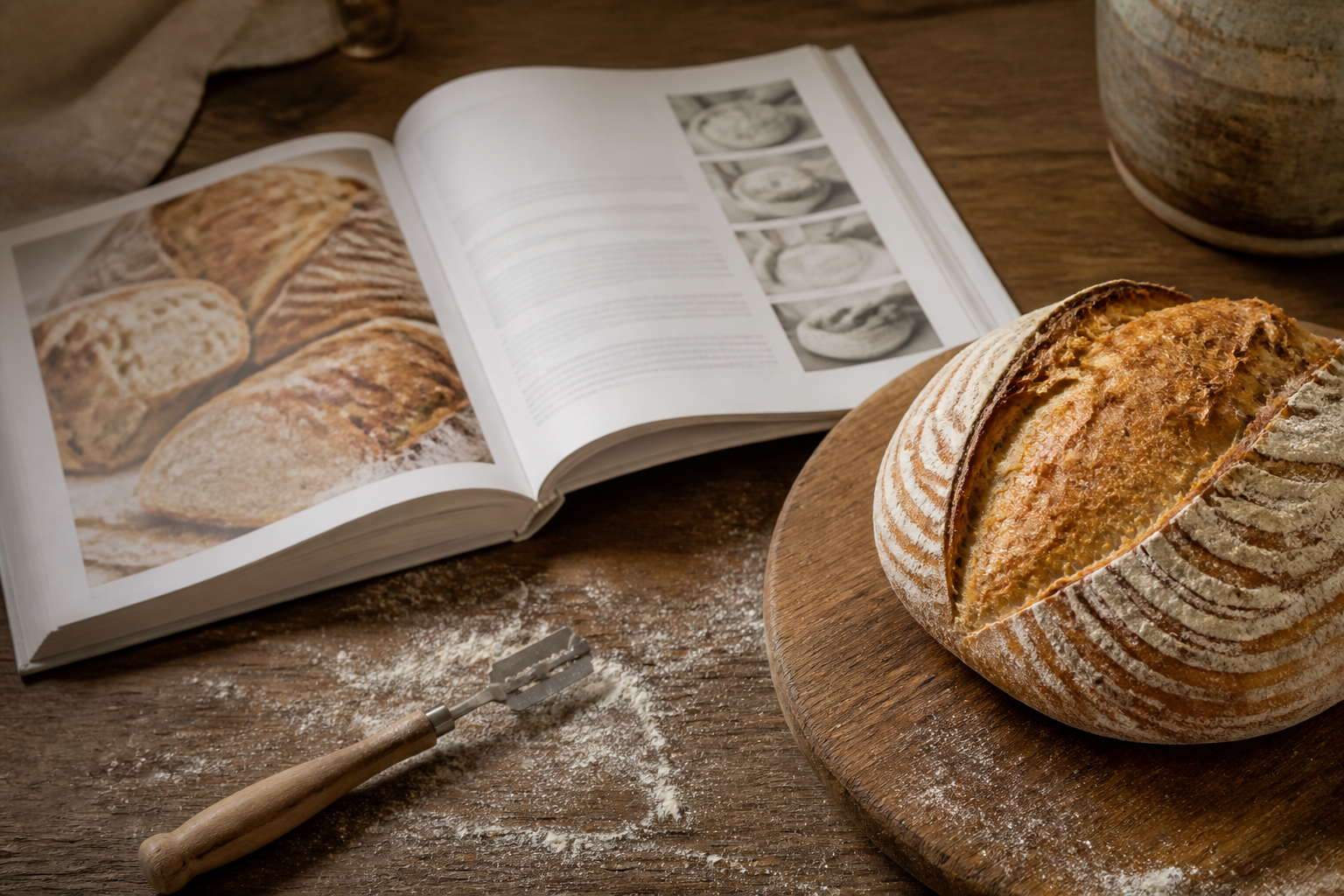
No recipe card on the planet warns you that a starter can go from sluggish to volcanic in the space of an evening, or that “double in size” doesn’t come with a manual for what to do when it actually happens at 11 PM on a Tuesday. That’s roughly the scene I found myself in — flour dusted across my arms and countertops, a jar of starter that had clearly decided to overachieve and nearly erupted onto my clean counters. My husband glanced around the doorway, clocked the look on my face, and smartly retreated without a word. That exact moment is what pushed me to finally crack open The Sourdough Whisperer by Elaine Boddy. People in sourdough circles had been talking about this book for months, and honestly, I doubted it had much to offer me. Eleven years into home baking, plus a few years running weekend-batch bakes for neighbors and coworkers, I assumed I’d already learned the important lessons. Turns out that assumption didn’t hold up.
A Skeptic Cracks Open The Sourdough Whisperer
I’ll admit it straight up — when this book first landed in my hands, I gave it a bit of an eye-roll. “The Sourdough Whisperer” sounded like a title someone dreams up for a TV baking personality, not a working guide. By that point I’d already dropped serious money on sourdough books, sat through online classes, and cranked out thousands of loaves over the years. Troubleshooting a stubborn fermentation was practically second nature. I could poke a dough and tell you exactly where it stood in its development. Naturally, I wondered what new ground this book could possibly cover.
It showed up on a drizzly Friday, and I dropped it onto my kitchen table alongside a stack of other cookbooks I kept promising myself I’d get to eventually. There it sat, untouched, for an entire week. I’m not exaggerating. Every day I walked right past it while running through my usual recipe lineup, fully convinced my experience level put me beyond needing whatever Elaine Boddy had written.
Then the failed bakes started piling up.
The Trap of Thinking You’ve Seen It All
Around that time, someone had asked me to put together fresh recipes for a sourdough class I was considering teaching. The bar was simple in theory: recipes that were reliable, repeatable, and fun enough to hook a beginner. Turns out that bar was harder to clear than expected. My loaves started coming out unpredictable — crumb structure all over the map. Some loaves had giant tunnels running through them. Others baked up dense and heavy. One particularly ugly attempt looked like a flattened shoe. I was genuinely stumped, since these were flavor combinations and methods I’d used successfully dozens of times before.
Frustration got the better of me (fine, it was closer to desperation), and I finally reached for The Sourdough Whisperer, which had been collecting dust on the table all that week. At that point, a new perspective seemed worth a shot. I opened it to the section covering starter behavior and temperature factors, half-expecting to skim through information I’d already absorbed a dozen times over.
Instead, I landed on a passage about hydration’s effect on fermentation speed that put into words something I’d never fully worked out on my own. Elaine laid out the connection between flour type, starter strength, and final dough temperature so clearly that I set the book down mid-page and walked straight to my kitchen. I’d spent all this time fiddling with salt levels and fermentation windows, completely missing how my slightly wetter dough, paired with the particular warmth of my kitchen, was quietly wrecking my whole timeline.
I ran the recipe again using the framework she laid out for weighing those variables. The result was flawless — not just decent, genuinely flawless. Exactly the loaf I’d been chasing without success for weeks.
The Real Reason This Book Stands Apart
Here’s the part that caught me off guard: this book comes from someone who clearly understands sourdough isn’t just a checklist of steps to follow. It’s about grasping the reasoning behind each choice you make along the way. Elaine Boddy walks through every recipe and technique with a mindset that’s almost scientific in its logic, yet somehow never feels intimidating or over-technical.
The recipes hold up on their own, sure, but what actually won me over was how the book trains you to reason through problems the way she does. Instead of a flat instruction like “ferment for 4 hours,” she spells out the visual cues to watch for, the variables that shift timing, and how to recalibrate for your own kitchen’s quirks. That’s exactly the kind of understanding it took me years — and countless batches ��� to piece together through pure trial and error.
The way the book is organized deserves credit too. It opens with the core fundamentals, and manages to make that groundwork engaging rather than dry, before gradually layering on complexity. The recipe lineup moves from straightforward, everyday loaves toward bolder flavors and more involved techniques. There’s also a troubleshooting section that felt almost uncomfortably accurate — practically every strange dough mishap I’ve encountered over the years gets addressed there, with actual fixes rather than a vague “just try again.”
Finally, an Explanation for My Chaotic Starter
Three dead starters taught me nothing useful until I actually understood what was going on inside that jar — and it turns out plenty of bakers hit that same wall. Elaine Boddy’s book unpacks the science and hands-on practice of starter management clearly enough that the guesswork disappears, replaced by real confidence at the bench.
Where it delivers
- The starter troubleshooting pages pinpoint the actual reason your starter isn’t rising properly — temperature, feeding ratio, timing — rather than the generic “just feed it more” advice.
- Each recipe spells out visual and physical cues for knowing when dough is ready to move forward, so you’re no longer at the mercy of a timer that ignores your kitchen’s real temperature.
- The detail around hydration and technique is specific enough that you can actually diagnose a failed bake instead of just chalking it up to your own lack of skill.
Where it falls short
- Anyone hunting for heritage grain deep-dives or edge-of-experimental recipes won’t find them here — the book sticks firmly to dependable, practical territory rather than wild fermentation adventures.
- Photography does its job but isn’t going to win design awards; treat this as a hands-on baking manual rather than a glossy coffee-table read, and set expectations accordingly.
I was skeptical that any book could fix the mess I’d made of my baking practice, but when my starter actually *stayed* active for the first time in months, I realized Boddy was writing from the perspective of someone who’d failed just as hard as I had. The Sourdough Whisperer: The Secrets to No-Fail Baking with Epic Results
Frequently Asked Questions
How long have you been baking sourdough at home?
I’ve been baking sourdough at home for eleven years, plus I spent a few years running weekend-batch bakes for neighbors and coworkers. That experience taught me a lot, but I discovered there were still gaps in my understanding that The Sourdough Whisperer helped fill.
What does the book say about starter temperature and fermentation?
The Sourdough Whisperer explains how temperature, feeding ratio, and timing affect starter behavior rather than offering generic advice. It also covers how hydration, flour type, and kitchen warmth work together to change fermentation speed, which helped me finally diagnose why my dough timings were off.
Does the book include recipes for heritage grains?
No, the book sticks firmly to dependable, practical territory rather than heritage grain deep-dives or experimental recipes. The focus is on reliable, repeatable loaves rather than edge-of-experimental baking adventures.
What happens when sourdough starter ferments too fast?
A sluggish starter can go volcanic in the space of an evening. My own Harold nearly erupted onto my counters one Tuesday night, which was the moment that pushed me to finally explore resources like The Sourdough Whisperer to understand what was actually happening in the jar.
About This Article

Written by Sam Whitaker. Sam Whitaker has been baking sourdough for over a decade, including three years baking commercially, and now works out of a home kitchen in the Pacific Northwest. Sam's eleven-year-old starter, Harold, is the foundation for every recipe and troubleshooting guide on Sourdough Rising — real bread tested over and over until it works. More about this site.
Scope and limits. Sam is a home baker with no formal culinary training. Follow current food safety guidance for storage and handling, particularly with enriched or filled doughs.
Verify this against a primary source
Specifics change, and your situation may differ from the one described here. These are the authorities worth checking directly:
- USDA FoodData Central — flour and ingredient composition data
- FoodSafety.gov — safe handling and storage