Ever catch yourself wondering whether the overnight cold-proof method really lives up to its reputation, or whether same-day sourdough deserves way more respect than it gets? Here’s my blunt answer after eight straight weekends of testing both: it’s complicated, and week three nearly talked me into quitting for good. Sunday, mismatched socks on, coffee still doing nothing for me, I pulled back the cloth and found a dough that had accomplished absolutely nothing overnight. Flat. Dense. Sad. The banneton’s spiral pattern sat on top like a decoration on a pancake, while underneath, the whole thing had settled into pure frisbee territory. My husband wandered in, glanced at the dough, glanced at me, and had the sense not to say a single word.
That particular disaster happened in week three of a comparison I’d stubbornly locked myself into: same-day sourdough versus the overnight cold-retard method, baked back to back every single weekend for two straight months. I tracked everything like some obsessive, flour-dusted researcher, and for those early weeks, the overnight loaves were flat-out humiliating me. Here’s the thing about kitchen failures, though — they teach you far more than a flawless bake ever could. By the time all eight weekends were done, I had a winner I genuinely hadn’t expected, a much sharper understanding of how both methods actually behave, and one unforgettable story involving a loaf I accidentally left baking for an extra hour. We’ll circle back to that.
| Method | Timeline | Fermentation | Final Proof |
|---|---|---|---|
| Same-Day Sourdough | 10 to 14 hours | Bulk fermentation during day with stretch and folds | Shorter, room-temperature |
| Overnight Cold Retard | Day + overnight + next morning | Bulk fermentation during day | Slow overnight in fridge |
Same-Day Sourdough vs Overnight Cold Retard: What’s the Real Difference?
Before wading into the mess of my two-month test, it’s worth pinning down exactly what each method actually involves, since the terminology tends to confuse anyone new to sourdough baking.
Same-day sourdough packs mixing, bulk fermentation, shaping, and baking into a single window of roughly 10 to 14 hours. The usual rhythm goes like this: you start in the morning with a lively, active starter, spend several hours working through stretch and folds, shape the dough sometime in the afternoon, run through a shorter room-temperature final proof, and get it into the oven by evening. It eats up your entire day, but at least you’re awake for nearly all of it.
The overnight method — better known as cold retarding — splits the timeline differently. You mix and bulk ferment during the day, shape the dough that evening, then send the shaped loaf straight into the fridge for a slow overnight proof. The next morning, it goes directly from the refrigerator into a screaming-hot Dutch oven. Cold temperatures drag out fermentation, which is supposed to build deeper flavor and hand you more scheduling flexibility. That’s the theory. In practice, it handed me defeat after defeat for weeks straight.
The Gear That Works for Either Method
No matter which timeline you’re following, the equipment list barely changes. A solid banneton basket really is non-negotiable. I rotate between a handful of them depending on whether I’m testing one loaf or two, and here’s exactly what’s sitting on my counter right now.
For a single, beautiful boule, I reach for the Saint Germain Bakery Premium Round Bread Banneton Basket with Liner. The 9-inch size is perfect for a standard home baker loaf, the liner is easy to flour, and the spiral imprint it leaves on the dough is genuinely gorgeous. This was actually the basket sitting on my counter during that fateful flat-dough Sunday.
By week five, baking two loaves side by side had turned into my regular habit, so I started reaching for the DOYOLLA Bread Proofing Baskets Set of 2. A matched pair beats mismatched sizes by a mile, and the liners included with it have held up beautifully through repeated flouring and washing.
I also keep the 2 Pcs Banneton Bread Proofing Baskets around as a backup pair. They’re solidly made, come with their own liners, and having spares on hand means I’m never stuck waiting on one to dry before I can load up a second batch of dough.
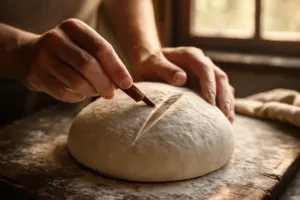
When it comes to scoring, I rely on two tools. The Saint Germain Premium Hand Crafted Bread Lame handles the decorative cuts — the kind worth photographing for Instagram. The leather blade sheath feels classy, and the handle sits securely in your grip. For quicker, everyday scoring, I reach for the Bread Lame Sourdough Scoring Tool in Beige, which uses a retractable, magnetic blade system that makes swapping blades almost painless. Both stay sharp enough to slice through cold, fridge-firm dough without ever dragging.
The Banneton That Doesn’t Collapse During Long Overnight Proofs
Run enough back-to-back overnight proofs and a cheap, flimsy banneton becomes public enemy number one — the dough spreads outward, slumps flat, and you end up staring at another one of those frisbee-shaped disappointments I kept pulling from the fridge. A properly built basket paired with a sturdy liner is what separates dough that climbs upward from dough that simply gives up trying.
Where it earns its keep
- Because the fitted linen liner stays put inside the basket instead of sliding around, your dough holds its tension and rises straight upward rather than oozing sideways during that long, cold proof.
- The basket itself resists flexing under the weight of a fully developed dough, so the spiral ridges actually prop the loaf up instead of buckling underneath it.
- The liner’s thickness keeps moisture absorption even across the surface, so you avoid those strange dry patches on one side of the loaf that throw off both scoring and oven spring.
Where it falls short
- At this price, part of what you’re paying for is simply the premium name — a generic, no-name banneton will get the same job done, just possibly with a looser liner that shifts a little more.
- The linen liner genuinely needs to dry out fully between uses, or it’ll trap moisture and start developing a musty smell faster than expected, especially if you’re proofing several loaves a week.
I nearly sent this back after week two when the liner still felt damp from the previous day’s proof, but then I stopped stacking them in the cupboard and actually let them air dry, and that single habit fixed everything. If you’re doing the same-day versus overnight experiment like I was, grab the Saint Germain Bakery Premium Round Bread Banneton Basket with Liner and stop losing loaves to gravity.
Frequently Asked Questions
How long does same-day sourdough take from start to finish?
Same-day sourdough packs mixing, bulk fermentation, shaping, and baking into a single window of roughly 10 to 14 hours. You start in the morning with a lively, active starter, work through stretch and folds over several hours, shape the dough in the afternoon, run a shorter room-temperature final proof, and get it into the oven by evening.
What is the overnight cold retard method for sourdough?
Cold retarding splits the timeline differently than same-day baking. You mix and bulk ferment during the day, shape the dough that evening, then send the shaped loaf straight into the fridge for a slow overnight proof. The next morning, it goes directly from the refrigerator into a screaming-hot Dutch oven.
Why did Sam’s overnight dough collapse in the banneton?
A cheap, flimsy banneton becomes a problem during long overnight proofs—the dough spreads outward and slumps flat. A properly built basket paired with a sturdy liner keeps your dough holding its tension and rising straight upward rather than oozing sideways during that long, cold proof.
How should I care for my banneton’s linen liner?
The linen liner genuinely needs to dry out fully between uses, or it’ll trap moisture and start developing a musty smell faster than expected, especially if you’re proofing several loaves a week. Stop stacking them in the cupboard and actually let them air dry instead.
About This Article

Written by Sam Whitaker. Sam Whitaker has been baking sourdough for over a decade, including three years baking commercially, and now works out of a home kitchen in the Pacific Northwest. Sam's eleven-year-old starter, Harold, is the foundation for every recipe and troubleshooting guide on Sourdough Rising — real bread tested over and over until it works. More about this site.
Scope and limits. Sam is a home baker with no formal culinary training. Follow current food safety guidance for storage and handling, particularly with enriched or filled doughs.
Verify this against a primary source
Specifics change, and your situation may differ from the one described here. These are the authorities worth checking directly:
- USDA FoodData Central — flour and ingredient composition data
- FoodSafety.gov — safe handling and storage