My oval willow banneton — the one with a permanent flour ring baked into its coils from years of use — witnessed my first real fruit sourdough disaster. I tossed a handful of fresh blueberries straight into the dough mid-bulk-ferment, and what came out of the oven had purple streaks running through it, soggy little craters where berries had popped, and a crumb so waterlogged in spots it never fully firmed up. Tasted okay. Looked like something out of a forensics report.
In the years since — including a stretch when I was cranking out large batches weekly for neighbors and friends through a home microbakery — I finally cracked the code on working fruit into sourdough without wrecking it. Dried, fresh, roasted, macerated: each type of fruit reacts to dough in its own way, and the real skill is understanding what fruit does to your hydration, your fermentation clock, and your final structure.
Everything below is what I’ve picked up along the way about building a fruit sourdough that turns out right, every time.
Why Fruit Throws Off Your Dough: Moisture and Sugar
Fruit behaves nothing like a simple mix-in such as seeds or nuts. It reshapes the dough in two distinct ways. First, it lets go of moisture — fresh fruit especially, since it can run 80 to 90 percent water by weight. That released water messes with your hydration math and can leave behind soggy pockets that keep the crumb from setting the way it should.
Second, fruit is loaded with sugar, and sugar is basically a feast for your yeast and bacteria. Overdo the fruit and fermentation takes off faster than expected, often tipping into overproofing before you notice anything’s wrong. Back during my busiest baking seasons, I learned to trim my starter percentage by roughly 2 to 3 percent for fruited loaves to counteract that speed-up.
Once you’ve internalized these two forces — added water, added sugar — you’ve got the foundation for fruit sourdough that behaves the same way every time you bake it.
Dried Fruit: The Forgiving Starting Point
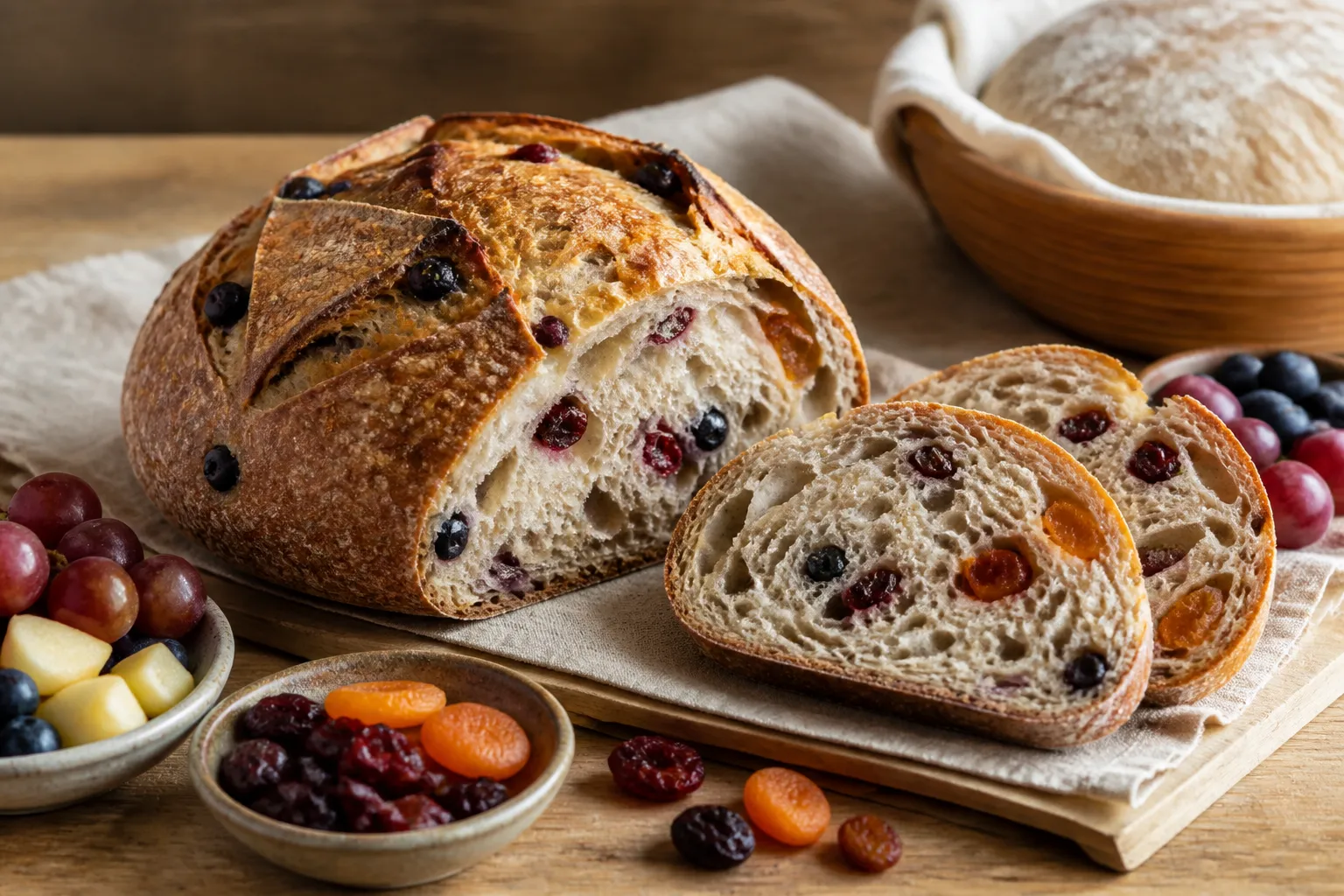
Dried fruit is far more cooperative than fresh because it pulls moisture out of the dough instead of dumping moisture into it. That’s actually a bonus — it plumps back up during fermentation and baking, leaving behind little bursts of concentrated flavor without any of fresh fruit’s sogginess issues.
Combinations I Keep Coming Back To
- Cranberry and walnut: This loaf got requested by name constantly during my microbakery years. The tartness of the cranberries slices right through sourdough’s natural tang, and the walnuts bring depth. My ratio: 100g dried cranberries and 80g toasted walnuts per 1000g flour.
- Fig and pecan: Quarter the dried figs, rough-chop the pecans. Baking coaxes the figs into slightly caramelized, jammy little pockets. I use 120g figs and 70g pecans per 1000g flour.
- Golden raisin and rosemary: A pairing that sounds odd on paper but works beautifully — the raisins’ sweetness against rosemary’s herbal edge makes a loaf that pairs equally well with butter or cheese. Go with 90g golden raisins and 2 tablespoons of fresh chopped rosemary.
- Apricot and almond: Small-diced dried apricots with sliced almonds — this version is fantastic toasted. Use 100g apricots and 60g almonds.
Timing and Method for Folding in Dried Fruit
Work dried fruit in during your final round of stretch and folds — usually somewhere around 1.5 to 2 hours into bulk fermentation. Add it any earlier and it gets dragged into the gluten network too roughly, which can tear the dough apart. Saving it for the last fold lets you spread it around evenly without overhandling anything.
Scatter it across the surface during a stretch and fold, then bring it together with a fold or two. Perfect distribution isn’t the goal — a little unevenness is part of what makes it interesting.
A trick from my high-volume days: give dried cranberries and raisins a 10-minute soak in warm water first, then drain and pat them dry. Skip that step and they’ll pull moisture out of the surrounding dough during fermentation, leaving dry patches around each piece. Figs and apricots can skip the soak entirely — they’ve already got enough moisture in them.
Fresh Fruit: More Effort, Bigger Payoff
Fresh fruit demands more attention, but when it works, it’s unforgettable. A loaf built around fresh apple and cinnamon, or one studded with roasted grapes, is something you flat-out won’t find at most bakeries.
Two Ways to Deal With the Extra Water
You’ve basically got two paths for managing the moisture fresh fruit introduces:
- Drop your dough hydration by 3 to 5 percent. A recipe that normally sits at 75% hydration should come down to 70-72% once fresh fruit enters the mix, offsetting the water the fruit releases while baking.
- Strip moisture from the fruit beforehand. Roasting, macerating, or dehydrating the fruit ahead of time works well. This is my default move almost every time.
Fruit-by-Fruit Techniques
Apples: Peel and core, then dice into roughly 1cm cubes. Toss with a tablespoon of sugar and a pinch of cinnamon, spread across a baking sheet, and roast at 375°F for 15 minutes until the edges caramelize slightly and the excess moisture cooks off. Let it cool fully before folding into the dough. This method gives me the best apple sourdough I’ve ever pulled off — roasting concentrates the flavor and wipes out the sogginess problem completely.
Blueberries: Left fresh, they’ll pop and turn your dough purple — some bakers are fine with that, I’m not. My workaround is freezing the berries solid and folding them in frozen during the final stretch and fold. They thaw slowly through proofing and baking, releasing juice gradually enough that the crumb soaks it up instead of pooling into wet spots. Stick to 120g per 1000g flour — go heavier and the dough gets overwhelmed.
Grapes: Halve red grapes and roast at 400°F for 20 minutes until they’ve shriveled and concentrated in flavor. Fold in during pre-shaping. Paired with cheese, grape sourdough is something else entirely — it became a regular October favorite during my bigger weekend baking runs.
Pears: Same treatment as apples — dice, toss with a little sugar, roast to push out the moisture. Pear and ginger sourdough, made with fresh grated ginger mixed in during the initial mix, is one of the strangest loaves I’ve made and also one of the most asked-for.
Adjusting Fermentation Once Fruit Is in the Mix
Sugar released from fruit speeds fermentation along, so here’s how I compensate:
- Drop my usual 20% starter down to 15-17% for loaves loaded with fruit
- Keep a closer eye on bulk fermentation — fruited dough can hit its mark 30 to 60 minutes sooner than a plain batch under the same conditions
- Push the cold retard out by 2 to 4 extra hours when I can — the added cold time builds more complexity in the flavor that plays well against the fruit
Overproofing is the real danger here. More than once I’ve watched a fruited loaf deflate in the oven because the sugar drove fermentation past the tipping point while I was still going by my usual schedule. Read the dough itself, not the clock on the wall.
The Tools I Reach for When Baking Fruit Sourdough
For a reliable all-purpose baking setup that handles fruited loaves especially well, the Umite Chef 5QT Enameled Cast Iron Dutch Oven is my standard. The enameled interior is easier to clean when fruit sugars caramelize on the surface — which they will.
Scoring matters even more here, since fruited dough tends to run slightly stickier than a plain batch. I rely on a Wire Monkey UFO Bread Scoring Lame — its curved blade slices cleanly through tacky dough, and the ergonomic handle keeps your cuts precise.
When it’s time to mix and fold fruit in during bulk fermentation, I’ll use a Danish Dough Whisk for the initial mix, then switch over to my hands once the stretch and folds begin and the fruit needs incorporating.
Begin Easy, Then Branch Out
If fruit sourdough is new territory for you, start with a dried cranberry and walnut loaf. It’s the most forgiving version, the flavor combination appeals to nearly everyone, and it teaches you how mix-ins move through dough without the moisture headaches that come with fresh fruit.
Once dried fruit feels comfortable, move on to roasted apples, then work your way toward fresh berries and grapes. Each fruit teaches you something new about managing moisture, sugar, and fermentation timing.
Eleven years in, fruit sourdough is still where I do most of my experimenting. Just last month I threw together a fig and blue cheese sourdough that people either loved or hated, no in-between. That’s honestly the fun part — the base method holds steady, and the variations never run out.
| Fruit Type | Preparation Method | Timing to Add | Amount per 1000g Flour |
|---|---|---|---|
| Dried cranberries | Soak 10 min in warm water, drain, pat dry | Final stretch and fold (1.5–2 hrs into bulk) | 100g |
| Dried figs | Quarter the figs | Final stretch and fold (1.5–2 hrs into bulk) | 120g |
| Golden raisins | Soak 10 min in warm water, drain, pat dry | Final stretch and fold (1.5–2 hrs into bulk) | 90g |
| Dried apricots | Small-dice, no soak needed | Final stretch and fold (1.5–2 hrs into bulk) | 100g |
| Fresh apples | Peel, core, dice 1cm cubes, roast 375°F 15 min | After cooling, during final folds | Varies |
| Fresh blueberries | Freeze solid | Final stretch and fold, frozen | 120g max |
| Fresh grapes | Halve, roast 400°F 20 min | During pre-shaping | Varies |
The Dutch Oven That Keeps Fruited Loaves From Turning Soggy
Sliding a wet, fruit-heavy dough into the oven turns steam control into the whole game — trap too much moisture and your berries cook down to jam, trap too little and the crust locks in before the crumb gets a chance to open up. A heavy enameled Dutch oven with a snug lid is the one piece of equipment that’s consistently delivered for me with high-hydration fruit doughs.
Where it shines
- The 5QT size holds a standard boule without forcing you to score blind or eyeball angles — a real advantage when you’re wrangling a heavier, fruit-packed dough that fights you a little.
- The enamel finish means zero rust concerns and a much easier cleanup after acidic fruit doughs — I don’t have the patience to scrub cast iron for an hour once three loaves are already cooling on the counter.
- The lid seals tight enough to hold steam in properly during the covered portion of the bake, which stops the crust from setting too early and choking off an open crumb in fruited loaves.
Where it falls short
- It’s heavy enough that dropping a 500g dough into a scorching-hot pot with oven mitts on gets genuinely nerve-wracking — I’ve nearly lost a loaf more than once, which is why I now transfer with parchment paper every single time, no exceptions.
- The enamel chips if you’re careless with it, or if a lame knocks against the rim — mine’s got a small nick along the edge that I’ve made peace with, though I notice it every time.
I almost returned mine after the first chip, convinced I’d wasted money on something that couldn’t handle real bakery work — but three years and dozens of fruit loaves later, it’s still performing better than any bare cast iron I’ve owned. Umite Chef 5QT Enameled Cast Iron Dutch Oven
Frequently Asked Questions
Why does fresh fruit make sourdough ferment faster?
Fresh fruit is loaded with sugar, which is a feast for yeast and bacteria. The extra sugar speeds up fermentation significantly, often tipping into overproofing before you notice. That’s why Sam trims starter percentage by roughly 2 to 3 percent for fruited loaves to counteract that speed-up.
When should I fold dried fruit into sourdough dough?
Fold dried fruit in during your final round of stretch and folds, usually around 1.5 to 2 hours into bulk fermentation. Adding it earlier tears the dough apart; saving it for the last fold lets you spread it evenly without overhandling. Scatter it across the surface, then bring it together with a fold or two.
Should I soak dried cranberries before adding to sourdough?
Yes, give dried cranberries and raisins a 10-minute soak in warm water first, then drain and pat them dry. Without soaking, they’ll pull moisture out of surrounding dough during fermentation, leaving dry patches. Figs and apricots can skip the soak entirely since they already have enough moisture.
How do I prevent blueberries from making sourdough soggy?
Freeze the berries solid and fold them in frozen during the final stretch and fold. They thaw slowly through proofing and baking, releasing juice gradually enough that the crumb soaks it up instead of pooling into wet spots. Stick to 120g per 1000g flour maximum.
About This Article

Written by Sam Whitaker. Sam Whitaker has been baking sourdough for over a decade, including three years baking commercially, and now works out of a home kitchen in the Pacific Northwest. Sam's eleven-year-old starter, Harold, is the foundation for every recipe and troubleshooting guide on Sourdough Rising — real bread tested over and over until it works. More about this site.
Scope and limits. Sam is a home baker with no formal culinary training. Follow current food safety guidance for storage and handling, particularly with enriched or filled doughs.
Verify this against a primary source
Specifics change, and your situation may differ from the one described here. These are the authorities worth checking directly:
- USDA FoodData Central — flour and ingredient composition data
- FoodSafety.gov — safe handling and storage