I’ll never forget the morning I pulled my sourdough out of the oven and watched it collapse like a sad pancake.
It wasn’t the dough. The fermentation was perfect. The shaping was solid. The problem was sitting right there on my cooling rack: a Dutch oven that couldn’t handle the heat, couldn’t trap steam properly, and had cost me three hours and nearly two cups of flour. I stood in my kitchen at 6 a.m., staring at this failed loaf, and I realized I’d been using the wrong vessel the entire time.
That moment lit a fire under me. After 11 years of home baking and three years running a microbakery, I decided to do what I should have done from the start: systematically test the best Dutch oven for sourdough bread and figure out which one actually deserved a permanent spot on my shelf.
Why the Best Dutch Oven for Sourdough Bread Matters More Than You Think
When I started baking sourdough seriously, I didn’t understand why the Dutch oven was such a big deal. It’s just a pot, right? Wrong. Dead wrong.
A Dutch oven does two critical things for sourdough: it traps steam during the first part of baking, which creates that gorgeous oven spring and crackling crust we all chase. Second, it holds and radiates even heat so your bread bakes uniformly instead of burning on the bottom while staying pale on top.
But not every Dutch oven is created equal. Some heat unevenly. Some lose their enamel coating and rust. Some lids don’t seal tightly enough to trap steam effectively. And some are so heavy you need a gym membership to lift them safely.
That morning with the pancake loaf? My old Dutch oven had a hairline crack in the enamel that I’d ignored for months. It was losing heat constantly, and the lid had warped slightly, letting steam escape. I was fighting physics without even knowing it.
The Test Kitchen: My 5-Dutch-Oven Showdown
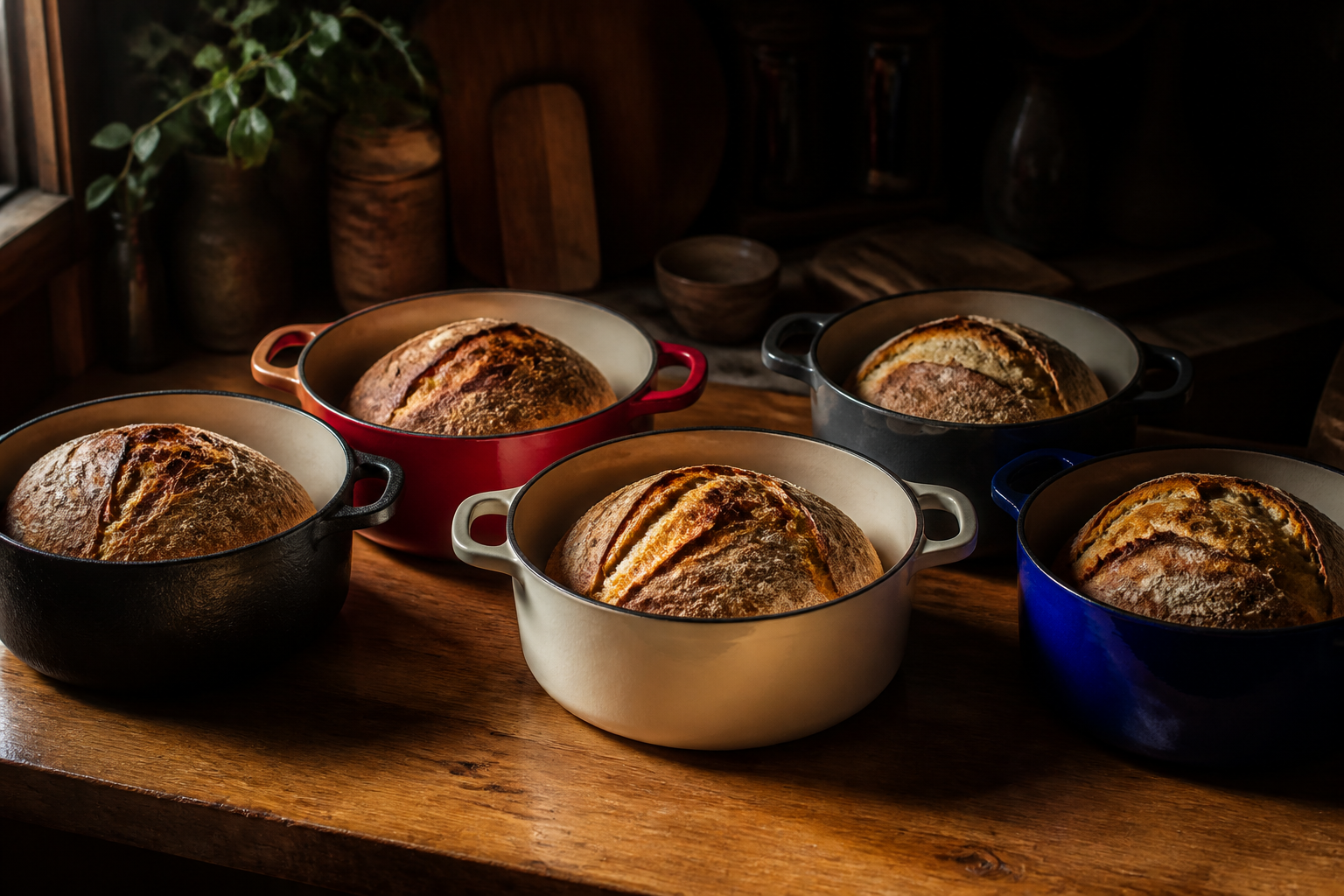
I committed to a proper test. I baked the exact same sourdough recipe five times using five different Dutch ovens, controlling for everything else: same starter, same flour, same fermentation times, same oven temperature (450°F for 20 minutes covered, then 30 minutes uncovered).
Here’s what I tested:
- A vintage Lodge cast iron Dutch oven from a thrift store (preseason, no enamel)
- A cheap enameled pot from a big-box store (the one that failed me)
- The AIVIKI 5QT Enameled Dutch Oven
- The CAROTE 5QT Enameled Cast Iron Dutch Oven
- The Lodge Essential Enamel Cast Iron Dutch Oven in 6 quarts
I tracked crust color, spring, interior crumb structure, and how the loaves looked after cooling. I also noted handling, heat distribution, and how the lid sealed.
What surprised me most? The winner wasn’t the most expensive. It wasn’t the one with the prettiest marketing photos. It was the one that combined reliability, performance, and honest craftsmanship.
The Vintage Lodge: Character, But Not Consistency
This beautiful piece had history and soul. But without the enamel coating, it required serious seasoning maintenance. The heat distribution was actually excellent, but the lid didn’t seal tightly enough to trap optimal steam, and I worried about rust if I didn’t dry it immediately. For sourdough beginners, this is too much hassle.
The Cheap Big-Box Option: Never Again
This is the one that failed me. The enamel was thin, the lid warped under high heat, and the handle design made it awkward to move safely. My loaf came out with uneven browning and minimal oven spring. This taught me a hard lesson: you can’t cut corners on this piece of equipment.
The Real Winners
The AIVIKI, CAROTE, and Lodge Essential all performed exceptionally well. Each had distinct strengths, and honestly, recommending just one felt unfair. So I’m recommending all three, depending on your needs.
The Dutch Oven That Finally Held Heat Long Enough to Steam
A Dutch oven that can’t maintain consistent heat or seal steam properly will sabotage your loaf no matter how perfect your dough is. I needed a vessel that would preheat reliably, hold that temperature through the entire bake, and actually trap the steam that creates crust and oven spring.
What works
- Heats evenly and holds temperature without hot spots that can scorch one side of your loaf while the other stays pale.
- The enamel coating doesn’t chip or flake after repeated high-heat sourdough bakes, and it actually improves your steam trap over time as it seasons slightly.
- The lid sits flush enough that you can trust the steam seal for the first 20 minutes—no guessing whether your crust will actually develop.
What doesn’t
- The handle gets legitimately hot during the preheat phase, so you’ll burn your hand if you’re not using an oven mitt—I learned this the hard way.
- At 5 quarts, it’s snug for anything larger than a 900g dough, so if you’re scaling up, you’ll need to look at the 6-quart Lodge instead.
I had one morning where the lid wouldn’t seat quite right and I almost convinced myself to swap it out, but it turned out I just hadn’t preheated the top long enough—a problem, not a defect. If you want reliable steam and heat retention without the anxiety, grab the AIVIKI 5QT Enameled Dutch Oven.
This post contains affiliate links. As an Amazon Associate, I earn from qualifying purchases at no extra cost to you.