
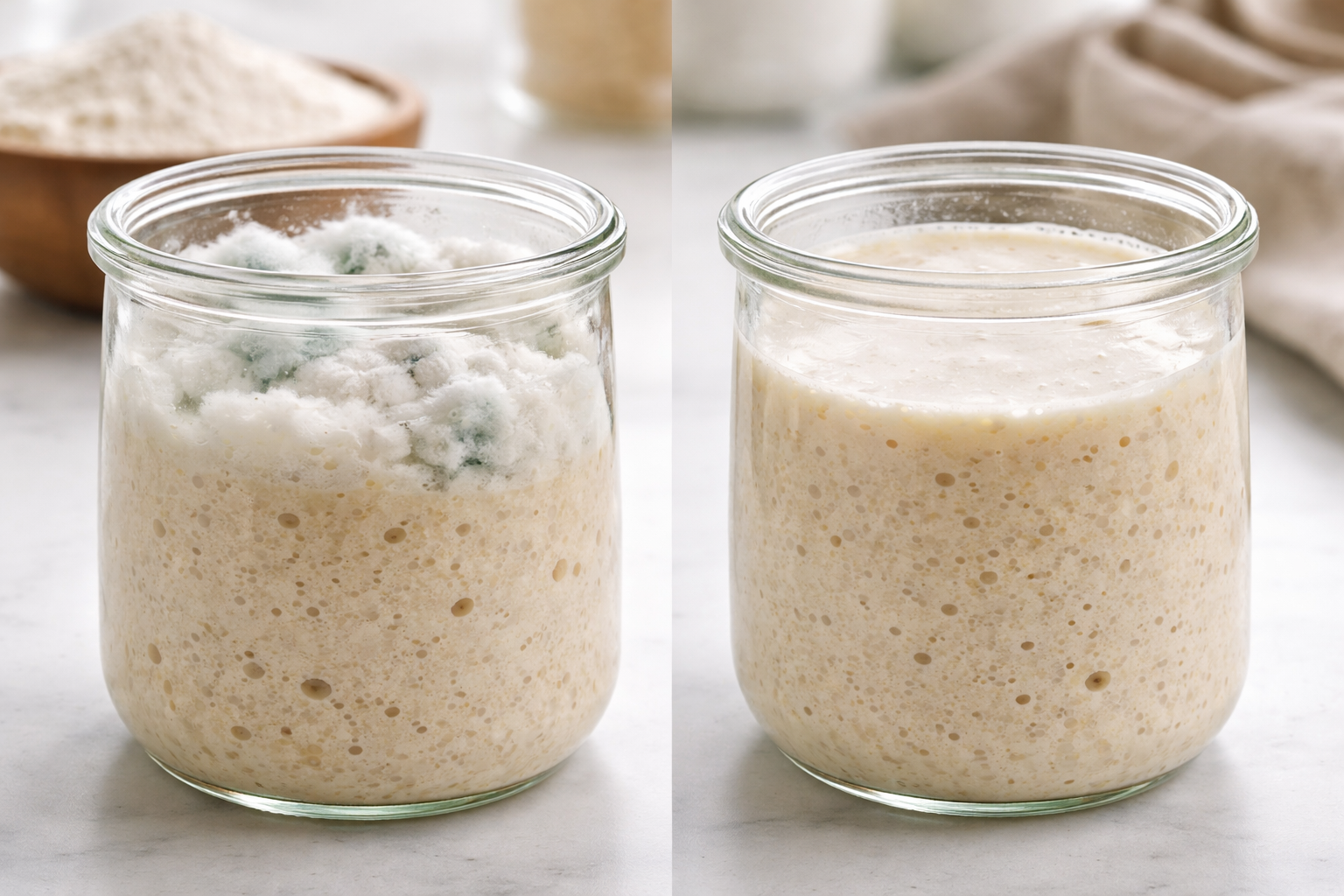
It was 6:47 in the morning, I hadn’t had coffee yet, and I was standing in my kitchen staring at my sourdough starter like it had personally betrayed me. There was something growing on top of it. Something white, flat, and very much not supposed to be there. I immediately grabbed my phone and typed in “mold vs kahm yeast sourdough starter” with shaking hands, because three months of feeding that little jar of flour and water was sitting on the counter, and I was not ready to let it die.
This post contains affiliate links. As an Amazon Associate, I earn from qualifying purchases.
If you have ever had that same heart-drop moment, this post is for you. By the end of that chaotic morning, I had learned more about starter health than I had in the entire previous three months combined. And spoiler alert: my starter survived. More than survived, actually. But let me back up.
The Morning Everything Looked Wrong
I had been neglecting my starter a little. Life had gotten busy, and instead of my usual every-other-day feeding routine, I had let a full five days pass without touching it. It was sitting in a loosely covered jar on my counter, not in the fridge, in a warm kitchen, with a thin layer of hooch on top that I had been planning to deal with “tomorrow” for about four days running. So honestly, I had set the stage for disaster.
When I finally pulled the lid off that morning, I found a thin, white, slightly wrinkled film spread across the entire surface. It was flat, almost papery looking, and it covered the liquid hooch layer underneath like a pale blanket. My stomach dropped. I poured out the hooch and stared harder. Was this fuzzy? Was it raised? Was it the end of everything I had built?
After about forty-five minutes of frantic research, two YouTube rabbit holes, and finally a very patient email from a baker friend, I had my answer. It was almost certainly kahm yeast, not mold. And understanding the difference between the two genuinely changed how I care for my starter.
Mold vs Kahm Yeast on Your Sourdough Starter: How to Actually Tell the Difference
Here is the practical breakdown I wish someone had handed me before that morning.
What Kahm Yeast Looks Like
Kahm yeast is a wild yeast and bacterial film that forms on the surface of fermented foods when conditions are a little off, usually too warm, too much oxygen exposure, or a pH that has shifted. In a sourdough starter, it shows up as a flat, white or cream-colored film. It can look slightly wrinkled or wavy, almost like tissue paper laid on the surface. The crucial detail: it is completely flat against the liquid. There is no fuzziness, no raised height, no dots of color. It smells a bit off, sometimes yeasty and sour, occasionally a touch cheesy, but not truly foul.
What Mold Looks Like
Mold is three-dimensional. It grows upward. You will see fuzzy, raised spots or patches, and they will almost always have color: pink, orange, blue, green, or black. Even white mold has a distinctly fluffy or powdery texture that stands up off the surface. If you see any of those colors or any fuzziness at all, that is mold, and that starter should be discarded. Do not try to scoop it out and save the bottom. Mold produces mycotoxins that can penetrate throughout the jar, and no amount of feeding will reverse that.
The Smell Test Is Your Friend
Kahm yeast smells unpleasant but recognizable, sour, a little funky, maybe slightly alcoholic. Mold smells genuinely rotten, damp, and musty in a way that turns your stomach. If you are not sure what you are looking at, close your eyes and trust your nose. Your body knows the difference between “fermented and funky” and “actually decomposing.”
What I Did to Save My Starter (And What You Should Do Too)
Once I was reasonably confident I was dealing with kahm yeast and not mold, I took action. Here is exactly what I did, and what I recommend if you find yourself in the same situation.
First, I scraped the entire surface layer off and discarded it. I did not try to stir it back in or salvage any of the affected portion. Then I dug down into the starter below the film, took about a tablespoon of the healthy-smelling paste from the bottom of the jar, and transferred it to a clean jar. I fed it at a 1:5:5 ratio, meaning one part starter to five parts flour and five parts water by weight, which creates a more acidic environment that discourages kahm yeast from coming back. I covered it loosely and placed it in a slightly cooler spot in my kitchen.
Within eight hours, it had doubled. The smell was clean and tangy. By the next morning, it was back to its bubbly, predictable self. I nearly cried. I absolutely did a little victory dance in my kitchen slippers.
To prevent a repeat of the whole ordeal, I also made some changes to my storage habits. I started keeping my starter in the fridge between bakes instead of leaving it out for days. I also upgraded my jar situation, because part of my problem was that my old jar did not allow me to see the sides clearly to monitor activity, and the lid was inconsistent about how much air it let in.
My Gear: The Jars That Changed My Starter Routine
Honestly, getting the right container made a bigger difference than I expected. Being able to see your starter clearly, track its rise, and control airflow matters more than most beginners realize. Here are the jars I use and recommend.
- Encheng 32 oz Wide Mouth Mason Jars with Airtight Hinged Lids (Set of 4) — These are the workhorses of my kitchen. The wide mouth makes feeding and scraping down the sides so much easier, and the hinged lid means I always have the lid right there and can control how tightly it seals.
- Anwoi Wide Mouth Glass Jars with Measurement Marks, 32 oz 4 Pack — I love these specifically because of the measurement marks etched right on the glass. After my kahm yeast incident, being able to see exactly where my starter started and how high it rose became a daily habit I will never give up.
- WACOI 32 oz Glass Mason Jars with Clip Top Lids, 6 Pack — If you like having extras on hand so you always have a clean jar ready for transferring your starter, this six-pack is a fantastic value. I keep two in rotation and always have a spare clean one waiting.
- Premium Sourdough Starter Jar, 40 oz with Feeding Band, Thermometer, Scraper, and More — This is the starter jar I wish I had owned from day one. The included thermometer takes the guesswork out of fermentation temperatures, which directly affects how quickly kahm yeast or other issues develop. The feeding band is genius for tracking rise without marking up the glass.
- Lorzon Sourdough Starter Jar Kit, 47 oz with Tracking Band and Silicone Spatula — The larger 47 oz size is great if you keep a bigger starter or want extra headroom to watch a vigorous rise. The silicone spatula included is perfect for scraping every last bit out cleanly, which matters a lot when you are doing a rescue feed.
Quick Tips to Prevent Kahm Yeast From Coming Back
- Store your starter in the fridge if you bake less than twice a week. Cold slows fermentation and dramatically reduces kahm yeast risk.
- Always use clean utensils when feeding. Introducing residue from other foods is one of the most common causes of contamination.
- Do not leave hooch sitting for days. Either stir it back in or pour it off, but do not ignore it.
- Keep your starter in a location where the temperature stays reasonably consistent. Fluctuating warmth encourages kahm yeast.
- Feed on a consistent schedule. A healthy, regularly fed starter has a lower pH that naturally fights off unwanted growth.
That morning that started with me panicking in my kitchen slippers ended with me baking