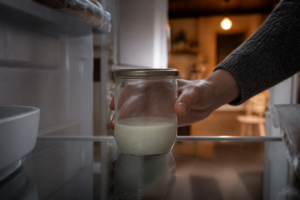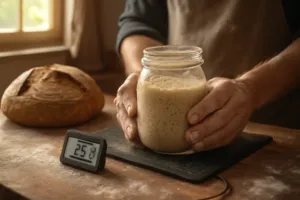

I want to tell you about the morning I stood in my kitchen, nose hovering over my sourdough starter jar, convinced I had somehow created nail polish remover. My sourdough starter smells like acetone, I typed frantically into Google with one hand while fanning the jar away from my face with the other. My husband walked in, took one whiff, and said, “Did you open a salon in here?” Reader, I almost threw the whole thing in the bin.
I didn’t throw it away. And I’m so glad, because what I learned over the next few days completely changed how I understand starter health. If you’re dealing with a starter that smells like acetone, nail polish, sharp cheese, or something vaguely reminiscent of a college dorm room, this post is for you. Stick with me, because there’s a happy ending.
What It Means When Your Sourdough Starter Smells Like Acetone, Cheese, or Nail Polish
Here’s the science in plain English, because once I understood what was actually happening inside that jar, I stopped panicking and started problem-solving.
Your sourdough starter is a living ecosystem of wild yeast and lactic acid bacteria. When everything is balanced and well-fed, it smells pleasantly tangy, maybe a little yeasty, sometimes almost fruity. But when the bacteria get ahead of the yeast, or when the whole culture goes too long without food, the fermentation process shifts. Instead of producing the lactic acid that gives sourdough its signature gentle tang, it starts producing acetic acid and other byproducts, including ethyl acetate, which is the compound responsible for that sharp, solvent-like smell. Ethyl acetate is literally a component of nail polish remover. So no, you are not imagining it, and no, your starter is not haunted.
The cheesy smell is a similar story. Certain strains of bacteria produce butyric acid during fermentation, which is the same compound responsible for the smell of parmesan and, less glamorously, vomit. It sounds alarming. It’s usually not. It’s just a sign that your starter is hungry, stressed, or living in an environment that’s tipping the microbial balance in the wrong direction.
The Most Common Reasons Your Starter Smells Off
When my own starter went rogue, I did a proper audit. Here’s what I found, and what you should check first.
It’s Been Too Long Since the Last Feeding
This was my problem. I had left my starter on the counter during a warm week and completely lost track of time. In warm temperatures, a starter can exhaust its food supply in as little as four to six hours and then sit there in its own acidic waste products for the next eighteen. The longer it sits unfed, the more the acetic acid builds up and the more that acetone smell intensifies. Think of it like leaving a pot of coffee on the burner all day. It starts as something wonderful and slowly becomes a punishable offense.
Your Kitchen Is Too Warm
Warmer temperatures speed up fermentation dramatically. If your kitchen runs above 78 degrees Fahrenheit, your starter may need feeding twice a day instead of once. During summer, I actually moved mine to a slightly cooler corner of my kitchen and the difference was immediate.
The Flour You’re Using Lacks Nutrients
Highly refined white flour is low in minerals and natural sugars compared to whole grain options. If your starter has been living on white flour alone for a long time, it may be struggling to thrive. Adding a small percentage of whole grain flour to your feedings can give the microbial community a real boost.
The Ratio Is Off
If you’re feeding a large amount of starter with a small amount of flour and water, the food runs out too quickly. A common fix is to discard more aggressively before feeding so your ratio of fresh flour to existing starter is more generous, typically 1:1:1 or even 1:2:2 by weight.
The Rye Flour That Turned My Acetone Problem Into My Starter’s Best Feature
That nail polish smell? It often means your starter is hungry and stressed, running on all white flour with nowhere to go metabolically. Adding rye flour to your feeding routine gives your culture a totally different food source, and the smell shifts from alarming to intentional — sometimes even pleasant.
What works
- The organic medium rye in King Arthur’s blend ferments faster and creates a noticeably richer, almost beer-like aroma instead of that harsh acetone bite — my starter went from concerning to characterful within two feedings.
- Rye’s natural enzyme activity actually helps stabilize a struggling starter; I’ve seen sluggish, smelly cultures come back to life when I switched one weekly feeding to a 50/50 blend with this flour.
- It’s organic and widely available, so you’re not hunting down some specialty mill product just to figure out what’s wrong with your jar.
What doesn’t
- Rye is thirstier than all-purpose flour — if you don’t adjust your water ratio when you switch, your starter gets thick and sluggish, which can actually make the smell problem worse temporarily.
- It won’t fix a starter that’s fundamentally neglected or contaminated; if your jar smells like actual mold or vinegar that won’t go away, rye flour is a band-aid, not a solution.
I almost gave up on my acetone starter the first time I fed it rye without adjusting water, and it looked worse before it looked better — but two more feedings in, the transformation was real. King Arthur Organic Medium Rye Flour became the tool that actually got me curious instead of queasy.
This post contains affiliate links. As an Amazon Associate, I earn from qualifying purchases at no extra cost to you.