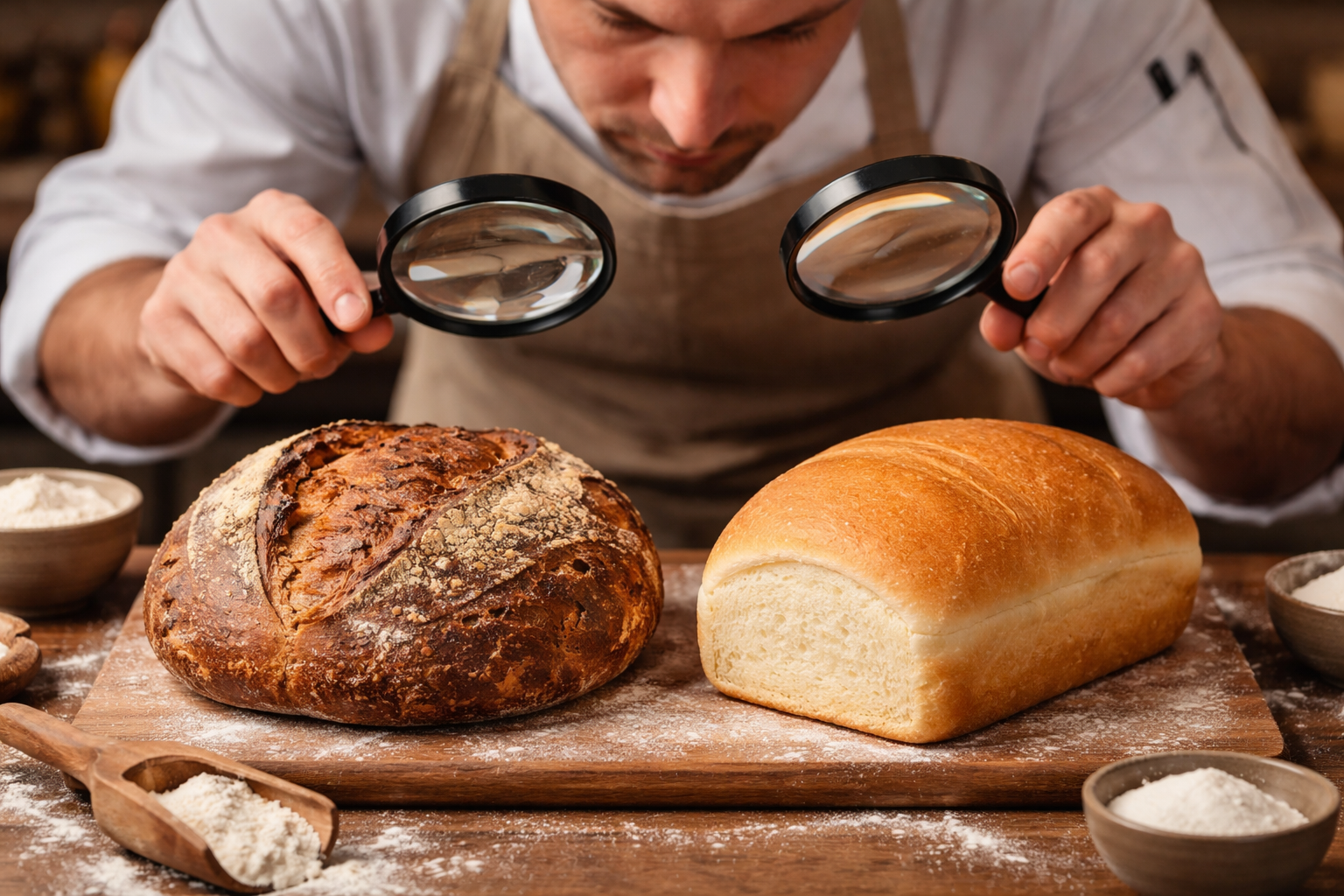
I want to tell you about the Saturday morning I stood in my kitchen holding two identical loaves of bread, completely convinced I had ruined both of them. Flour on my shirt, coffee going cold on the counter, my dog staring at me with what I can only describe as concern. This was my grand experiment into wild yeast vs commercial yeast sourdough, and at that moment, it was not going well. Or so I thought.
This post contains affiliate links. As an Amazon Associate, I earn from qualifying purchases.
I had been baking sourdough for about two years at that point, nursing my starter like a tiny, bubbly pet. But I kept seeing debates online about whether wild yeast truly produces a superior loaf compared to fast-acting commercial yeast. So I decided to settle it myself with a controlled side-by-side bake. What followed was part science experiment, part comedy of errors, and honestly one of the most useful things I have ever done in my baking life.
Why I Decided to Pit Wild Yeast vs Commercial Yeast Sourdough
My starter, whose name is Gerald, was having a rough month. He was sluggish, he smelled a little too vinegary, and three loaves in a row had come out denser than a paperweight. My husband, bless him, had started quietly buying sandwich bread from the grocery store. I noticed. I said nothing. But I noticed.
A fellow baker in my online group suggested I try baking the same recipe twice simultaneously, once with Gerald and once with commercial yeast, to see exactly where the differences showed up. The idea was to isolate the variable. Same flour, same hydration, same shaping technique, same Dutch oven. One loaf fed by wild yeast and lactic acid bacteria built up over months. The other powered by a reliable, predictable packet of commercial yeast from the pantry.
Spoiler: I learned that the differences go way deeper than just flavor, and my embarrassing struggle with Gerald actually had a completely fixable explanation I had been ignoring for months.
What Is Actually Happening Inside Each Dough
Before I get to the bread disaster twist, let me share what this experiment taught me about the science because understanding it genuinely changed how I bake.
Commercial yeast, like Red Star Active Dry Yeast or the ever-reliable Fleischmann’s Active Dry Yeast packets, is a single purified strain of Saccharomyces cerevisiae. It is bred specifically for fast, consistent CO2 production. Proof it, add it to dough, and within a couple of hours you have a well-risen loaf. The process is predictable, repeatable, and frankly very forgiving. For a beginner or a Tuesday night bake when you are tired, this is a genuine gift.
Wild yeast in a sourdough starter is a whole different community. Your starter contains multiple wild yeast strains alongside lactic acid bacteria (LAB), primarily Lactobacillus species. These bacteria produce lactic acid and acetic acid as byproducts of fermentation. That is where sourdough’s signature tang comes from. The wild yeasts work more slowly and at lower temperatures than commercial yeast, which means longer fermentation windows and more complex flavor development happening at the same time as the rise.
The key practical differences come down to three things: timing, flavor, and temperature sensitivity. Wild yeast fermentation can take anywhere from 4 to 16 hours depending on your starter’s strength and your kitchen temperature. Commercial yeast is generally done in 1 to 2 hours. Wild yeast produces organic acids that lower the dough’s pH, improving shelf life and creating that depth of flavor. Commercial yeast produces almost none. And wild yeast slows dramatically below 70 degrees Fahrenheit, while commercial yeast is more tolerant of cooler kitchens.
My Gear for This Kind of Experiment
If you want to do your own side-by-side bake, having the right starter jar matters more than you might think. I wasted months trying to gauge my starter’s rise in an old pasta sauce jar with no markings. Here are the options I actually use and recommend.
For beginners who want everything in one place, the Sourdough Bread Baking Supplies Starter Kit with Date Marked Feeding Band, Thermometer, Silicone Scraper, Sewn Cloth Cover, and Aluminum Lid is genuinely excellent. The date-marked feeding band alone is worth it because you can actually track when your starter peaked, which is critical for timing your bake correctly.
If you want a straightforward glass jar with a wide mouth for easy feeding, the INOBYO 24 OZ Wide Mouth Sourdough Starter Jar is a beautiful, practical option that works for beginners and experienced bakers alike.
My personal daily driver right now is the Brod and Taylor Sourdough Starter Jar (32oz), which is fully dishwasher safe, has clear measurement markings, and has a loose-fitting lid that prevents pressure buildup. That last feature matters because I have definitely had a tightly sealed lid pop off a very active starter at 7am, which was both startling and deeply unpleasant.
The Embarrassing Twist That Changed Everything
Back to that fateful Saturday. I mixed both doughs early in the morning. The commercial yeast dough was visibly puffy and pillowy within two hours. Gerald’s dough sat there looking flat and slightly resentful. I poked it. Nothing. I covered it and gave it another two hours. Still sluggish. I baked both loaves anyway because at that point I had committed to the experiment.
The commercial yeast loaf was gorgeous. Tall, open crumb, lovely ear on the score. Gerald’s loaf was a dense little hockey puck with a pale crust and the structural integrity of wet cardboard.
I posted a photo to my baking group half as a joke and half out of genuine defeat. Within about ten minutes someone asked me what temperature my kitchen had been that morning. I looked at my thermometer. Sixty-four degrees Fahrenheit. My house had been cool all week and I had not thought about it once.
Wild yeast fermentation slows dramatically below 70 degrees. My starter had not been sluggish for a month because something was wrong with Gerald. Gerald was cold. I had been underfeeding a perfectly healthy starter while blaming him for my cold kitchen. I felt genuinely terrible about this, and I did apologize to him out loud. My husband witnessed this. He did not comment.
The fix was simple. I started proofing Gerald near my oven light, monitoring temperature with the thermometer from my starter kit, and targeting bulk fermentation at 75 to 78 degrees. The following weekend I did the experiment again. This time Gerald’s loaf rose beautifully, developed a crackling crust, and had a mild, complex tang that the commercial yeast loaf simply could not match. My husband tried both slices, paused, and said, “Okay, the homemade one is actually better.” The store-bought bread has not reappeared since.
Practical Tips for Your Own Wild Yeast vs Commercial Yeast Sourdough Comparison
If you want to run this experiment yourself, here is what I would tell you to keep in mind.
- Use identical recipes for both loaves, same flour weight, same hydration percentage, same salt amount.
- Substitute your starter at a ratio that accounts for the flour and water it contains. A common guideline is 200g of active starter replacing roughly 100g flour and 100g water in the recipe, plus about 1/4 teaspoon commercial yeast as the equivalent leavening force.
- Monitor your kitchen temperature consistently. Wild yeast needs 75 to 78 degrees Fahrenheit for reliable bulk fermentation. Use a probe thermometer or the one included in your starter kit.
- Use the float test or the dome test to judge when each dough is ready, not the clock alone. The commercial yeast dough will be ready much faster.
- Taste both loaves side by side after they have cooled completely, at least one hour out of the oven. The flavor difference is most apparent at room temperature.
- Keep notes. Write down your starter’s peak time, dough temperature at the end of bulk, and bake time. This data becomes incredibly useful when you start troubleshooting.
What I Take Away from This Now
The wild yeast vs commercial yeast sourdough debate is not really about which one is better. It is about what you are trying to achieve on any given bake. Commercial yeast is a reliable, fast, and genuinely excellent tool. I still use it for pizza dough on week