
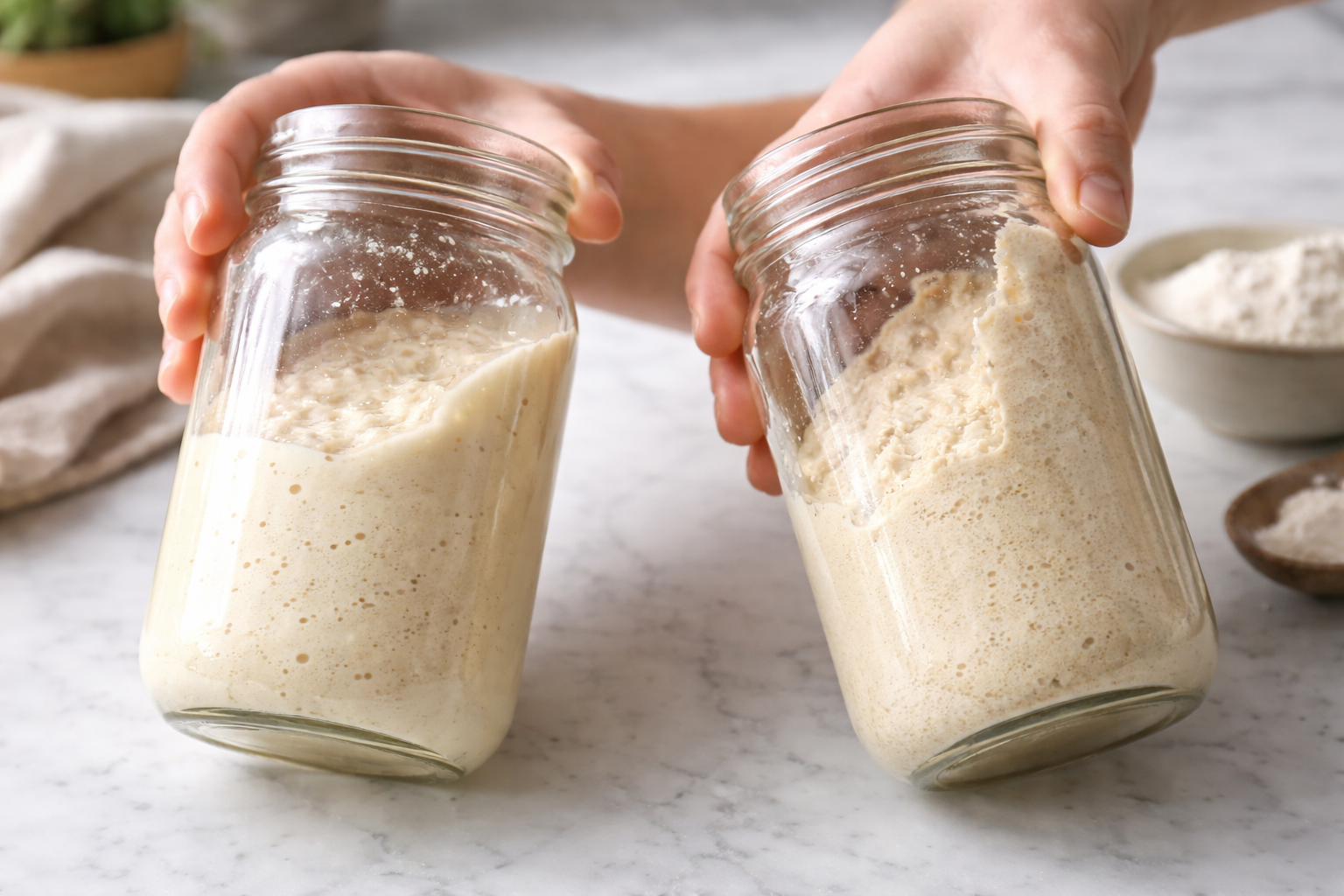
I want to tell you about the morning I confidently announced to my husband that my sourdough starter had “really come into its own” — right before I picked up the jar and accidentally poured half of it down the front of my pajamas. It had the consistency of gray pancake batter, it smelled vaguely like nail polish remover, and I had absolutely no idea what I’d done wrong. If you’ve ever stared at your jar wondering whether your sourdough starter too runny too thick situation is normal, fixable, or a sign that you should just order bread from the bakery down the street, this post is for you.
This post contains affiliate links. As an Amazon Associate, I earn from qualifying purchases.
Why Starter Consistency Actually Matters
Here’s the thing nobody told me when I started this journey: the consistency of your starter isn’t just an aesthetic preference. It directly affects fermentation speed, flavor development, and how your finished bread turns out. A starter that’s too runny tends to ferment faster and can become overly acidic very quickly, producing that harsh, vinegary smell I was so intimately familiar with. A starter that’s too thick ferments more slowly, can trap gas unevenly, and sometimes struggles to reach its full rise potential. Both extremes are fixable. Neither one means your starter is dead. I promise.
The magic number you’ll keep hearing about is hydration percentage. This is simply the ratio of water to flour in your starter, calculated by weight. A 100% hydration starter means equal parts water and flour by weight. That gives you a thick, scoopable consistency — something like a very stiff peanut butter or a paste that holds its shape when you drop it from a spoon. A 125% hydration starter (more water than flour) is looser and pourable, more like a thick pancake batter. Both styles have devoted fans, and both can produce incredible bread. The key is knowing what you’re aiming for and being consistent about it.
Is Your Sourdough Starter Too Runny or Too Thick? Here’s How to Tell
Before you can fix anything, you need to know what you’re actually working with. And I say this as someone who spent three weeks eyeballing her ratios and wondering why every loaf came out different: please, please start weighing your ingredients. It changed everything for me. But let’s talk about what each problem actually looks like first.
Signs Your Starter Is Too Runny
- It pours easily from the jar rather than plopping or stretching
- It smells sharply acidic or like acetone, especially a few hours after feeding
- It rises quickly but deflates just as fast, and the peak is hard to catch
- The bubbles are large and uneven rather than small and distributed throughout
- You notice liquid (hooch) pooling on top more frequently than usual
Signs Your Starter Is Too Thick
- It looks more like dough than batter, stiff and hard to stir
- It rises slowly or inconsistently and doesn’t show a clear peak
- The surface cracks or dries out between feedings
- It smells pleasantly sour but never seems very active or lively
- It’s difficult to incorporate into dough because it clumps rather than blends
How to Fix Starter Hydration — The Simple Way
Good news: adjusting starter hydration is genuinely one of the easier fixes in sourdough baking. You don’t need to throw anything out or start from scratch. You just need to adjust your feeding ratios intentionally over two or three feedings and let the starter recalibrate.
To Thicken a Runny Starter
At your next feeding, reduce the water you add and increase the flour slightly. If you’ve been feeding equal weights of water and flour, try shifting to 80g of water for every 100g of flour. This brings you down toward 80% hydration, which is noticeably stiffer. Maintain this ratio for two or three feedings and you’ll see the texture change. Once you hit a consistency you like, find your ratio and stick with it. Consistency is genuinely more important than which hydration level you choose.
To Loosen a Stiff Starter
Go the opposite direction. Add a bit more water at each feeding. If you’ve been doing equal parts, bump your water to 120g per 100g of flour. Stir it thoroughly so everything is fully incorporated — a stiff starter can resist mixing and you want no dry clumps hiding in there. After two or three feedings at the new ratio, your starter should be noticeably more active and easier to work with.
One Absolute Rule: Use a Scale
I can not stress this enough. Measuring flour and water by volume (cups and tablespoons) introduces so much variability that you’ll never truly know what hydration your starter is at. A packed cup of flour and a sifted cup of flour can differ by 30 grams or more. That difference absolutely matters here. Weigh everything, every time, and your starter will reward you for it.
My Gear: What I Actually Use
These are the tools sitting on my actual kitchen counter right now. No fluff, just the things that genuinely helped me stop guessing and start baking with confidence.
For weighing, I rotate between a couple of scales depending on what I’m doing. The Etekcity Food Kitchen Scale with LCD Display is my everyday workhorse. It’s simple, accurate, and the stainless steel surface is easy to wipe down. When I want something with a little more precision for smaller quantities, I reach for the Etekcity Digital Food Kitchen Scale with USB Recharging, which measures in 0.05oz increments and is actually waterproof, which I discovered the hard way one very sloppy feeding session. And if you’re looking for something with a bit more visual flair on the counter, the Nicewell Food Scale with Tempered Glass is beautiful and accurate with a 22lb capacity so it handles big baking days easily.
For the starter itself, I’ve been obsessed with the Brod and Taylor Sourdough Starter Jar. The measurement markings on the side make tracking rise so much easier, and the loose-fitting lid means I’m not accidentally creating a tiny fermentation bomb on my counter. If you want a slightly smaller option or a backup jar, the INOBYO 24oz Wide Mouth Sourdough Starter Jar is a great value and the wide mouth makes stirring and cleanup genuinely painless.
The Pajama Story Has a Happy Ending
So here’s what actually happened after the Great Starter Cascade of a Tuesday morning. Once I’d changed clothes and stopped laughing (it took a minute), I sat down and actually looked up what a proper 100% hydration starter should look like. I weighed my discard for the first time ever. I had been adding water almost entirely by feel, which meant my hydration was probably somewhere north of 130% on a good day. No wonder the thing moved like a liquid. I adjusted my feeding ratios deliberately over the next three days, using my scale every single time, and by day four I had a starter that held its shape, smelled beautifully tangy and mild, and peaked reliably about five hours after feeding. I made a loaf that weekend that my husband declared the best thing I had ever baked. He ate half of it standing at the counter before it had even properly cooled.
If you’re dealing with a sourdough starter too runny too thick situation right now, I want you to know it is almost certainly not ruined. Start weighing your feeds, make small adjustments over a few days, and watch what happens. Your starter is more resilient than you think, and honestly, so are you. Now go check on that jar and let me know in the comments how it’s looking — I genuinely want to hear about it.