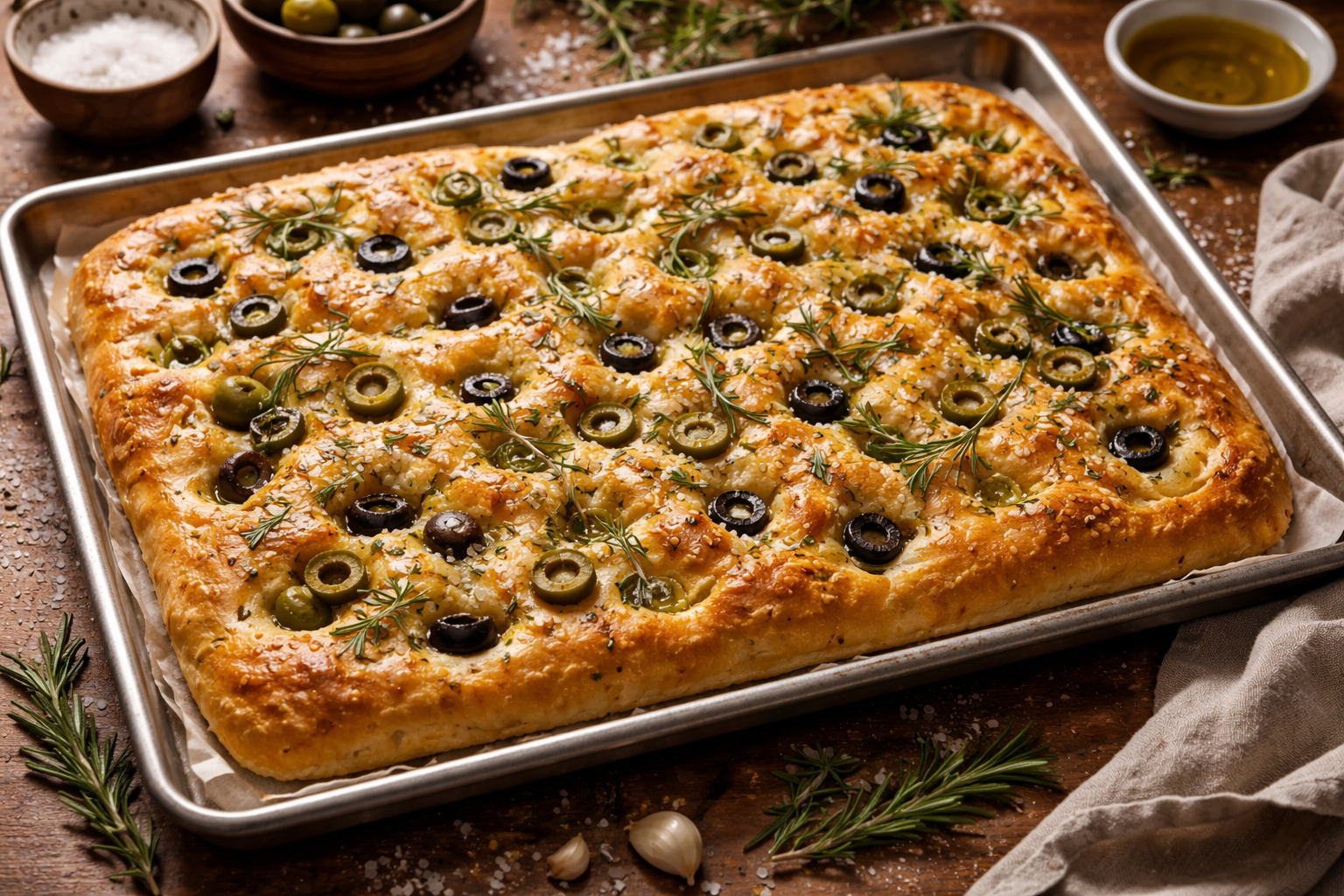
I want to tell you about the time I brought a “rustic artisan focaccia” to my neighbor’s dinner party and accidentally set it down directly on her brand-new linen tablecloth, leaving a perfect olive oil ring the size of a dinner plate. I stood there holding my masterpiece, watching the oil spread in slow motion, and all I could manage was, “So… it’s extra hydrated.” That, my friends, is how this sourdough focaccia recipe became my signature dish. Nothing like a little public humiliation to really commit you to perfecting something.
This post contains affiliate links. As an Amazon Associate, I earn from qualifying purchases.
Here’s the wild part though. Despite the tablecloth incident (RIP, beautiful linen), my neighbor took one bite of that focaccia and immediately asked me for the recipe. Then her husband asked. Then their guests asked. I drove home that night feeling equal parts mortified and genuinely proud, and I thought: okay, this bread clearly has something going for it. I just need to work on my spatial awareness.
Why Focaccia Is the Perfect Gateway to Sourdough Baking
If you have ever felt intimidated by sourdough, I am here to tell you that focaccia is the antidote. There is no shaping, no scoring, no holding your breath while you wrestle a boule into a screaming hot Dutch oven. You mix the dough, you let it do its thing in a pan, you dimple it with your fingers (genuinely one of the most satisfying things in baking), and you bake it. The whole process is forgiving in a way that sourdough loaves sometimes are not, and the results are consistently stunning. We are talking golden, crispy-bottomed, pillowy-centered, olive-oily perfection every single time.
The sourdough starter adds something a commercial yeast focaccia simply cannot replicate: a gentle, complex tang and a depth of flavor that makes people stop mid-conversation to say, “Wait, what IS this?” That is the moment every home baker lives for.
What You’ll Need for This Sourdough Focaccia Recipe
Let me walk you through the gear and ingredients I rely on, because the right tools genuinely make a difference here, especially when it comes to the pan.
The Pan: Non-Negotiable
Focaccia lives and dies by its pan. You need something that conducts heat evenly, will not warp in a high oven, and gives you that gorgeous crispy bottom. I use the Nordic Ware Naturals Half Sheet Pan (1-Pack) and I honestly cannot say enough good things about it. Made in the USA, heavy-gauge aluminum, with an encapsulated steel rim that prevents warping. It heats evenly, cleans up easily, and it has survived my oven’s hottest days without buckling. If you bake often, the Nordic Ware Naturals Half Sheet 2-Pack is a great investment so you always have a clean one ready. I also keep the Umite Chef Warp Resistant Baker’s Half Sheet Pan Set (2-Pack) on hand as a reliable backup. Both sets are the standard 18×13 half-sheet size, which is exactly what you want for this recipe.
The Olive Oil: Also Non-Negotiable
Focaccia is basically an olive oil delivery system, so please do not use the sad bottle that has been in your pantry since 2019. I use Atlas Cold Press Extra Virgin Olive Oil from Morocco, which is polyphenol-rich, newly harvested, and unprocessed from a single family farm. It is the kind of olive oil that has actual flavor and a gorgeous peppery finish. They also make a convenient 500 mL bottle of Atlas Organic Cold Pressed Moroccan EVOO if you want to try it before committing to a larger size. Trust me: good olive oil is what makes focaccia extraordinary rather than just good.
Other Essentials
- Active, bubbly sourdough starter (fed 4 to 6 hours before mixing)
- Bread flour or all-purpose flour (bread flour gives a chewier crumb)
- Fine sea salt plus flaky salt for topping
- Warm water
- Toppings of your choice: rosemary, olives, cherry tomatoes, flaky salt
How to Make Sourdough Focaccia: Step by Step
The Dough
In a large bowl, combine 500g bread flour, 375g warm water, 100g active starter, and 10g fine sea salt. Mix until no dry flour remains. This is a high-hydration dough, around 75 percent, so it will feel loose and sticky. That is completely correct. Do not add more flour.
Cover the bowl and let the dough rest for 30 minutes. Then perform 3 to 4 rounds of stretch and folds over the next 2 hours, about 30 minutes apart. Each set involves grabbing one side of the dough, stretching it up, and folding it over the center. Rotate the bowl and repeat on all four sides. After your last set, cover and let the dough bulk ferment at room temperature until it has grown by about 50 to 75 percent and looks bubbly and alive. Depending on your kitchen temperature and the strength of your starter, this typically takes 6 to 10 hours.
The Pan Proof
Pour a generous amount of olive oil into your sheet pan. We are talking at least 4 tablespoons. Do not be shy here. Turn the dough out into the pan and gently coax it toward the edges. It will resist. That is fine. Let it rest uncovered for 30 minutes, then try again. The dough will relax and spread more easily. Cover loosely and refrigerate overnight, or let it proof at room temperature for another 2 to 4 hours until it looks puffy and pillowy.
The Dimpling and Baking
Preheat your oven to 450 degrees Fahrenheit. Drizzle more olive oil over the top of the dough because you have come this far and you are committed. Then comes the fun part: press your fingers firmly and evenly into the dough to create those signature deep dimples. You want to go all the way down but not through. Add your toppings, sprinkle generously with flaky salt, and slide the pan into the hot oven.
Bake for 22 to 28 minutes until the top is deeply golden and the edges are pulling away from the pan. Let it cool in the pan for 5 minutes, then transfer to a wire rack. Resist cutting it immediately. Ten minutes of patience will give you a much cleaner slice and a better crumb.
A Few Tips That Made All the Difference for Me
- The cold overnight proof in the fridge is my favorite method. It slows fermentation beautifully and develops incredible flavor.
- If your focaccia is browning too quickly on top before the bottom crisps up, move the pan to the lower rack for the last 5 minutes.
- Leftover focaccia (if you have any) makes the most outrageously good sandwich bread the next day.
- A well-oiled, quality pan like the Nordic Ware half sheet is what gives you that crispy, almost fried bottom crust. Do not underestimate this step.
The Happy Ending (And Why I Still Bring This Everywhere)
So here is the rest of the tablecloth story. My neighbor actually reached out a week later to tell me she had tried this sourdough focaccia recipe herself using the instructions I emailed her, and it came out beautifully. She brought it to her own book club. She said three people asked her if she had bought it from a bakery. She also, in the same message, mentioned she had decided the tablecloth was “due for retirement anyway.” I choose to believe her.
This bread has a way of doing that: turning small disasters into something worth talking about. It is generous and forgiving in the pan, it rewards good ingredients, and it genuinely makes people happy. Whether you are brand new to sourdough or you have been baking for years