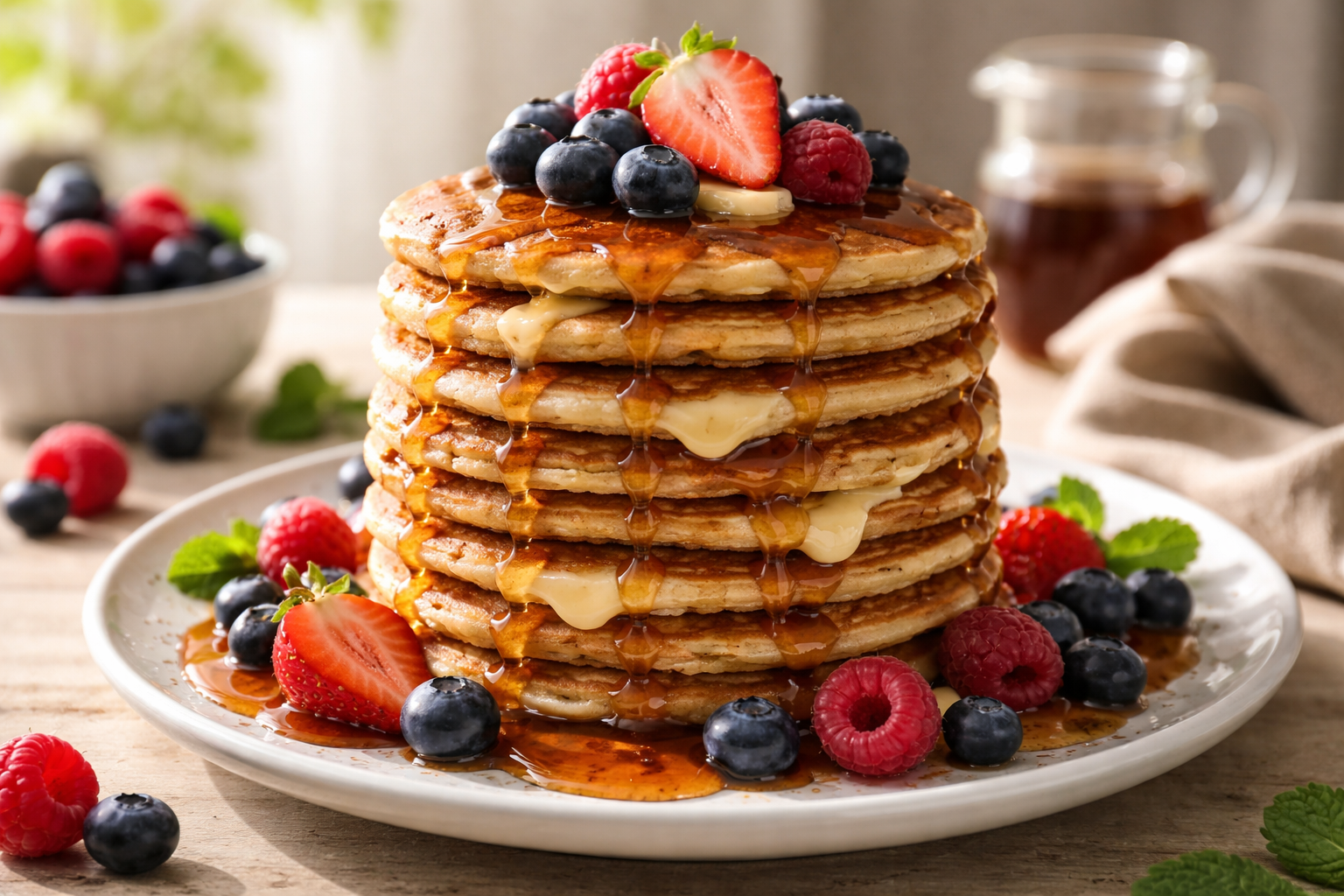
I want to tell you about the Saturday morning I accidentally served my family what I can only describe as sourdough frisbees. Flat, dense, vaguely rubbery discs that my husband cheerfully described as “interesting” while my kids pushed them silently around their plates. I had been so proud of myself for finally using up my discard instead of throwing it away, and yet there I was, watching my seven-year-old try to fold one in half like a sad little taco. That disaster, embarrassing as it was, is exactly what sent me down the rabbit hole of perfecting sourdough discard pancakes — and I am so glad it did.
This post contains affiliate links. As an Amazon Associate, I earn from qualifying purchases.
Because here is what I know now that I did not know that fateful frisbee morning: sourdough discard pancakes are not just a clever way to use up the stuff you would otherwise scrape into the trash. They are genuinely, legitimately better than regular pancakes. Tangier, more complex, with a tenderness in the crumb that boxed mix simply cannot replicate. Once I figured out what I was doing wrong — and oh, there were several things — these became an absolute non-negotiable part of our weekend routine. Every single Saturday, without fail.
What Went Wrong (And What I Finally Learned)
Let me walk you through my crimes against pancakes so you do not have to repeat them.
My first mistake was using discard that was way too old and acidic. I had let mine sit in the fridge for nearly two weeks without feeding, and it smelled sharp enough to strip paint. That level of acidity interfered with my leavening and left the batter fighting itself. The sweet spot for discard pancakes is discard that is anywhere from a few days to about a week old. It should smell pleasantly tangy, not aggressively sour or alcoholic.
My second mistake was overmixing. I stirred and stirred, trying to get every single lump out, which developed the gluten and made my pancakes tough. The rule with any pancake batter is to mix until just combined. Lumps are your friends. Embrace the lumps.
My third and most consequential mistake was my pan. I was using a thin nonstick skillet that heated unevenly and ran too hot in the center. The outsides burned before the insides cooked through, and because the heat was uneven, some pancakes puffed beautifully while others just sort of gave up on life. Switching to a cast iron griddle genuinely changed everything for me, and I will get into that below.
My Go-To Sourdough Discard Pancakes Recipe
This is the recipe I have been making on repeat since I finally cracked the code. It is simple, forgiving, and endlessly customizable. You can add blueberries, a little cinnamon, a splash of vanilla — the base recipe handles additions beautifully.
Ingredients
- 1 cup sourdough discard (unfed, straight from the fridge is fine)
- 1 cup all-purpose flour
- 1 cup buttermilk (or whole milk with a tablespoon of lemon juice stirred in)
- 1 large egg
- 2 tablespoons melted butter, plus more for the griddle
- 1 tablespoon sugar
- 1 teaspoon baking powder
- 1/2 teaspoon baking soda
- 1/2 teaspoon salt
Instructions
Whisk together the discard, buttermilk, egg, and melted butter in a large bowl. In a separate bowl, whisk together the flour, sugar, baking powder, baking soda, and salt. Pour the dry ingredients into the wet and fold gently until just combined. The batter will be a little lumpy and that is completely correct. Let it rest for five to ten minutes while your griddle heats up. This rest time matters — it lets the baking soda start reacting with the acidity in the discard and gives you better lift.
Heat your griddle over medium to medium-low heat, add a small knob of butter, and pour about a quarter cup of batter per pancake. Cook until bubbles form across the surface and the edges look set, about two to three minutes, then flip once and cook for another minute or two. Do not press them down. Do not peek constantly. Just trust the process, as they say in sourdough circles.
What You Will Need: My Favorite Gear for Perfect Pancakes
Gear genuinely matters here, and I want to save you from my early frisbee era. After trying a few different setups, I have landed on cast iron as the absolute best surface for sourdough discard pancakes. The even heat retention means consistent browning, no hot spots, and that gorgeous golden crust that makes a pancake actually worth eating.
For most Saturday mornings when I am cooking for four, I reach for the Lodge Double Play Reversible Cast Iron Grill/Griddle. The dual-burner configuration means I can cook six to eight pancakes at once, which is the only way to feed a hungry family without someone always eating cold pancakes while you stand at the stove. It is heavy, yes, but that weight is exactly what gives you such steady, even heat.
If you are cooking for one or two, or you just want something a little more manageable, the Lodge Round Seasoned Cast Iron Griddle, 10.5 Inches is a wonderful option. It fits over a single burner, preheats evenly, and gets a beautiful sear on pancakes without any fuss. I also keep the smaller Lodge Cast Iron Griddle, 8 Inch Round on hand for those lazy mornings when it is just me, a cup of coffee, and three pancakes I do not intend to share with anyone.
And then there is the syrup situation. I am a little particular about this. I do not believe in drowning a beautifully tangy sourdough pancake in corn syrup dressed up in a plastic bottle. Real maple syrup is non-negotiable in this house, and the Butternut Mountain Farm Pure Vermont Maple Syrup, Grade A Dark Robust is my personal favorite. The deep, almost caramel-like flavor plays beautifully against the tang of the sourdough in a way that lighter syrups simply do not. If you prefer something a little more classic and delicate, their Grade A Amber Rich Taste maple syrup is equally wonderful and the easy-pour jug means no sticky cap disasters at the breakfast table, which in my house counts as a genuine quality of life improvement.
A Few Tips That Will Change Your Pancake Game
Beyond the recipe itself, a few habits have made a real difference in my results every week.
- Do not skip the batter rest. Five to ten minutes of resting activates your leavening and results in noticeably fluffier pancakes.
- Keep your heat on the lower side. Medium to medium-low is your friend. High heat burns the outside before the inside cooks through.
- Only flip once. Resist the urge to flip and flip again. One flip, then hands off.
- Your first pancake is always a test pancake. Every cook knows this. Eat it standing at the stove and adjust your heat accordingly. This is one of life’s quiet pleasures.
- If your batter thickens as it sits, add a small splash of milk to loosen it. Discard continues to absorb liquid as it rests.
The Saturday Morning Redemption Arc
A few weeks after the Great Frisbee Incident, I tried again. New discard, gentler mixing, proper cast iron griddle preheated low and slow, a short batter rest, and real maple syrup standing by like a reward I had genuinely earned. My husband walked into the kitchen, sniffed the air, and said, “Okay, that actually smells incredible.” My youngest, the same child who had folded my previous attempt into a taco, ate four pancakes and asked if we could have them for dinner too.
That is the thing about so