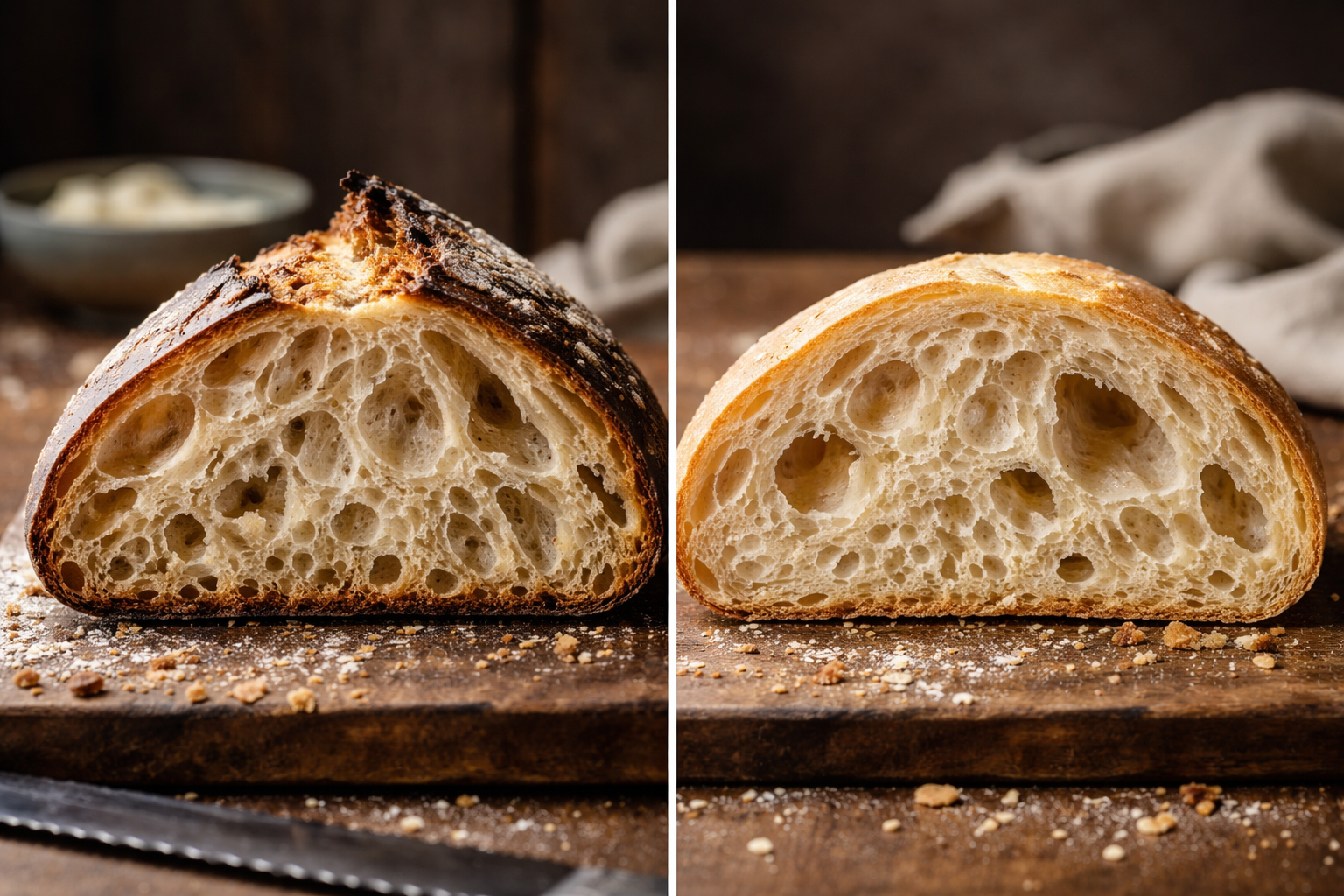
I pulled my sourdough out of the Dutch oven, set it on the cooling rack, and actually did a little victory dance in my kitchen. Then I knocked it off the rack. It hit the tile floor with a sound that I can only describe as someone dropping a bowling ball, bounced twice, and rolled under the stove. That crust was not thick. That crust was basically a helmet. If you have ever dealt with a sourdough crust too thick or too thin situation, I promise you, this post is for you — and yes, the story gets better from here.
This post contains affiliate links. As an Amazon Associate, I earn from qualifying purchases.
Crust problems are honestly one of the most frustrating parts of sourdough baking because they feel so final. You have already waited 24 hours, you have done your folds, you have shaped with care, and then the oven gives you something that is either shattering under a butter knife or collapsing like wet cardboard the moment you breathe on it. Neither is fun. But both are fixable once you understand what actually caused the problem, and that is exactly what we are going to dig into today.
My Gear: What I Use to Bake Better Sourdough
Before we get into the diagnosis, let me share the tools that made a real difference in my own crust troubleshooting journey. Having the right gear eliminated a lot of guesswork for me.
First, a good Dutch oven is everything. I bake in the Umite Chef 5QT Enameled Cast Iron Dutch Oven in Cream White, and I am genuinely obsessed with it. The heavy lid traps steam perfectly, the enamel makes cleanup easy, and it comes with cotton potholders, which is a small but very appreciated touch. If cream white is not your style, it also comes in a gorgeous bold red and a beautiful deep green. All three are 5QT, heavy-duty, and absolutely built for bread baking.
Second, oven thermometers saved my crust life. My oven runs about 25 degrees cooler than the dial says, which I only discovered after months of mystery problems. I keep the Rubbermaid Commercial Stainless Steel Oven Thermometer in there full time now. The AcuRite Stainless Steel Oven Thermometer is another great option that reads up to 600°F and is super easy to read at a glance. Honestly, do not bake another loaf without one of these in your oven.
Diagnosing a Sourdough Crust Too Thick: What Went Wrong
Back to my armored loaf. After I retrieved it from under the stove and actually tasted it, the inside was genuinely lovely. The crust, though, was so thick and hard that my husband quietly suggested we use it as a doorstop. Lovingly. He said it lovingly.
A thick, hard, overdeveloped crust usually comes down to a few specific causes.
Too Much Time Uncovered in the Oven
The two-phase baking method exists for a reason. You bake covered first to trap steam, which keeps the surface of the dough soft and allows the loaf to expand. Then you uncover to develop color and set the crust. If you bake uncovered for too long, the crust keeps hardening and thickening past the point of pleasantness. The standard approach is about 20 minutes covered at a high temperature, then 20 to 25 minutes uncovered. If your crust is coming out like armor plating, try reducing your uncovered time by five minutes and see what changes.
Oven Temperature Is Too High
This was my actual problem that day of the floor bounce incident. I thought I was baking at 475°F. My oven thermometer told me I was actually baking at almost 510°F. That extra heat was creating a crust that set too fast and too hard. Get an oven thermometer. I cannot say this enough. Your oven dial is almost certainly lying to you.
Low Hydration Dough Without Enough Steam
Lower hydration doughs are naturally more prone to a thick, hard crust if they do not get enough steam during the first phase of baking. Make sure your Dutch oven lid is sealing well and that you preheat the Dutch oven fully before your dough goes in. A cold Dutch oven means the steam environment is slow to develop, and your crust suffers for it.
Diagnosing a Sourdough Crust Too Thin: The Other Side of the Problem
The opposite problem is just as demoralizing. You pull out a loaf that looks beautiful, the color is perfect, you wait (mostly) patiently for it to cool, you finally cut into it, and the crust just kind of crumbles or goes soft within an hour. You press the top of the loaf and it gives like a slightly stale pillow. Not exactly the crackling sourdough experience you were dreaming about.
Too Much Steam or Covered Too Long
If you bake covered for too long, the crust never gets the dry heat it needs to develop properly. The steam phase should soften the surface just enough to let the loaf spring and bloom. After that, you need dry oven heat to set and crisp the crust. If you are regularly going 30 or more minutes covered, try pulling the lid off at the 20-minute mark instead.
Cooling in a Closed Environment
This one surprises a lot of home bakers. If you cool your loaf inside the Dutch oven, in a closed oven, or wrapped in a towel right away, the steam from the inside of the loaf has nowhere to go. It condenses back onto the crust and softens it. Always cool your loaf on an open wire rack with airflow all around it, and give it a full hour before you cut in. That cooling time matters more than most people realize.
Oven Temperature Too Low
If your oven is running cold, the crust may not ever reach the temperature it needs to properly set and develop that characteristic snap. This is the flip side of the hot oven problem, and again, an oven thermometer is the only reliable way to know what is actually happening in there. A well-developed sourdough crust needs real, sustained heat.
High Hydration Dough Challenges
Very high hydration doughs have more moisture to drive off before the crust can set. If your formula is 80% hydration or above, you may need a few extra minutes of uncovered baking time to fully set the crust. Watch the color, not just the clock. You want a deep, rich amber brown, not a pale golden.
A Quick Reference: Sourdough Crust Too Thick or Too Thin
- Crust too thick and hard: reduce uncovered baking time, verify oven temperature, ensure Dutch oven is fully preheated
- Crust too thin and soft: reduce covered baking time, always cool on an open rack, verify oven is reaching full temperature
- Both problems: check your oven thermometer first before changing anything else
- High hydration doughs may need slightly longer uncovered time to set the crust
- Low hydration doughs need strong initial steam to prevent an overly thick, tough crust
The Happy Ending (and Why I Still Smile at That Loaf)
Here is the twist I promised you. After I retrieved the bowling ball loaf from under the stove, brushed it off (do not tell anyone), and actually sat down with a thick slice of it, my neighbor knocked on the door. She could smell it from next door, she said. She came in, I cut her a slice, and she declared it the best bread she had ever eaten in her life. The inside was genuinely incredible, creamy and tangy and perfectly chewy. She asked me for the recipe. She called her sister to tell her about it.
I did not have the heart to mention that the crust had recently been used as informal floor tile. I just smiled and wrote down the recipe.
After that I installed my oven thermometer, adjusted my uncovered baking time down by five minutes, and the very next loaf had a crust that was genuinely perfect