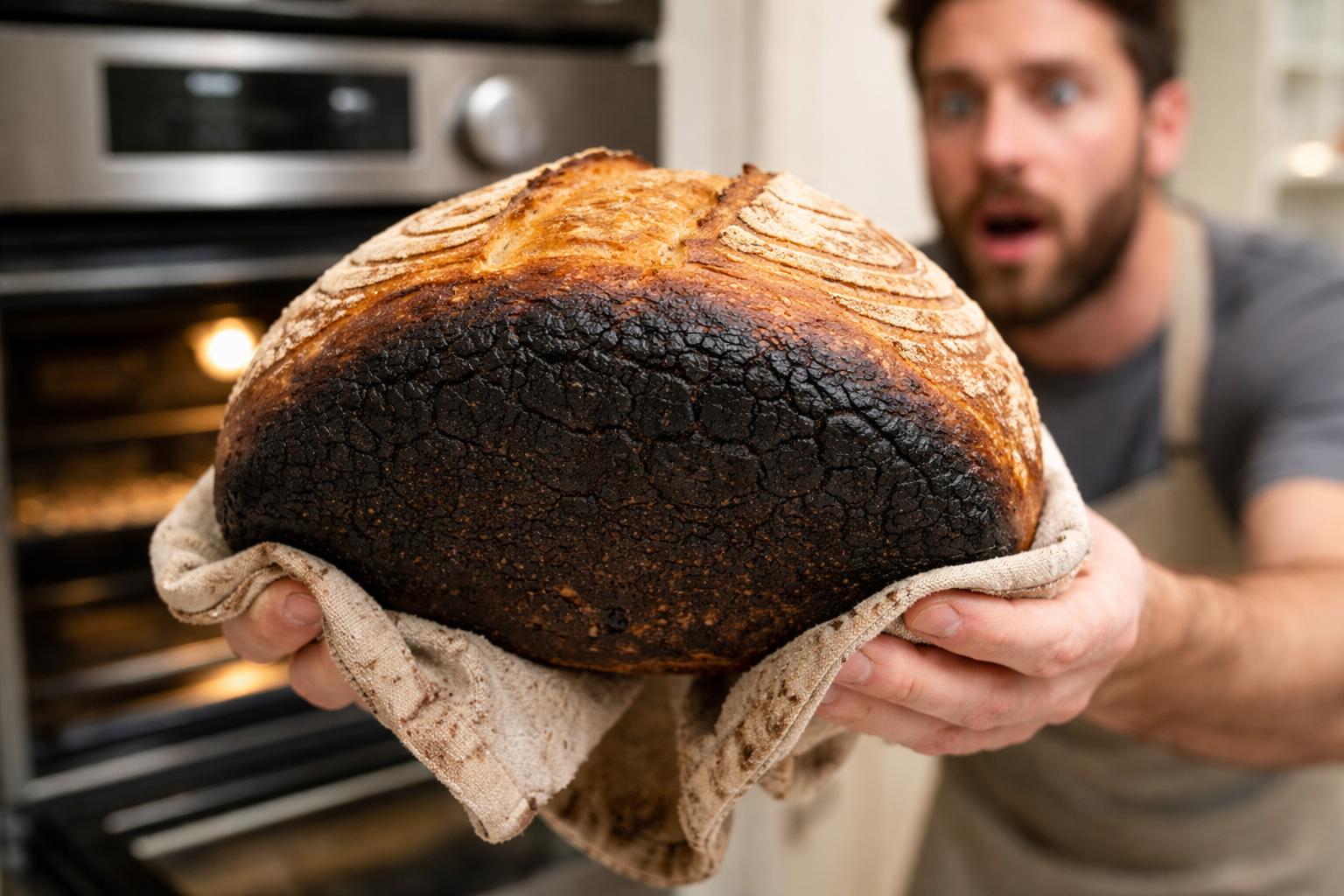
I pulled my Dutch oven out of the oven, set it on the counter, and lifted the lid with the kind of dramatic flair you only develop after months of sourdough obsession. The top of my loaf? Pale, soft, barely kissed with color. The bottom? A crime scene. A perfect, pitch-black, smoke-alarm-triggering crime scene. This was the third time in a row my sourdough bottom burns had ruined what should have been a beautiful bake, and I was officially losing my mind.
I did what any reasonable person does when they can’t figure something out: I blamed the recipe, then the flour, then Mercury being in retrograde. It took me an embarrassingly long time to consider that the villain in this story might actually be my own oven.
This post contains affiliate links. As an Amazon Associate, I earn from qualifying purchases.
Why Sourdough Bottom Burns Happen (And Why Your Oven Is Probably Lying to You)
Here is the thing nobody tells you when you first get into sourdough baking: your oven’s built-in temperature dial is basically decorative. I am only slightly exaggerating. Most home ovens run anywhere from 25 to 75 degrees off from what the dial claims, and the heat distribution inside the oven cavity is almost never uniform. There are hot spots, cold spots, and in my case, what I now lovingly call the “scorched earth zone” — which is apparently right where my Dutch oven was sitting.
When the bottom element of an electric oven (or the burner of a gas oven) cycles on, it blasts heat upward from the floor. If your baking vessel is sitting on a rack that’s too low, or if your oven floor is just running extra hot, the base of your loaf absorbs intense direct heat while the top of the loaf is still catching up. The result is exactly what kept happening to me: carbonized bottom, underbaked top, and a baker quietly weeping into her cooling rack.
My Gear: The Tools That Actually Fixed the Problem
Before I walk you through how I mapped my oven’s hot spots, let me share the tools that made the whole process possible. These are things I now consider non-negotiable in my baking kitchen.
Oven Thermometers
I started with one oven thermometer and quickly realized I needed more than one to test different positions at the same time. The Taylor Large 2.5 Inch Dial Kitchen Cooking Oven Thermometer was my first purchase, and I love it because the dial is genuinely large enough to read through the oven window without opening the door. I also picked up the Stainless Steel Oven Thermometer with Hook and Stand Design, which is great because the hook and stand options let you position it on different racks easily. For redundancy and coverage, I added the AWLKIM 2 Pack Stainless Steel Oven Thermometers, which meant I could place one on the bottom rack and one on the middle rack simultaneously. Having both readings at once was genuinely eye-opening.
Pizza Stones as a Heat Buffer
Once I understood my oven’s hot spots, I needed a way to buffer that aggressive bottom heat. A baking stone on the rack below your Dutch oven absorbs and redistributes heat, acting like a thermal shock absorber between the element and your loaf. I use the Unicook Heavy Duty Cordierite Pizza Stone (rectangular, 15×12 inches, seriously heavy and durable) and it has made a remarkable difference. If you prefer a round option that fits neatly under a Dutch oven, the Old Stone Round Pizza Stone at 16 inches is another excellent choice and the size is just right for this purpose.
How I Actually Mapped My Oven’s Hot Spots
Okay, here is where the story gets both mortifying and genuinely useful. After my third consecutive charcoal-bottomed loaf, I decided to run a full oven audit. I felt ridiculous doing it. I felt like a scientist in my own kitchen, and not in a cool way. I felt like someone who had been dramatically overcomplicating a bread recipe for months while ignoring the obvious.
The bread audit method is simple and I am annoyed I did not do it sooner.
- Place one oven thermometer on the bottom rack, one on the middle rack, and one toward the back of the middle rack if you have a third.
- Preheat your oven to 500°F (the temperature most of us use for sourdough baking) and let it preheat for a full 60 minutes, not just until the oven beeps.
- Without opening the door, read the thermometers through the oven window. Write down every reading.
- After 30 more minutes, read them again. Ovens cycle their heating elements on and off, so temperatures fluctuate constantly.
- Do the white bread test: lay slices of white sandwich bread across your oven racks in a grid pattern and bake at 350°F for about 10 to 12 minutes. The toast pattern shows you exactly where the heat concentrates. Dark spots equal hot spots, pale spots equal cold zones.
My results were, to put it gently, humbling. My bottom rack was running a full 65 degrees hotter than my middle rack. The back left corner of my oven was the hottest point in the entire cavity. I had been placing my Dutch oven on the bottom third rack, essentially sitting it directly on top of a personal volcano, and then wondering why my sourdough crust was turning into charcoal.
Reader, I laughed out loud in my kitchen. Alone. On a Tuesday afternoon.
What I Changed After the Audit
Armed with my oven map, I made three targeted adjustments that transformed my bakes almost immediately.
- I moved my Dutch oven to the middle rack, which sits in a more moderate temperature zone in my oven.
- I placed my Unicook pizza stone on the rack one level below the Dutch oven to act as a heat shield and buffer the rising heat from the bottom element.
- I added a double-stacked sheet pan directly on the bottom rack as an extra layer of insulation on days when I am not using the pizza stone.
- I started rotating my Dutch oven 180 degrees at the 20-minute mark when I remove the lid, so both sides of the loaf get even exposure to my oven’s uneven heat distribution.
- I began preheating for a full 45 to 60 minutes instead of 20 minutes, allowing the stones and the oven walls to fully saturate with heat before the loaf ever goes in.
A Note on Dutch Oven Position and Timing
If you are still getting some darkening on the bottom even after moving racks, try sliding a piece of parchment under your loaf for the first 20 minutes of the covered bake, then removing it when you uncover. The parchment adds a small but meaningful buffer. Alternatively, slide a second baking sheet under your Dutch oven inside the oven. Multiple thin layers of insulation add up quickly.
You can also reduce the temperature by 25 degrees after removing the lid for the second half of the bake. This slows the browning process on the crust and gives the interior crumb time to finish baking without the outside pushing past golden into black.
The Loaf That Finally Made Me Cry Happy Tears
Two Saturdays after my very scientific bread-toast mapping experiment, I pulled a loaf out of the oven that made me set it down on the counter and just stare at it for a full minute. Deep, mahogany-brown crust all the way around. A bottom that was genuinely and evenly golden, with just the right amount of color. An ear that had burst open like it was showing off. I tapped the base and heard that hollow knock that every sourdough baker lives for.
I texted a photo to three different people who absolutely did not ask for it. My mom replied with a string of fire emojis, which felt appropriate given our history.
The whole journey from “why does my sourdough bottom burn every single time” to that beautiful loaf took less than two weeks once I actually diagnosed the real problem. It was not my starter, it was not my shaping, it