
It was 6:47 on a Sunday morning and I was standing in my kitchen in mismatched socks, staring at a dough that had clearly done absolutely nothing overnight. Flat. Dense. Sad. The banneton had left its pretty spiral pattern on top, sure, but underneath it was basically a frisbee. My husband walked in, looked at the dough, looked at me, and had the good sense not to say a single word.
That was week three of my little experiment comparing same-day sourdough vs overnight methods, and I was losing badly. I had committed to baking both versions every single weekend for two months, keeping notes like some kind of flour-dusted scientist, and so far my overnight loaves were humbling me on a weekly basis. But here is the thing about embarrassing baking failures: they teach you more than any perfect loaf ever could. And by the end of those eight weekends, I had a genuinely surprising winner, a much better understanding of both methods, and one very memorable story about a loaf I accidentally left in the oven for an extra hour. We will get there.
This post contains affiliate links. As an Amazon Associate, I earn from qualifying purchases.
Same-Day Sourdough vs Overnight: What Are We Actually Talking About?
Before I get into the chaos of my experiment, let me quickly lay out what these two approaches actually involve, because the names are a little misleading if you are new to sourdough.
A same-day sourdough loaf is mixed, bulk fermented, shaped, and baked all within roughly 10 to 14 hours. You typically start in the morning with a ripe, active starter, work through your stretch and folds over several hours, shape in the afternoon, do a shorter final proof at room temperature, and bake in the evening. It is a full-day commitment, but you are awake for most of it.
The overnight method, often called cold retard, means you mix and bulk ferment during the day, shape your dough in the evening, and then pop the shaped loaf into the refrigerator to proof slowly overnight. You bake it the next morning, usually straight from the fridge into a screaming hot Dutch oven. The cold temperature slows fermentation way down, which develops flavor and gives you more scheduling flexibility. In theory. In practice, it kept wrecking me for weeks.
What You Will Need for Either Method
Whether you go same-day or overnight, the gear is mostly the same. A good banneton basket is honestly non-negotiable. I rotate between a few depending on whether I am testing one loaf or two, and here are the ones sitting on my counter right now.
For a single, beautiful boule, I reach for the Saint Germain Bakery Premium Round Bread Banneton Basket with Liner. The 9-inch size is perfect for a standard home baker loaf, the liner is easy to flour, and the spiral imprint it leaves on the dough is genuinely gorgeous. This was actually the basket sitting on my counter during that fateful flat-dough Sunday.
When I am baking two loaves at once, which became my habit by week five of the experiment, I use the DOYOLLA Bread Proofing Baskets Set of 2. Getting a matching set is so much more practical than mismatched sizes, and the included liners hold up really well after repeated flouring and washing.
I also keep the Banneton Bread Proofing Basket 2 PCS set on hand as a backup pair. They are well-constructed, come with liners, and having extras means I never have to wait for one to dry before loading up a second dough.
For scoring, I have two favorites. The Saint Germain Premium Hand Crafted Bread Lame is the one I use for decorative scoring, the kind you want to show off on Instagram. The leather blade cover is a classy touch and the handle feels secure. For quick, everyday scoring, I also love the Bread Lame Sourdough Scoring Tool in Beige, which has a retractable, magnetic design that makes blade changes genuinely painless. Both are sharp enough to score cold, refrigerator-firm dough without dragging.
Eight Weekends, A Lot of Flour, and What I Actually Learned
Okay, back to the experiment. My early overnight failures came down to one embarrassingly simple problem: I did not understand that cold retard does not pause fermentation, it just slows it down. So when my bulk ferment was running too long before I shaped, my dough was already over-proofed before it even hit the fridge. Hence, frisbee. The fix, once I figured it out around week four, was to shorten my bulk ferment slightly when I knew a cold overnight was coming. I started pulling the dough when it had risen about 50 to 60 percent instead of waiting for a full 75 to 80 percent rise, and the overnight loaves immediately improved.
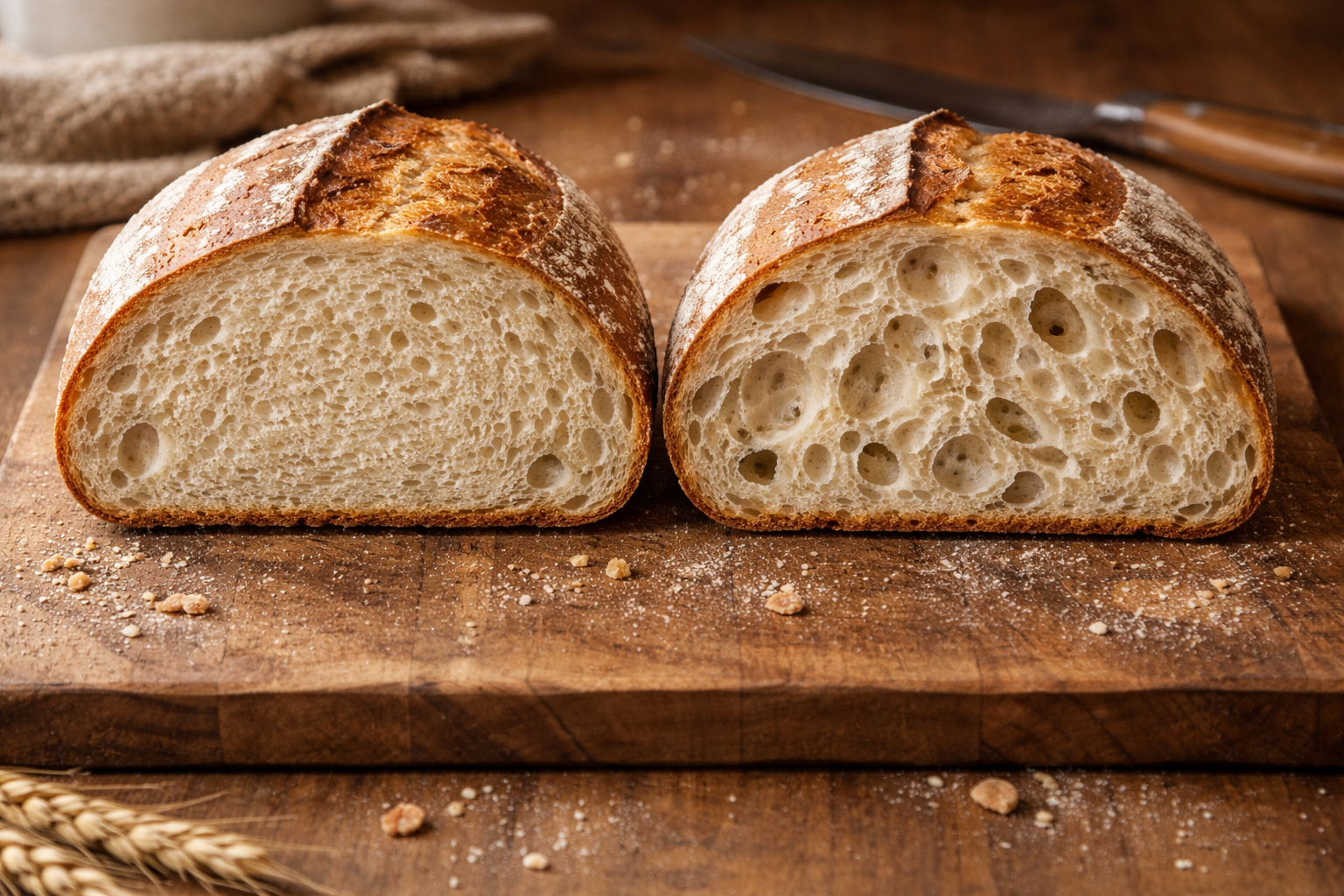
The same-day loaves, meanwhile, were more forgiving in terms of timing because I could actually watch them. Room temperature proofing moves fast enough that you can catch the dough at its peak and bake it right away. The texture was a little more open and creamy, the crust crackled beautifully, and the whole process felt very satisfying in a focused, meditative kind of way.
Here is a quick breakdown of what I noticed across both methods by the end of the experiment:
- Overnight loaves had noticeably more complex, tangy flavor, especially by Saturday morning after a Friday night in the fridge
- Same-day loaves had a milder, sweeter crumb that my kids preferred by a wide margin
- The overnight cold dough was much easier to score cleanly because it held its shape on the way into the Dutch oven
- Same-day proofing required me to actually be home and available, which some weekends just did not cooperate
- Overnight gave me flexibility to sleep in, which is honestly not a small thing
- Both methods produced a great ear and open crumb once I dialed in the fermentation timing for each
Now, about that loaf I left in the oven too long. Week six. I had been up since five baking the same-day version, and I put the overnight loaf in for its bake, set a timer, and then absolutely fell asleep on the couch. I woke up to a smell that was somewhere between “artisan” and “crime scene.” The loaf was so dark it looked like a lump of coal. I genuinely considered throwing it away. But I cut into it out of curiosity, and you know what? The interior was perfectly baked, the crumb was open and gorgeous, and the crust, while aggressively charred on the outside, had this deep, complex bitterness that paired outrageously well with salted butter. My husband, the same man who had wisely stayed quiet during the frisbee incident, declared it his favorite loaf of the entire experiment.
So Which Method Actually Wins?
After two months of comparing same-day sourdough vs overnight baking side by side, my honest answer is: it depends entirely on what you want from your weekend. If you have time to be present in the kitchen, you want a milder loaf, or you are trying to teach yourself fermentation by feel, go same-day. The feedback is faster and you stay connected to the dough through the whole process.
If you want more complex flavor, the flexibility to live your Saturday without watching a dough, or the satisfaction of pulling a cold, perfectly firm loaf out of the fridge on Sunday morning and scoring it cleanly with a sharp lame, go overnight. Just mind your bulk ferment timing and do not fall asleep on the couch. Or do. Maybe it will be your best loaf yet.
I still bake both. Most weeks, I do an overnight on Friday night because the flavor genuinely cannot be beat. But on a quiet Saturday morning when I want to spend the day in the kitchen? Same-day all the way. The great news is that once you understand the principles behind each, you are not locked into either method. You can read your dough, adjust on the fly, and confidently bake a beautiful loaf no matter which approach fits your week.
Now go feed your starter, grab a banneton, and make something. Even if it turns out looking like a lump of coal, it might still be delicious. Trust me on that one.