I want to tell you about the day I served my mother-in-law a loaf of sourdough that tasted like a gym bag. Not slightly tangy. Not “rustic.” A full-on, eyes-watering, where-did-you-go-wrong gym bag. She was very polite about it, which somehow made it worse. That loaf was the moment I finally got serious about understanding pH sourdough bread acidity, and honestly, it changed everything about how I bake.
This post contains affiliate links. As an Amazon Associate, I earn from qualifying purchases.
Up until that fateful Sunday dinner, I had been baking sourdough completely by feel and vibes. My starter looked bubbly, my dough passed the poke test, and I trusted my gut. My gut, it turns out, was confidently wrong. What I didn’t understand was that the sourness of sourdough isn’t random — it’s chemistry, and it’s measurable. Once I learned to actually track the acidity in my dough, I stopped producing edible science experiments and started baking bread I was genuinely proud of.
Why pH Actually Matters in Sourdough Baking
Here’s the short version: sourdough is a living, fermenting ecosystem. Your starter contains wild yeast and lactic acid bacteria working together. As those bacteria ferment, they produce acids — primarily lactic acid (mild, yogurt-like, smooth) and acetic acid (sharp, vinegary, punchy). The balance between these two acids is what determines whether your bread tastes complex and pleasant or overwhelming and harsh.
pH is simply how we measure that acidity on a scale from 0 to 14. Pure water sits at 7 (neutral). Anything below 7 is acidic. A healthy, active sourdough starter typically reads somewhere between 3.5 and 4.5. Your final dough at the end of bulk fermentation should generally land around 4.1 to 4.5 for well-developed flavor without tipping into that dreaded gym bag territory. My that-Sunday loaf? I later estimated it had almost certainly been fermenting far too long at a warm temperature, driving the pH way too low and cranking up acetic acid production. Mystery solved, three years too late.
The pH of your dough also affects gluten structure, crust color, and even how well the loaf holds its shape. Over-acidified dough gets proteolytic breakdown — basically, the acids start eating the gluten network. That explains why my gym bag loaf was also inexplicably flat. It was a very thorough failure.
Understanding pH Sourdough Bread Acidity at Each Stage
Once I started paying attention, I realized that pH is useful at multiple points in the baking process, not just at the end. Here’s a rough breakdown of what to look for:
Your Starter
A ripe, ready-to-use starter that has peaked and is ready to leaven bread typically falls between 3.5 and 4.2. If it’s reading above 4.5, it may still be climbing toward peak activity. If it’s reading below 3.5, it has likely over-fermented and become too acidic to perform well. I now do a quick pH check on my starter before I mix my dough, especially in summer when my kitchen runs warm and fermentation speeds up fast.
After the Autolyse
Before you add your starter to your flour and water mix, the dough sits at a neutral or very slightly acidic pH (around 6 to 6.5). This is your baseline. Once you add your starter, acidity will begin to drop as fermentation kicks in.
End of Bulk Fermentation
This is the most critical reading. You want to end bulk fermentation when the dough is somewhere around 4.1 to 4.5. Around 4.2 is a sweet spot many bakers aim for — enough acidity for flavor development and structure, but not so much that you’re degrading the gluten. This was my problem: I was leaving my dough to bulk ferment until it “looked ready,” which, in a warm kitchen with an enthusiastic starter, meant it was already past the ideal window.
Tools for Measuring pH: My Gear
After the gym bag incident, I went on a small but enthusiastic shopping spree. Here’s what I actually use and recommend:
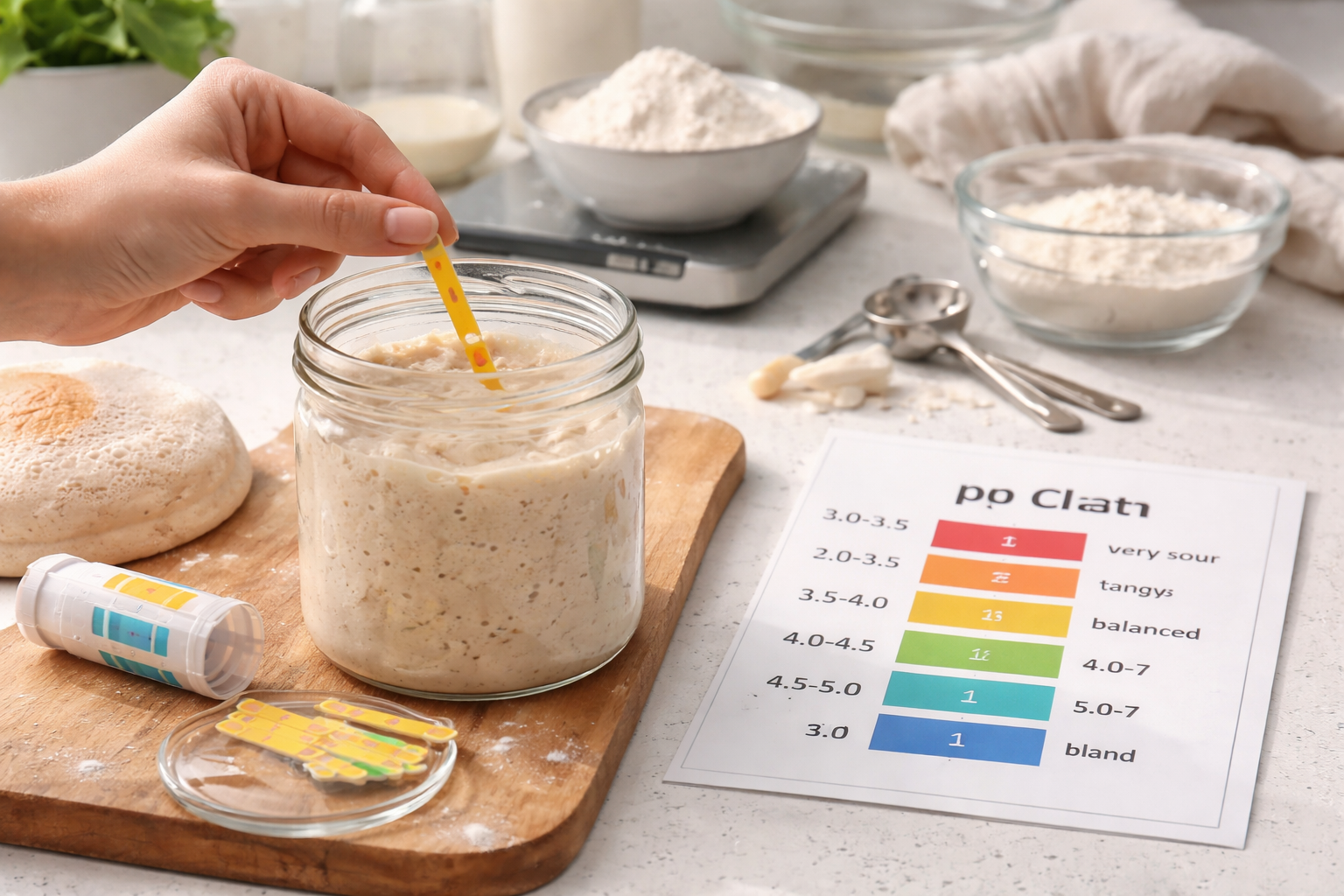
For an easy, low-commitment entry point, these 2 Pack pH Test Strips (160 strips, pH 1-14) are a great place to start. You dip a strip in a small sample of your starter or dough slurry (more on that below), compare the color to the chart, and get a reading in seconds. They’re not laboratory-precise, but for home baking purposes, they’re genuinely helpful. I kept a pack on my counter for months before upgrading.
A similar and well-reviewed option are these pH Test Strips 0-14 (200 strips), which are designed specifically for fermentation and food applications. The pack is generous and they cover everything from sourdough to kombucha to canning, so if you’re a fermentation nerd like me, you’ll use the whole thing.
If you want something more versatile for general pH monitoring across different projects, the Just Fitter pH Test Strips are a solid everyday option that work well for food and non-food testing alike.
When I wanted to get more precise, I upgraded to a digital meter. The GIDIGI pH Meter Food Digital pH Tester is purpose-built for fermentation and food testing, and it comes with calibration solution kits, which is important because meters need to be calibrated regularly to stay accurate. It has a probe designed specifically for thick substances like dough, which is exactly what you need — a standard water-testing meter probe is not ideal here.
My current everyday tool is the Smart pH Meter for Food by GIDIGI, which has automatic temperature compensation (ATC) built in. This matters because temperature affects pH readings, and if you’re baking at different times of year or in different rooms, ATC helps keep your readings consistent. The spear probe makes it easy to test dough directly rather than fussing with a slurry every time.
A Quick Note on Testing Dough
If you’re using test strips, you’ll need to make a small dough slurry: mix about a teaspoon of your dough or starter with a teaspoon of distilled water, let it sit for a minute, then dip your strip. Tap water can affect readings, so distilled is worth keeping on hand. If you’re using a spear probe meter, you can often insert it directly into the dough for a reading, just make sure to rinse and dry the probe carefully between uses.
Practical Tips for Using pH to Improve Your Bakes
- Test your starter at the same time each day to build a baseline understanding of its rhythm in your specific kitchen environment.
- If your bulk fermentation keeps over-shooting, try targeting an end pH of 4.3 as your “stop” signal rather than relying on visual dough rise alone.
- Cooler bulk fermentation temperatures (around 75°F or below) favor lactic acid, producing a milder, creamier sour flavor. Warmer temperatures and longer ferments favor acetic acid, producing more tang. Use this intentionally, not accidentally.
- If your loaves have been coming out flat and spreading sideways, check whether you might be over-fermenting. A pH reading below 4.0 at the end of bulk is often the culprit.
- Write your readings down. Keeping a simple baking journal with pH notes alongside your other observations will help you spot patterns faster than memory alone.
The Happy Ending (And Yours)
About two months after the gym bag incident, I invited my mother-in-law back for dinner. I had been faithfully testing my starter and dough pH for several weeks by that point, learning what the numbers actually meant in my kitchen with my flour and my starter. I baked a simple country loaf: mild, slightly tangy, with an open crumb and a crackly crust. She had two slices and asked if I sold loaves. I nearly fell off my chair.
I’m not saying pH testing is magic, and I’m not suggesting you need a digital meter to bake beautiful bread. But understanding pH sourdough bread acidity gave me a concrete, measurable way to understand what was happening inside my dough — and that knowledge turned a humiliating dinner into a genuine win. If your sourdough has been inconsistent, too sour, flat, or just mysteriously off, grab some