
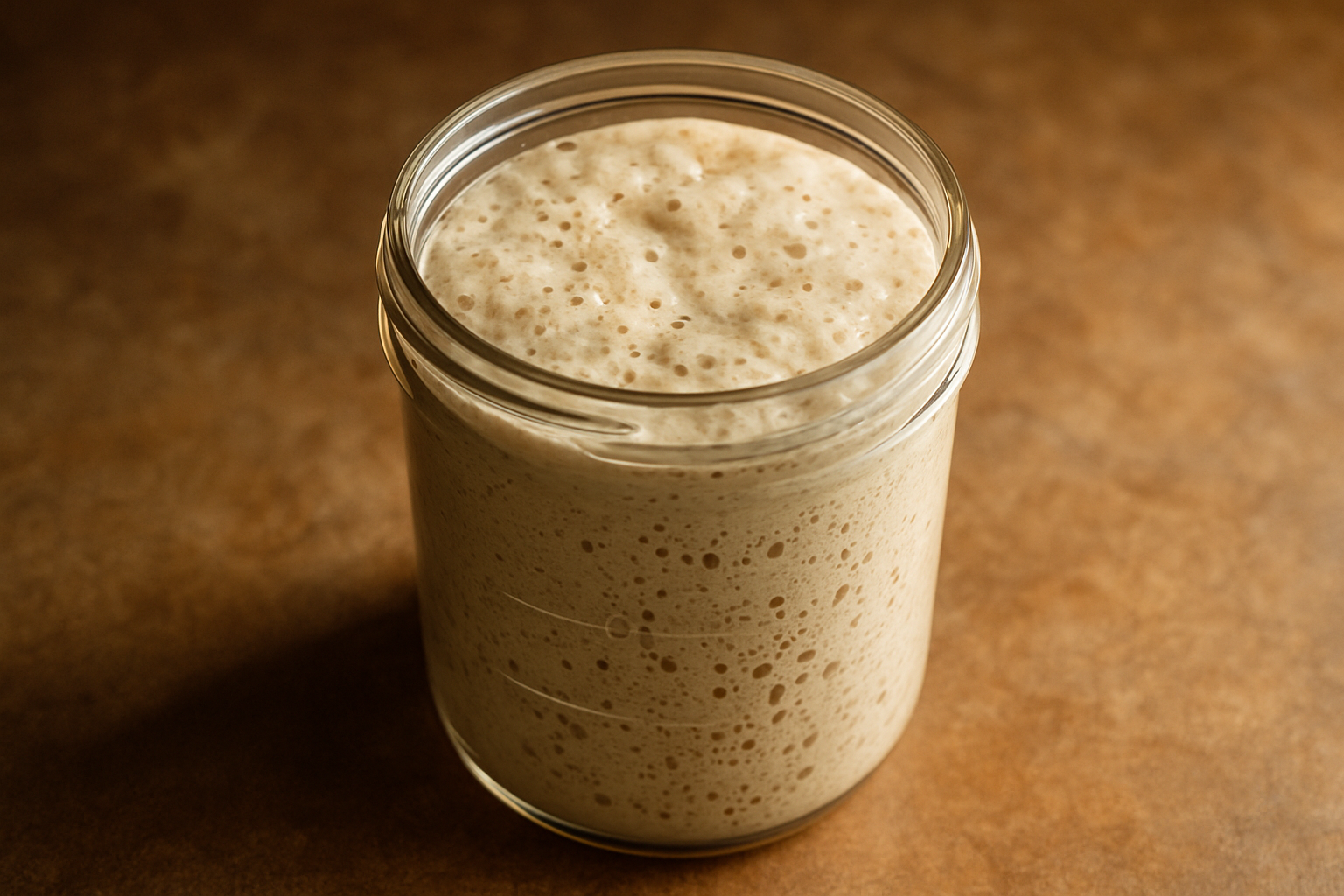
- Use whole wheat or rye flour for at least the first few days — the extra wild yeast on the bran speeds things up
- Consistency matters more than perfection — feed at roughly the same time each day
- A hooch layer (gray liquid on top) just means your starter is hungry — stir it in or pour it off, then feed
- Warmer temperatures accelerate fermentation; cooler ones slow it down
- Pink or orange streaks mean contamination — start over with a clean jar
- Use whole wheat or rye flour for at least the first few days — the extra wild yeast on the bran speeds things up
- Consistency matters more than perfection — feed at roughly the same time each day
- A hooch layer (gray liquid on top) just means your starter is hungry — stir it in or pour it off, then feed
- Warmer temperatures accelerate fermentation; cooler ones slow it down
- Pink or orange streaks mean contamination — start over with a clean jar
I still remember staring into a mason jar on my kitchen counter, watching nothing happen. Day three of my very first attempt, and there wasn’t a single bubble in sight. I almost poured it down the drain. I’m so glad I didn’t — because by day five, that same jar was alive, tangy, and practically climbing out on its own. If you’ve ever wanted to know how to make sourdough starter from scratch, you’re in exactly the right place. I’ve been through the failures, the flat loaves, and the triumphant rises, and I’m here to walk you through every single day of this magical process.
This post contains affiliate links. As an Amazon Associate, I earn from qualifying purchases. This means if you click a link and make a purchase, I may earn a small commission at no extra cost to you. I only recommend products I genuinely use and love in my own kitchen.
What Is a Sourdough Starter and Why Should You Make One?
A sourdough starter is simply a living culture of wild yeast and beneficial bacteria, fed with nothing more than flour and water. It’s the ancient engine behind every sourdough loaf — no commercial yeast required. When you feed it regularly, it rewards you with lift, flavor, and a depth that store-bought bread can only dream about. The best part? You’re cultivating something completely unique to your home, your hands, and your kitchen environment. No two starters are exactly alike, and that’s honestly one of the things I love most about this craft.
What I Use: Tools That Make the Process So Much Easier
Before we dive into the day-by-day guide, let me share the tools that have genuinely made my starter journey smoother. You don’t need fancy equipment, but having the right jar setup makes a world of difference — especially when you’re watching for that first rise.
My current everyday jar is the Premium Pro Sourdough Starter Jar Kit (40oz). It comes with a marked feeding band, a thermometer, a scraper, a cloth cover, and both a silicone lid and base. The feeding band alone is worth it — being able to mark exactly where your starter sits after each feeding so you can watch it double (or more) is genuinely satisfying. No more guessing.
If you prefer something with a more artisan feel, I also really love the Snuvid 1L Potbelly Crock Sourdough Starter Jar Kit. That wide-mouth potbelly design is beautiful on the counter and incredibly easy to clean — no fighting with a narrow opening to get your scraper in there.
For those of you planning to keep two starters (one in the fridge, one active — which I highly recommend once you get going), the 2-Pack Premium Pro Sourdough Starter Jar Kit is incredible value and includes everything you need for both jars.
And if you’re ready to go all-in on sourdough baking from the very start, I’d point you toward either the Astercook Complete Sourdough Starter Kit or the Complete Sourdough Starter Kit with Banneton Proofing Basket. Both include proofing baskets, a starter jar, scrapers, and more — everything you need to go from zero to baked loaf without scrambling for gear.
How to Make Sourdough Starter From Scratch: Your 7-Day Plan
All you need to begin is unbleached all-purpose or whole wheat flour and non-chlorinated water. Filtered or bottled water works great. Tap water is fine if you let it sit uncovered for 30 minutes to let the chlorine dissipate. Keep your starter somewhere warm — ideally between 70°F and 78°F. Cooler kitchens slow fermentation, and that’s okay, it just takes a little longer.
Day 1: The Beginning
In your clean jar, mix 50g of whole wheat flour with 50g of room-temperature water. Stir vigorously to incorporate air, then loosely cover (a cloth cover or lid set ajar works perfectly). Mark the level with your feeding band or a rubber band. Set it somewhere warm and walk away. That’s it — you’ve started.
Days 2–3: Don’t Panic
You may see a few bubbles, or you may see nothing. Both are completely normal. Discard all but 50g of your starter, then feed it with 50g of all-purpose flour and 50g of water. Stir well, mark the level, and cover again. The discard step might feel wasteful, but it keeps acid levels balanced so the right microbes can thrive. You can save that discard for pancakes or crackers — nothing goes to waste in my kitchen.
Days 4–5: Things Get Interesting
This is usually when the magic starts showing up. You might notice a more sour smell, more vigorous bubbling, and your starter beginning to rise noticeably between feedings. Continue the same routine: discard down to 50g, feed with 50g flour and 50g water, mark the level. If your starter smells like nail polish remover (that’s acetic acid building up), just feed it more frequently — twice a day if needed.
Days 6–7: The Float Test
By now, your starter should be doubling in size within 4–8 hours of feeding, smell pleasantly tangy and yeasty, and have a bubbly, airy texture. To test if it’s ready to bake with, drop a small spoonful into a glass of water. If it floats — congratulations, your starter is active and full of gas. That’s your green light. If it sinks, give it another day or two of consistent feedings and try again.