I still remember the afternoon I ruined what should have been a beautiful sourdough loaf — all because of a cup of flour. I’d packed it too tightly, the way you do when you’re in a hurry and not really thinking. The dough came out stiff and dense, like a brick wrapped in a crust. I couldn’t figure out what went wrong until a fellow baker gently asked, “Did you weigh your flour?” That one question changed everything. If you’re serious about sourdough and you’re not yet using a digital scale for sourdough baking, I promise this is the most important upgrade you can make to your entire process.
This post contains affiliate links. As an Amazon Associate, I earn from qualifying purchases. This means if you click a link and make a purchase, I may earn a small commission at no extra cost to you. I only recommend tools I genuinely believe in and would use in my own kitchen.
Why Cups and Spoons Are Letting Your Sourdough Down
Volume measurements like cups and tablespoons were designed for convenience, not precision. And sourdough is a craft that rewards precision above almost everything else. The problem is that flour, in particular, is wildly inconsistent when measured by volume. A loosely spooned cup of bread flour can weigh as little as 120 grams. A packed, scooped cup from the same bag can tip the scales at 165 grams or more. That’s a difference of 45 grams — and in a sourdough recipe, that kind of variance can mean the difference between an open, airy crumb and something better suited as a doorstop.
Sourdough baking is built on ratios. Hydration percentages, starter percentages, salt percentages — all of these are calculated by weight. When professional bakers write recipes, they’re working in grams. When you bake by weight, you can follow those recipes exactly, troubleshoot problems logically, and scale a recipe up or down with total confidence. There’s no guesswork. There’s no “level it off with a butter knife and hope for the best.” There’s just math, and math is honest.
Beyond flour, weight measurement matters for your starter, your water, and especially your salt. A gram or two of extra salt can slow fermentation noticeably. A slightly wetter or drier starter affects timing, rise, and flavor. These are small variables that compound, and a kitchen scale eliminates nearly all of them in one simple step.
What to Look for in a Digital Scale for Sourdough Baking
Not all kitchen scales are created equal, and when it comes to sourdough, a few specific features really matter. Here’s what I always look for before recommending a scale to fellow bakers:
- Precision of 0.1 grams: For measuring salt and yeast-heavy starters, 1-gram graduation isn’t always fine enough. A scale that reads to 0.1g gives you real control over small quantities.
- Capacity of at least 5kg (11 lbs): You’ll often be weighing dough directly in a bowl or Dutch oven. Bigger batches need bigger capacity.
- Tare function: This resets the scale to zero with your bowl on it, so you can add ingredients one by one without doing mental math. Absolutely non-negotiable.
- Grams and ounces display: Grams are standard for sourdough, but having both gives you flexibility.
- Easy-to-read LCD display: Flour-dusted kitchens and squinting don’t mix well.
- Stainless steel platform: Durable, easy to wipe clean, and it won’t stain from starter spills.
The Scales I Use and Recommend
I’ve tested quite a few scales over the years, and these are the ones I genuinely trust and recommend to bakers at every level. Whether you’re just starting out or you’re baking multiple loaves a week, there’s something on this list for you.
Best Overall: Etekcity 0.1g Food Kitchen Scale
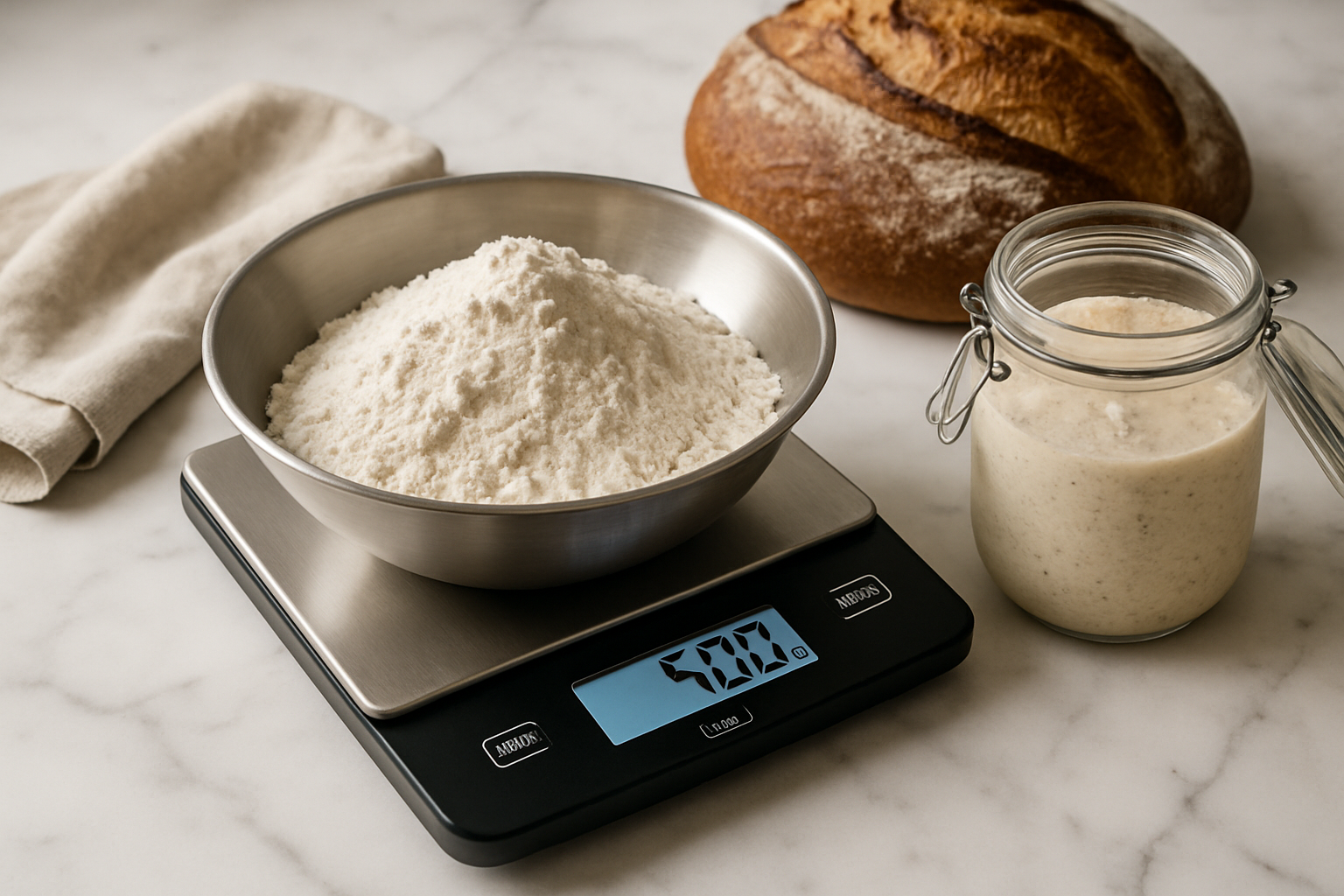
This is the scale sitting on my counter right now, and it’s earned its place there. The Etekcity 0.1g Food Kitchen Scale reads to 0.1 gram precision with an 11 lb / 5 kg capacity, which covers everything from a pinch of salt to a full batch of dough. The stainless steel bowl is a nice touch — it’s easy to clean and feels sturdy. I love that I don’t have to hunt for a bowl every time I bake. Simple, accurate, reliable. Exactly what sourdough demands.
Best for Bakers Who Love Data: BOMATA Large Kitchen Scale
If you’re the kind of baker who loves dialing in percentages, the BOMATA Large Kitchen Scale is genuinely exciting. It has a built-in percentage function — yes, you can weigh your ingredients and watch the hydration percentage calculate in real time. It’s USB rechargeable (goodbye, dead batteries mid-bake), reads to 0.1g precision, and has a full-view angle LCD with backlight. For the data-driven sourdough baker, this one is a serious upgrade.
Best for Starter and Small Measurements: YONCON Mini Pocket Scale
I keep a small secondary scale just for measuring starter, salt, and add-ins like seeds or inclusions. The YONCON 3000g/0.1g Mini Pocket Scale is perfect for this role. It’s compact, highly accurate at small weights, comes with two trays, and the batteries are already included — a small thing that I deeply appreciate. If you’re measuring 8 grams of salt or tracking your starter feed to the decimal, this little scale pulls its weight (pun very much intended).
Best Budget Pick: Etekcity Digital Kitchen Scale
If you’re new to sourdough and want something reliable without spending much, the Etekcity Digital Kitchen Scale is a fantastic starting point. It measures in grams and ounces, has a clean LCD display, and features a 304 stainless steel platform that’s easy to keep clean. It’s straightforward and honest — just like good sourdough should be.
Best for Large Batches: Nicewell 22lb Food Scale
When I’m making multiple loaves or baking for a crowd, I reach for the