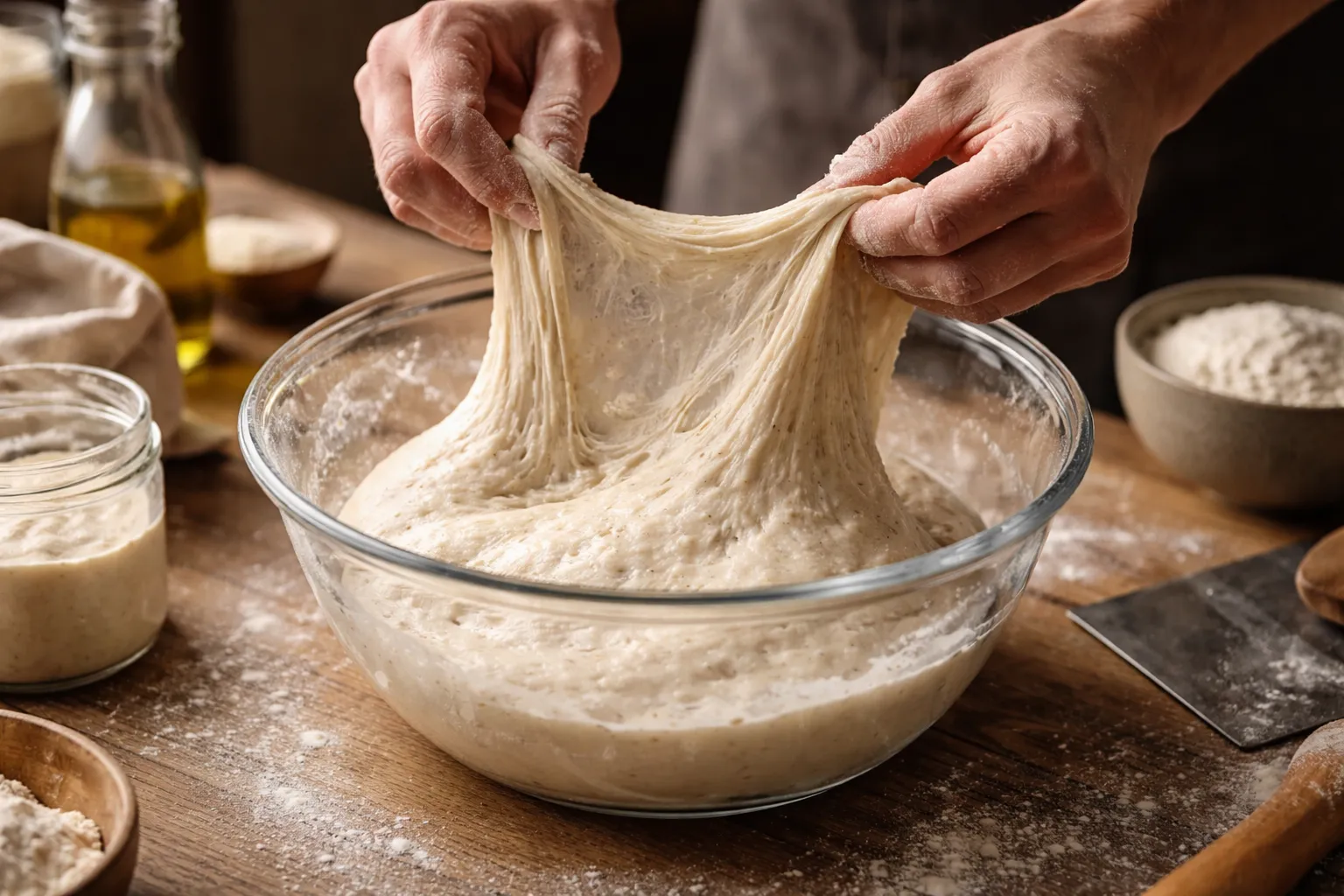
I still cringe when I think about the loaf I proudly slid onto the counter for my in-laws’ first visit. It looked like a deflated football. A sad, pale, gummy deflated football. My mother-in-law, bless her, picked it up, turned it over twice, and said, “Oh, how… rustic.” Reader, it was not rustic. It was structureless. And the reason — I would later discover — came down entirely to gluten development in sourdough stretch fold technique, or rather my complete ignorance of it. I had mixed my dough, covered it with a tea towel, and walked away for four hours like some kind of rogue sourdough cowboy. No folds. No structure. No shame. Well, a lot of shame actually.
That embarrassing football loaf turned out to be one of the best things that ever happened to my baking. Because it sent me down a rabbit hole of research about what gluten actually is, what stretch and fold is genuinely doing to your dough, and why skipping it produces something that looks like it lost a fight with gravity. Stick with me here, because once you understand the why, the how becomes so much more intuitive.
What Gluten Actually Is (No, It’s Not the Villain)
Gluten gets a bad rap in some circles, but inside a loaf of sourdough bread, it is your absolute best friend. When flour meets water, two proteins naturally present in wheat flour — glutenin and gliadin — combine and form gluten. Think of gluten as a stretchy, elastic web that runs through your entire dough. This network does two critical things: it traps the carbon dioxide gas produced by your fermentation, and it gives your final loaf structure so it can hold its shape during baking.
Without a strong gluten network, those gas bubbles just escape. Your dough spreads sideways instead of rising upward. The crumb turns dense and gummy rather than open and chewy. Sound familiar? It should, because that is exactly what happened to my football loaf. The fermentation was actually fine. My starter was active and bubbling. The dough just had nowhere to hold all that beautiful gas because I had never given it any structure.
Gluten Development in Sourdough: Why Stretch and Fold Works
Here is where it gets genuinely fascinating. You might assume that kneading is the only way to develop gluten, and certainly traditional bread baking leans heavily on it. But sourdough operates on a longer, slower timeline, and that timeline actually works in your favor. You can develop an exceptional gluten network through a combination of time and a few simple stretch and fold sets during bulk fermentation — no aggressive kneading required.
Each time you perform a stretch and fold, you are doing a few things simultaneously. You are physically aligning the gluten strands into a more organized, stronger network. You are also redistributing yeast and bacteria throughout the dough, giving them fresh access to sugars for fermentation. And you are gently degassing the dough without destroying the structure you have already built. It is a remarkably elegant process once you see it for what it is.
The most common approach is to perform four sets of stretch and folds spaced roughly 30 minutes apart during the first two hours of bulk fermentation. Wet your hand, grab one side of the dough, stretch it up as high as it will comfortably go without tearing, then fold it over to the opposite side. Rotate the bowl 90 degrees and repeat. Do that four times per set. By the end of your second or third set, you will feel the dough transform under your hands — tighter, more resistant, almost silky. That resistance is your gluten network talking back to you, and it is a beautiful thing.
Beyond the basic stretch and fold, you can also try coil folds, which involve lifting the dough from the center and letting the ends fold beneath it. Many bakers find coil folds work especially well in the later sets when the dough is already tighter and more developed. The goal is always the same: build tension, build structure, build strength.
Signs You Are Getting It Right
After my football incident, I became mildly obsessed with reading my dough during bulk fermentation. Here are the signs I now look for that tell me the gluten development is on track.
- The dough feels noticeably tighter and more elastic after each set of folds compared to the set before.
- It holds its shape in the bowl rather than spreading flat and looking defeated.
- When you perform a stretch, the dough resists slightly instead of tearing immediately — that resistance is a healthy sign.
- By the end of bulk fermentation, the dough has increased in volume, looks slightly domed, and has visible bubbles around the edges and on the surface.
- The windowpane test passes — you can gently stretch a small piece of dough thin enough to see light through it without it tearing.
The windowpane test was a game changer for me. Before I knew about it, I was essentially guessing. Now I have an actual physical benchmark that tells me my gluten network is strong enough to trap gas and hold structure through the proof and into the oven.
My Gear: Tools That Make the Process Easier
You genuinely do not need fancy equipment to develop great gluten in sourdough, but having the right tools makes the whole process more enjoyable and a lot less messy. Here is what I use and genuinely love.
The Bowl That Made Me Actually See My Gluten Development
For years I was doing stretch and folds in opaque bowls, which meant I was basically working blind — I couldn’t tell if my dough was actually getting stronger or just getting warm. Getting a clear bowl changed everything because now I can watch the dough transform in real time, see the gluten network tighten, and know exactly when to stop folding.
What works
- You can actually see gluten development happening — watching the dough go from shaggy to smooth and cohesive during folds is the real-time feedback that takes the guesswork out of knowing when you’re done.
- The lid keeps your dough from drying out between folds while you’re monitoring it, which matters a lot during those crucial first few hours of bulk fermentation.
- The size is generous enough for high-hydration doughs (mine usually live at 80%+) without the dough spilling over during aggressive folds or climbing up the sides.
What doesn’t
- Glass conducts temperature pretty aggressively, so your bulk fermentation times might run shorter in summer than you’d expect — I’ve had to start watching my dough earlier than recipes suggest.
- The lid doesn’t seal perfectly, which is actually fine for sourdough, but if you’re paranoid about drying or want an airtight environment, you’ll need to cover it with a damp towel as backup.
I once second-guessed whether the dough was strong enough to shape because I’d stopped folding too early out of impatience, and only when I could see it clearly in the glass did I realize I’d barely built any strength at all — so I did four more folds and got an actual structure. If you’re serious about understanding what stretch and fold is actually doing, grab the EWAFILU 4.7QT Large Glass Mixing Bowl with Lid.
This post contains affiliate links. As an Amazon Associate, I earn from qualifying purchases at no extra cost to you.