I want to tell you about the morning I stood in my kitchen, staring at two sourdough loaves like a disappointed parent at a science fair, wondering why on earth I had just spent six weeks obsessively testing water quality sourdough filtered vs tap when both loaves looked… completely fine. Not revelatory. Not catastrophic. Just fine. I had a notebook full of scribbled observations, a slightly strained relationship with my husband (who was very tired of hearing about fermentation times), and absolutely zero dramatic conclusion to share. Or so I thought.
Let me back up. It started, as most of my sourdough rabbit holes do, with an argument I read on a baking forum at eleven o’clock at night. Someone had declared, with tremendous confidence, that tap water was “killing” their starter. Someone else fired back that filtered water was “completely unnecessary for home bakers.” I closed my laptop, lay awake for an hour, and then did what any reasonable person would do: I designed a six-week experiment involving two separate starters, a dedicated baking journal, and a new filter pitcher I had been eyeing anyway.
Why Water Quality Actually Matters for Sourdough (The Science Part, I Promise It’s Short)
Before I get to my deeply humbling results, let me explain why this question is worth asking in the first place. Municipal tap water in most cities contains chlorine or chloramine, added specifically to kill microorganisms. That’s great for your drinking water safety. It is less great when you’re trying to cultivate a thriving colony of wild yeast and lactic acid bacteria in a jar on your counter.
Chlorine is the more manageable of the two. It’s a volatile compound, which means you can actually let a jar of tap water sit uncovered on your counter for thirty minutes to an hour and a good portion of it will off-gas. Many experienced home bakers do exactly this and have perfectly healthy starters. Chloramine, however, is a different story. It’s a more stable compound that doesn’t evaporate easily, and it’s become increasingly common in municipal water treatment. If your city uses chloramine, letting your water sit out won’t help much. Filtration is a more reliable solution.
Beyond chlorine and chloramine, hard water with very high mineral content can sometimes affect gluten development, while extremely soft water can make dough feel slack and harder to handle. The ideal water for sourdough is somewhere in the middle: moderately mineralized, free of heavy disinfectants, and at the right temperature for your dough. That last one, by the way, is arguably the most important water variable of all, and it’s the twist I’ll get to shortly.
My Gear for the Water Quality Sourdough Filtered vs Tap Test
If you’re thinking about running your own test, or you just want to start filtering your water for baking in general, here are the pitchers I used and recommend. I picked up the filter pitcher at the start of my experiment and honestly, filtered water has become part of my daily baking routine now regardless of what the experiment proved.
- Brita Large Water Filter Pitcher (10-Cup, Bright White) – This is the one I used throughout my test. It’s BPA-free, filters last two months, and it lives happily on my counter next to my starter jars. Simple, reliable, and it works.
- Waterdrop Water Filter Pitcher (7-Cup, NSF Certified) – A great option if you want something compact. NSF certified and rated for 200 gallons per filter, which is impressive. Also reduces chlorine and PFOA/PFOS.
- Waterdrop 10-Cup Large Water Filter Pitcher – If you bake a lot or feed a busy household, this larger Waterdrop model is excellent. Five times the filter lifetime compared to standard pitchers and it reportedly improves coffee and tea flavor too, which is a lovely bonus.
- Brita UltraMax Large Water Dispenser (27-Cup) – This is the one I want next. A 27-cup dispenser that sits on your counter like a tiny hydration station. Perfect for high-volume bakers or anyone who bulk ferments multiple loaves at once.
- Brita 10-Cup Pitcher with SmartLight Change Indicator (Stretch Limo Black) – A sleeker version of the classic Brita with a built-in light that tells you when to change your filter. I have been known to forget filter changes for embarrassingly long stretches, so this is genuinely useful for me.
Six Weeks of Baking, Two Starters, and One Deeply Embarrassing Realization
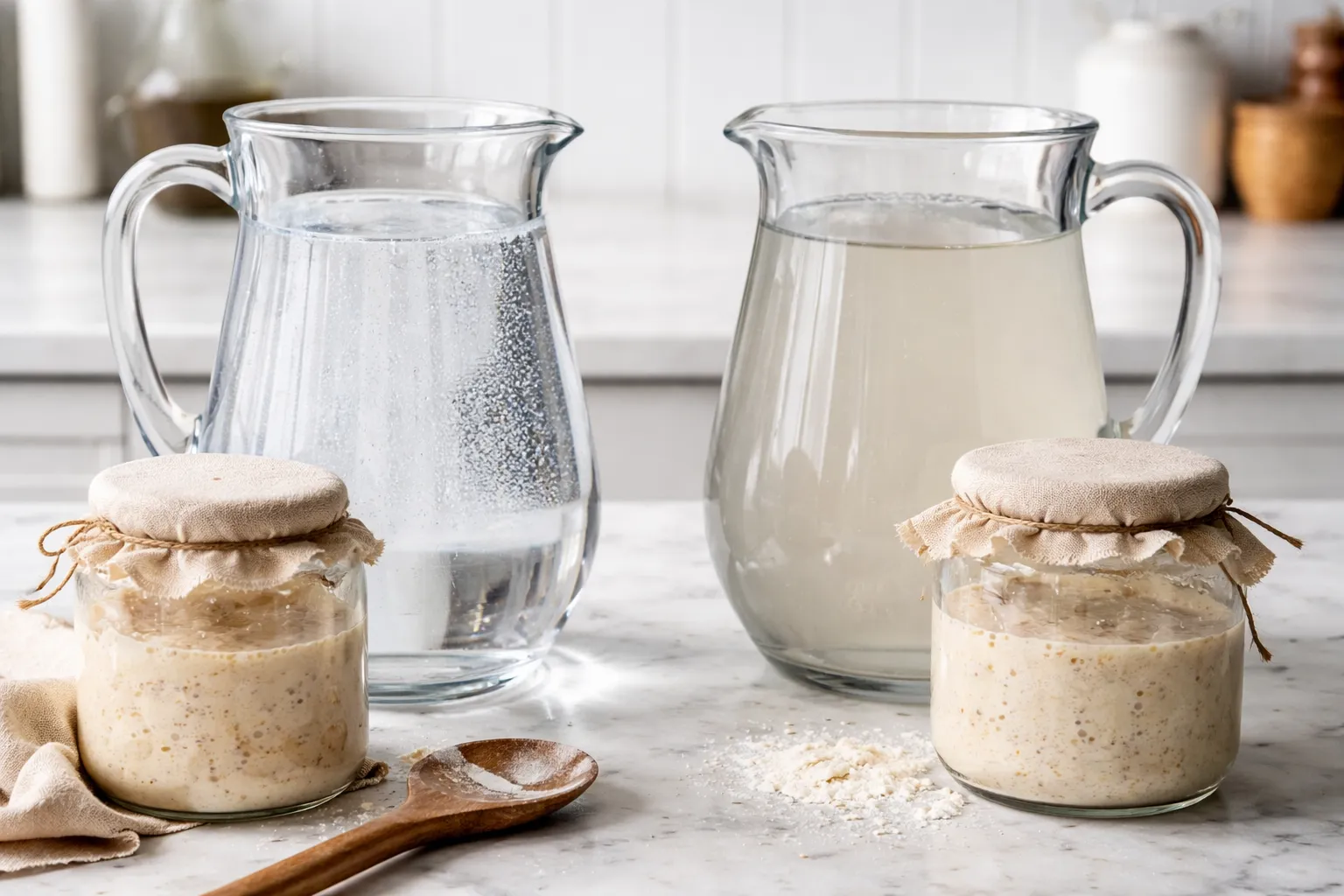
Here is how I ran the test. I split my mature starter into two equal portions on the same day, feeding them identical ratios of the same flour (my usual blend of bread flour and a little whole wheat). Starter A got filtered water from my new Brita pitcher at every feeding. Starter B got straight tap water. I kept them in identical jars, at the same spot on my counter, and I baked from each one every single week for six weeks. I took notes on rise time, peak height, smell, and the final loaves: oven spring, crumb structure, crust color, and taste.
Weeks one through four: genuinely not that different. Starter A, the filtered water one, did seem marginally more consistent in its rise times. Starter B had one slightly sluggish week around week three, which I attributed to the tap water. My notes from that week say, and I quote, “B is being difficult, as expected.” I was already writing the narrative in my head.
Then week five happened, and Starter B bounced back completely, producing one of the better loaves of the entire experiment. My confident narrative wobbled. I went back through my notes looking for patterns and that is when I found it. The embarrassing thing. The thing my husband has been gently not laughing about for months.
Week three, the week Starter B was “being difficult”? My notes also recorded, in my own handwriting, that I had used cooler water than usual because I was in a rush. Not the tap water that had sabotaged the starter. Me. I had used water that was several degrees too cold and slowed down fermentation entirely. Starter B was not suffering from chlorine. Starter B was just cold.
I had been so convinced that water quality was the variable that I almost missed the actual variable: water temperature. The single biggest water-related factor in sourdough baking is not filtration. It is temperature. Dough temperature and water temperature directly control fermentation speed, and getting that right consistently matters more than whether you filtered your water or not, at least if you live somewhere with reasonably good tap water.
The Water Filter That Finally Let Me Stop Blaming My Tap Water
If you’re like me and your tap water comes out slightly cloudy or has that distinct mineral taste, it’s easy to convince yourself it’s sabotaging your fermentation timeline. After six weeks of testing, I realized that consistent, filtered water removes at least one variable from an already chaotic equation—and that’s worth something.
What works
- Filter removes visible cloudiness and mineral deposits, so you’re not wondering if your water is the culprit when bulk fermentation takes longer than expected
- The pitcher sits seamlessly in the fridge and filters fast enough that you’re not waiting around; I could refresh my water between refreshments without friction
- The change indicator actually works—you’ll know when to swap the filter instead of guessing whether your water quality just quietly degraded
What doesn’t
- Filters need replacing every 2 months, which adds up in cost if you’re using filtered water for every autolyse and every hydration adjustment
- It won’t fix the real problem if your fermentation timeline is off—filtered water is a control variable, not a silver bullet for weak starter or warm kitchen temps
I went through one filter in week two thinking it wasn’t actually filtering (it was), but once I committed to the rhythm, it became the baseline I needed to actually isolate what was affecting my dough. Grab a Brita Large Water Filter Pitcher (10-Cup, Bright White) and stop wondering if your water is the problem.
This post contains affiliate links. As an Amazon Associate, I earn from qualifying purchases at no extra cost to you.