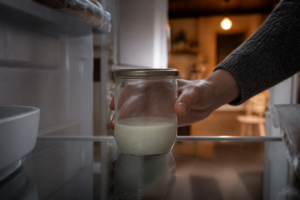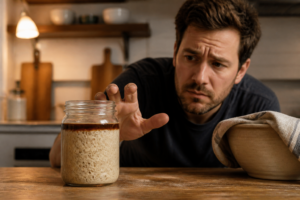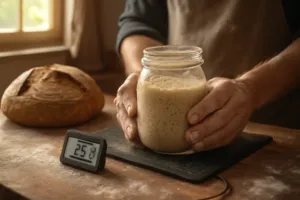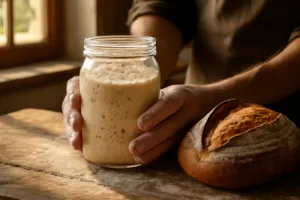
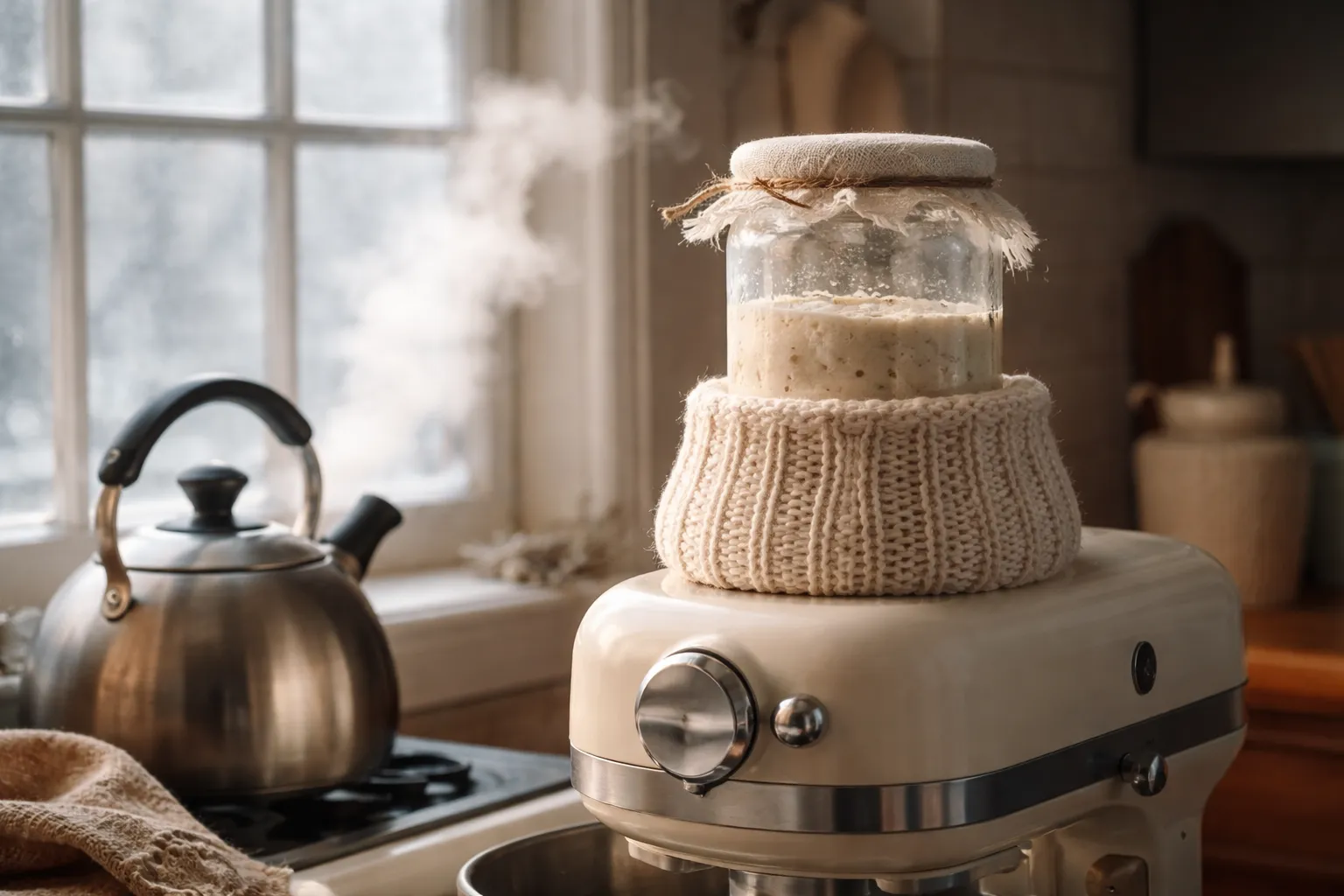
It was 6 a.m. on a Tuesday in February, and I was standing in my kitchen in two pairs of socks, staring into a jar of what can only be described as sad, flat, defeated goo. My sourdough starter — the one I had been nurturing for eight months — had not budged a single millimeter overnight. Again. For the fourth day in a row. If you have ever tried managing a sourdough starter cold kitchen winter situation, you already know exactly where this story is going.
I want to tell you about the winter that very nearly made me quit sourdough entirely. About the loaves that came out like frisbees, the starter that looked more like library paste than a living culture, and the slow, humbling education I got in how cold air can silently destroy everything you are working toward. But I also want to tell you how it ended, because it ended really well. Grab something warm to drink. Let’s talk about it.
When a Cold Kitchen Turns Your Sourdough Starter Into a Ghost
Our house is old. Like, “original cast iron radiators that clank at 3 a.m. and heat exactly one room properly” old. That February, we had a stretch of brutal cold that pushed our kitchen down to about 61°F during the day and closer to 57°F at night. I did not think much of it at first. I had been baking sourdough for the better part of a year and felt reasonably confident. I figured I would just feed my starter and let it do its thing.
Except it did not do its thing. It did nothing. My starter, which I had lovingly named Gerald (do not judge me), peaked at maybe 10 percent growth over eight hours and then collapsed without so much as a bubble worth bragging about. My bread came out gummy, dense, and completely lacking that gorgeous open crumb I had been chasing since summer. One loaf was so flat I briefly considered using it as a trivet.
Here is the thing nobody told me clearly enough when I started baking: sourdough starter activity is almost entirely temperature-dependent. The wild yeast and lactic acid bacteria that make your starter alive and powerful are dramatically slower below 70°F and can nearly stop functioning below 65°F. A starter that doubles in four hours at 76°F might take twelve or more at 62°F, and the flavor profile shifts too, becoming more sour and less complex. Cold does not kill your starter outright. It just quietly suffocates it.
What I Tried Before I Found What Actually Worked
I am nothing if not stubborn, so before I found real solutions, I tried a series of increasingly desperate workarounds. I put Gerald on top of the refrigerator, which helped maybe two degrees. I tried wrapping the jar in a dish towel, which helped not at all. I set him near the oven while I was baking other things, which worked inconsistently and once resulted in a very vigorous overproofing situation that I will not elaborate on here, except to say it involved the ceiling.
I also tried switching to a stiffer starter consistency, which does retain heat slightly better, and using warmer water in my feedings, which gave a short-term boost but did not solve the ambient temperature problem. These are legitimate techniques worth knowing, but they are bandages, not cures.
What finally changed everything was accepting that I needed to create a dedicated warm environment for my starter and my dough, rather than hoping the kitchen would cooperate. Once I reframed it that way, the solutions became obvious.
My Gear: What I Now Use to Bake Sourdough in a Cold Kitchen All Winter Long
I want to be genuinely useful here, so let me walk you through what I actually use and why each piece earned its spot in my kitchen.
The Proofing Box That Saved My Starter (and My Sanity)
When your kitchen sits at 58°F and your starter won’t rise, you’re fighting physics—not your technique. A dedicated proofing box gives your starter and bulk dough the consistent warmth they actually need to ferment, not just survive.
What works
- Maintains a steady 75–78°F inside, which is exactly where sourdough wants to be—no more watching ambient temperature swings kill your rise.
- Fits a full-size banneton and dough bowl at once, so you can proof your starter, bulk dough, and final shaped loaf all in one small footprint.
- The fold-down design packs away flat when it’s not winter survival mode, so it doesn’t become yet another kitchen appliance you resent.
What doesn’t
- No built-in timer or temperature readout—you’ll still need to check on your dough manually and use an external thermometer to dial in your exact temp.
- Takes up real counter or cabinet space, and if your kitchen is already cramped, this becomes one more thing to negotiate around during work hours.
I was skeptical that a $60 box could actually make the difference when my cold kitchen had beaten me down so thoroughly, but within three days of turning it on, my starter was rising on schedule again. If you’re in the same frozen-kitchen situation I was, grab a GIYUDOT Folding Bread Proofing Box.
This post contains affiliate links. As an Amazon Associate, I earn from qualifying purchases at no extra cost to you.