
This post contains affiliate links. As an Amazon Associate, I earn from qualifying purchases at no extra cost to you.
For two years, I chased the same problem. My sourdough loaves looked decent, smelled wonderful, and had a reasonable crumb. But something was missing — a depth of flavor I kept reading about in forums and watching in videos. Bakers who talked about the Mockmill grain mill fresh flour sourdough combination described their bread as transformative. I dismissed it as hype. Eventually, curiosity won.
My starter was active and healthy. My hydration was dialed in. My shaping had improved dramatically over months of practice. Still, every loaf tasted a little flat compared to what I imagined it could be. A neighbor who bakes seriously suggested I try milling my own flour. She said store-bought flour — even good organic bread flour — loses volatile compounds quickly after milling. Fresh flour, she insisted, changes everything.
I was skeptical but desperate enough to try. A dedicated stone mill like the Mockmill was on my radar, but the price point gave me serious pause. Then I remembered I already owned a KitchenAid stand mixer sitting on my counter every single day. That realization sent me straight to researching grain mill attachments instead.
Why I Chose the KitchenAid KGM All Metal Grain Mill Attachment
Once I committed to exploring home milling, I compared dedicated countertop mills with KitchenAid attachments. The Mockmill 100 and Mockmill 200 kept appearing in recommendations. They are excellent machines with stone burrs and impressive capacity. However, at two to three times the price of an attachment, they required a harder commitment for someone still testing the concept.
The KitchenAid KGM All Metal Grain Mill Attachment emerged as the most practical entry point. Multiple experienced home bakers in sourdough communities recommended it specifically for people who wanted to explore fresh flour milling without a major investment. It uses steel burrs rather than stone, which is a meaningful difference. Still, it mills whole grains into flour fine enough for bread baking.
Three things sealed my decision. First, I already owned the mixer, so the attachment would actually cost less than a dedicated mill. Second, reviewers consistently praised its all-metal construction as a sign of durability. Third, it works directly with grain I could source locally — hard red wheat, hard white wheat, spelt, and more. That versatility mattered to me.
First Impressions Out of the Box
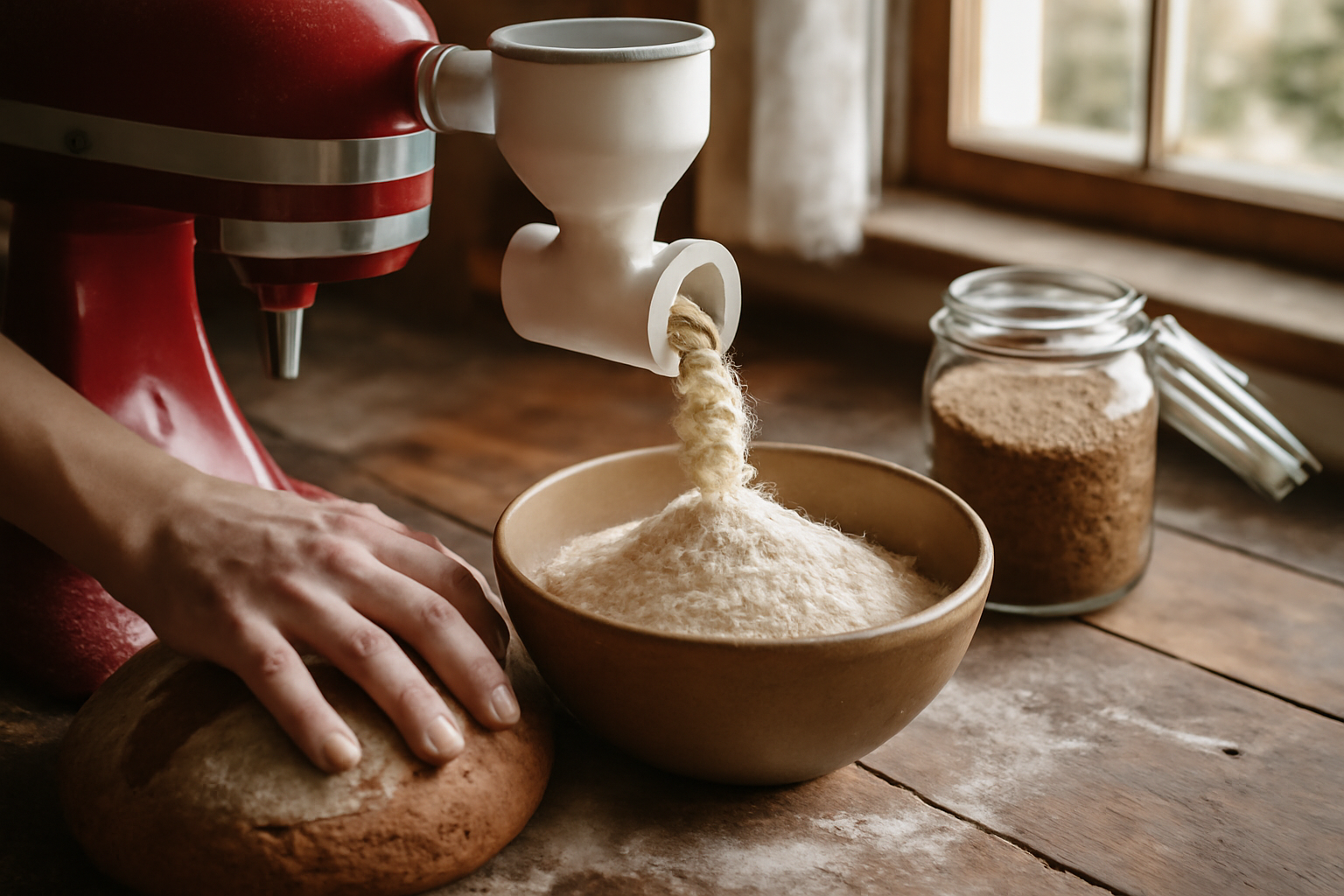
The KitchenAid KGM All Metal Grain Mill Attachment arrived well-packaged and felt immediately substantial. Picking it up, I noticed the weight right away — this is not a flimsy plastic accessory. The housing is metal throughout, which aligned with every positive review I had read. It connects directly to the power hub on the front of any KitchenAid stand mixer.
The adjustment dial for grind coarseness is straightforward. Moving from coarse to fine settings is simple and intuitive. A hopper sits on top to feed grain, and flour exits through the front spout into a bowl you position underneath. Setup took less than five minutes. Cleanup, I would later learn, requires a little more patience — but more on that shortly.
My first impression was positive overall. The build quality felt appropriate for the price. Nothing rattled, nothing felt cheap, and the attachment locked into the mixer hub securely. I ordered two pounds of hard white wheat berries from a local co-op and got to work the same afternoon it arrived.
My Testing Protocol — Eight Weeks of Fresh Flour Baking
I tested the KitchenAid KGM All Metal Grain Mill Attachment over eight weeks and approximately twenty baking sessions. My routine involved milling flour fresh on the day I planned to mix dough. I started with a simple approach — replacing twenty percent of my usual bread flour with freshly milled hard white wheat.
After two weeks, I increased that ratio to forty percent. By week five, I was experimenting with fifty percent fresh flour loaves and some all-fresh-flour bakes. Each session, I milled between one and two cups of grain at the finest setting the attachment offers. The mixer handled this without any concerning strain on the motor, though I kept baking sessions under fifteen minutes of continuous milling as a precaution.
I used hard white wheat berries for most testing because the flavor profile is milder than hard red wheat. That made it easier to isolate changes in my bread rather than attributing everything to a dramatically new flavor. My standard sourdough formula stayed consistent throughout — same hydration, same levain percentage, same bulk fermentation approach.
Comparing Loaves Side by Side
At week three, I baked two loaves on the same day using identical formulas. One used all store-bought bread flour. The other used thirty percent freshly milled hard white wheat. I let both cool fully before cutting. The fresh flour loaf had a noticeably more complex aroma when sliced. The crumb was slightly tighter, which I expected. The flavor, however, was genuinely richer.
My partner, who is not a bread obsessive, tried both without knowing which was which. She preferred the fresh flour loaf immediately and without hesitation. That moment felt validating in a way that surprised me.
What Actually Changed — Honest Results With a Timeline
Here is what I observed across the eight-week testing period, broken down honestly.
- Weeks 1–2: At twenty percent substitution, the flavor difference was subtle. I noticed something, but I could not confidently describe it. The crumb behaved similarly to my usual loaves.
- Weeks 3–4: At thirty to forty percent fresh flour, flavor complexity increased clearly. The loaves had a nuttier, earthier quality that I genuinely enjoyed. Fermentation times also shortened slightly, likely due to the higher enzyme activity in fresh whole grain flour.
- Weeks 5–6: Fifty percent fresh flour loaves produced my best-tasting bread in two years of sourdough baking. The crust caramelized more deeply. The crumb was tighter than I preferred, so I adjusted hydration upward by five percent to compensate.
- Weeks 7–8: I tested a full one-hundred-percent fresh flour loaf. It was dense but flavorful — worth making occasionally, but not my everyday preference.
The most meaningful change was flavor. Describing it precisely is difficult. Fresh flour bread tastes more like wheat — in the best possible way. The complexity is real and not imagined.
A Moment of Genuine Doubt
Around week four, I had a rough bake. The loaf spread more than I expected, and the crumb was gummy in the center. My first instinct was to blame the fresh flour. I considered whether I had overcomplicated a process that was working reasonably well before.
After troubleshooting, I realized the issue was overfermentation — not the flour. Fresh flour accelerates fermentation, and I had not adjusted my timing to account for that. Once I shortened bulk fermentation by thirty minutes, subsequent loaves improved significantly. The lesson mattered: fresh flour requires some recalibration. It is not simply a drop-in replacement.
The Downsides — What the KitchenAid Grain Mill Attachment Does Not Do Well
Honesty requires covering the limitations clearly. There are real ones worth knowing before you buy.
- Flour fineness: Even at the finest setting, the output is not as fine as commercial bread flour. Some bran particles remain coarser. If you want very fine flour, you may need to sift and re-mill — which adds time.
- Heat generation: Steel burrs generate more heat than stone burrs. This can slightly affect some of the volatile aromatic compounds in the grain. Dedicated stone mills like the Mockmill handle this better by design.
- Cleanup: Residual flour inside the attachment is difficult to remove completely. You cannot wet-clean it. Brushing it out takes several minutes. It is manageable but not convenient.
- Noise: Milling grain is noticeably louder than mixing dough. It is not extreme, but it is not quiet either.
- Capacity: Milling enough flour for multiple large loaves takes time. Two cups of grain at a sitting is a comfortable limit before checking your mixer’s temperature.
None of these issues are dealbreakers for me. However, they are real trade-offs compared to a purpose-built stone mill. You should weigh them honestly before deciding.
Final Verdict — Mockmill Grain Mill Fresh Flour Sourdough Without the Mockmill Price
The KitchenAid KGM All Metal Grain Mill Attachment delivered on the core promise that led me to home milling in the first place. Fresh flour genuinely improved my sourdough. The flavor difference is real, noticeable, and repeatable. If you already own a KitchenAid mixer and want to explore the Mockmill grain mill fresh flour sourdough experience at a lower entry cost, this attachment is a credible path to get there.
Who Should Buy This
- KitchenAid stand mixer owners who want to try home milling before committing to a dedicated mill
- Sourdough bakers who are curious about fresh flour flavor but want a lower financial barrier
- Home bakers who bake one to three loaves per week and don’t need high-volume milling
- Anyone willing to adjust their fermentation timing and hydration to work with whole grain fresh flour
Who Should Skip This
- Bakers who want the finest possible flour without sifting — a stone mill will serve you better
- High-volume bakers who mill flour for many loaves weekly — a dedicated mill has more capacity
- Anyone without a KitchenAid stand mixer, since this attachment requires one
- Bakers who want minimal equipment changes to their current setup
A Note on the Alternative: Ezato 2026 Grain Mill Attachment
While researching, I also came across the Ezato 2026 Grain Mill Attachment for KitchenAid Stand Mixer. It offers nine grind levels compared to the KitchenAid attachment’s simpler adjustment range, and it is marketed as compatible with a wider variety of grains including coffee beans and millet. If you want more granular control over grind coarseness and a newer design, the Ezato is worth considering as an alternative. Both options attach to the same KitchenAid power hub and serve similar purposes. I have not personally tested the Ezato long-term, so I cannot speak to its durability with confidence — but its specifications look competitive for the price point.
Either way, the journey into home milling changed how I think about sourdough ingredients. Fresh flour is not a gimmick. My bread is genuinely better. That outcome was worth every experiment, every dense loaf, and every late-night forum deep dive that started this whole adventure.