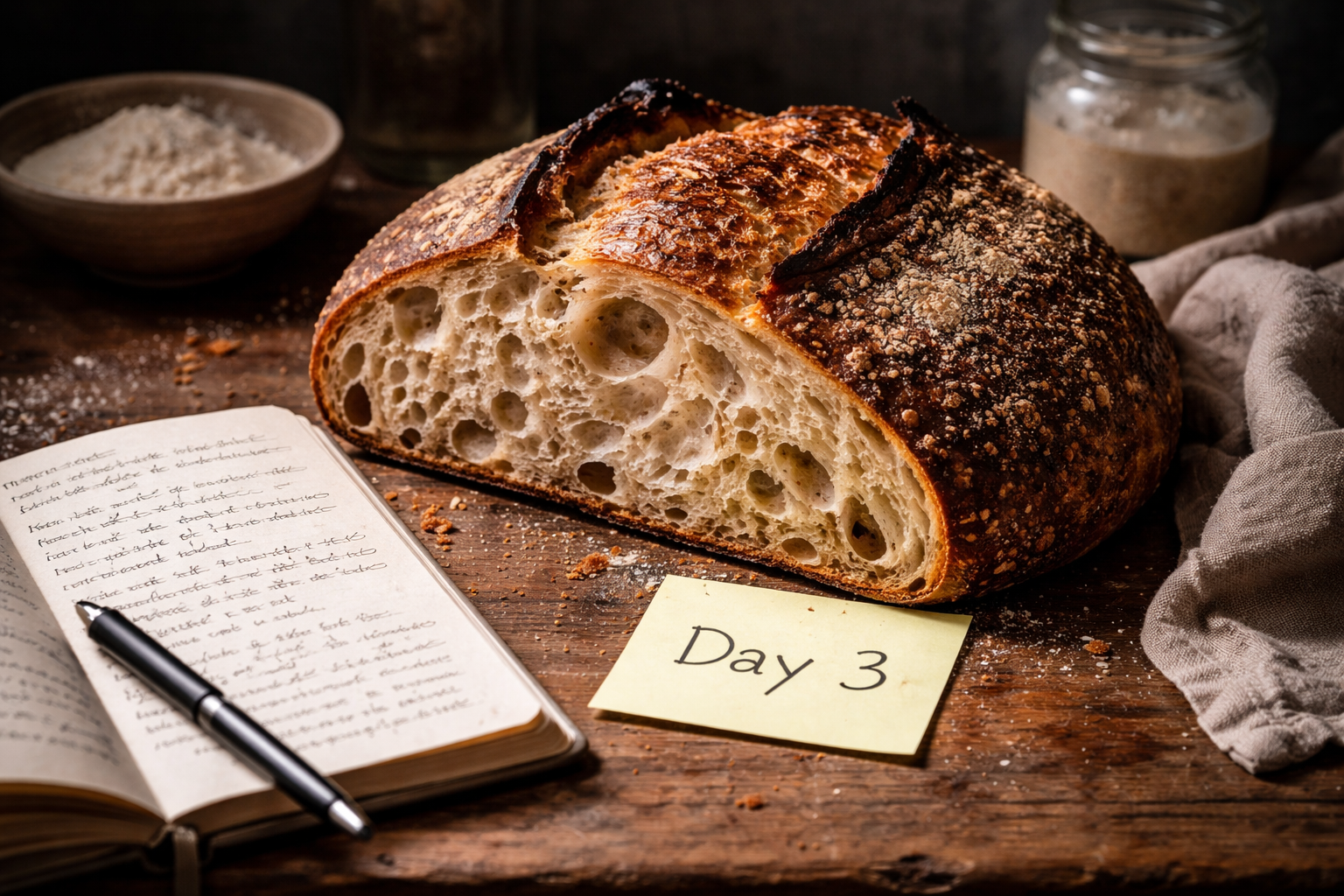
I want to tell you about the Sunday afternoon I sat on my kitchen floor and cried over a loaf of bread. Not metaphorically. Actually sat down, back against the cabinet, flour on my shirt, and cried. I had been chasing a specific flavor for months — that deep, complex, almost wine-like tang you get from a truly great sourdough — and I kept falling short. My loaves were fine. Pretty, even. But they tasted like bread, not like an experience. That afternoon, my fourth attempt in two weeks had come out gummy in the center and barely sour at all, and I had wasted nearly four cups of flour and a whole weekend on something I was embarrassed to put on the table. It wasn’t until I finally committed to a real two day sourdough schedule flavor experiment — slowing everything down intentionally — that everything changed.
This post contains affiliate links. As an Amazon Associate, I earn from qualifying purchases.
If you have ever felt like your sourdough is good but not great, like it’s missing that something you can’t quite name, I genuinely believe this two-day schedule is the answer. It was for me, and I want to walk you through exactly how it works and why the slow road makes all the difference.
Why Slowing Down Unlocks Two Day Sourdough Schedule Flavor
Here is the thing nobody told me when I started baking sourdough: flavor is not built in the oven. Flavor is built during fermentation, and fermentation needs time. When you rush a bulk ferment at room temperature and bake the same day, you are leaving most of the flavor potential sitting on the table.
Sourdough gets its complexity from two main organisms in your starter: wild yeast and lactic acid bacteria. The wild yeast produces carbon dioxide, which gives you rise and structure. The bacteria produce acetic acid and lactic acid, which give you flavor. The key detail is that these bacteria work more slowly at lower temperatures, and when they work slowly, they produce more acetic acid — the sharper, more complex acid associated with that deep sour flavor you are chasing.
A cold, extended proof in the refrigerator does something almost magical. It slows the yeast down enough to prevent over-fermentation while giving the bacteria hours and hours to keep working. The result is a loaf with layered flavor, better crust color, and a crumb that has had time to develop real structure. A two-day schedule simply gives all of that chemistry more room to breathe.
What You’ll Need (My Actual Gear)
Before we get into the schedule, let me share what I use. Getting the right containers and a reliable thermometer genuinely changed my consistency.
For bulk fermentation, I now use the Cambro Food Storage Containers with Lids (2 Pack, 4 Quart). These are the translucent buckets that professional bakers actually use, and the straight sides make it so easy to mark your dough and track its rise. Being able to see through the container without opening it is a game changer during a long bulk ferment.
For the cold proof overnight, I rotate between two options depending on how many loaves I’m making. For single loaves or smaller batches, I love the Rainmae 12pcs Pizza Dough Proofing Box with Lids. The stackable design means I can fit multiple shaped loaves in the fridge without playing Tetris with my shelves. When I’m baking for a crowd and shaping several loaves at once, I reach for the Vtopmart 2 Pack Pizza Dough Proofing Box with Snap-on Lids — the buckle-up latches keep everything sealed tightly, which matters a lot when you want a cold proof to last 18 hours without the dough drying out.
And then there is the thermometer situation. This is the thing I wish someone had told me sooner. Your refrigerator temperature matters enormously for cold proofing. Most home fridges run warmer than we think, especially on crowded shelves. I now keep a TempPro Refrigerator Thermometer (2 Pack) in both my main fridge and my backup. The large backlit display and the max/min record feature let me see exactly how cold my fridge actually got overnight, not just what it reads when I open the door. If you prefer an analog option, the Classic Fridge Thermometer with Red Indicator (2 Pack) is simple, reliable, and fits anywhere. Either way, knowing your actual fridge temperature is not optional when you are doing extended cold proofs — it is essential.
The Two-Day Sourdough Schedule, Step by Step
Here is the schedule I now follow every single weekend. I have baked this way probably forty times and the results are consistent in a way my old same-day bakes never were.
Day One: Morning to Evening
- 8:00 AM — Feed your starter. You want it active and bubbly at peak before you mix. I aim for a 1:5:5 ratio (starter:flour:water) so it peaks in about 5 to 6 hours at a room temperature of around 74 to 76 degrees Fahrenheit.
- 1:00 PM — Mix your dough. Combine your flour, water, salt, and levain. I do a 30-minute autolyse before adding the levain, which helps with extensibility and makes shaping much easier later.
- 1:30 PM to 6:30 PM — Bulk fermentation. This is where the flavor builds. Aim for a 75 to 78 degree environment. Perform 4 sets of stretch and folds in the first two hours, then let the dough rest undisturbed. At 76 degrees, I watch for about 50 to 60 percent volume increase. Mark your container with a rubber band so you can actually see this happening.
- 6:30 PM — Pre-shape and bench rest. Gently pre-shape your loaf, cover it, and let it rest on the counter for 20 to 30 minutes.
- 7:00 PM — Final shape and into the fridge. Shape your loaf with confidence and place it seam-side up in your proofing container or a well-floured banneton. Cover it tightly and slide it into the fridge.
Day Two: The Bake
- Morning, whenever you are ready — Preheat your oven. Do not take the dough out of the fridge. You want to score and bake it cold. Preheat your Dutch oven along with your oven to 500 degrees Fahrenheit for a full 45 minutes to an hour.
- Bake covered at 500°F for 20 minutes. The cold dough going into the screaming hot pot creates incredible oven spring and helps the crust stay pliable long enough for the loaf to fully expand.
- Bake uncovered at 450°F for 20 to 25 minutes. Watch for deep, mahogany color. Do not pull it early. A fully baked crust means better flavor and a crust that stays crispy after cooling.
- Cool for at least 2 hours before cutting. I know. It is the hardest part. But the crumb is still setting during this time, and cutting early is how you end up with gumminess.
The Tips That Made the Biggest Difference For Me
A few lessons I learned the hard way so you do not have to:
Keep your fridge between 37 and 40 degrees Fahrenheit. Warmer than 40 degrees and your dough keeps fermenting aggressively and risks over-proofing overnight. Colder than 36 degrees and the yeast goes almost completely dormant and you can lose oven spring. This is exactly why I trust the TempPro thermometers mentioned above — my fridge was running at 43 degrees for months before I checked it properly, which explains so many of my gummy, over-fermented disasters.
Longer cold proofs build more flavor, but know your limit. Twelve hours is a solid starting point. Sixteen to eighteen hours is where I find the sweet spot. Beyond 24 hours, the gluten structure can start to weaken and scoring becomes difficult. Experiment within that window.
Do not skip the bench rest. After months of rushing, I now treat the bench rest as non-negotiable. That 20 to 30 minutes of relaxation after pre-shaping allows the gluten to loosen just enough to take a final shape