
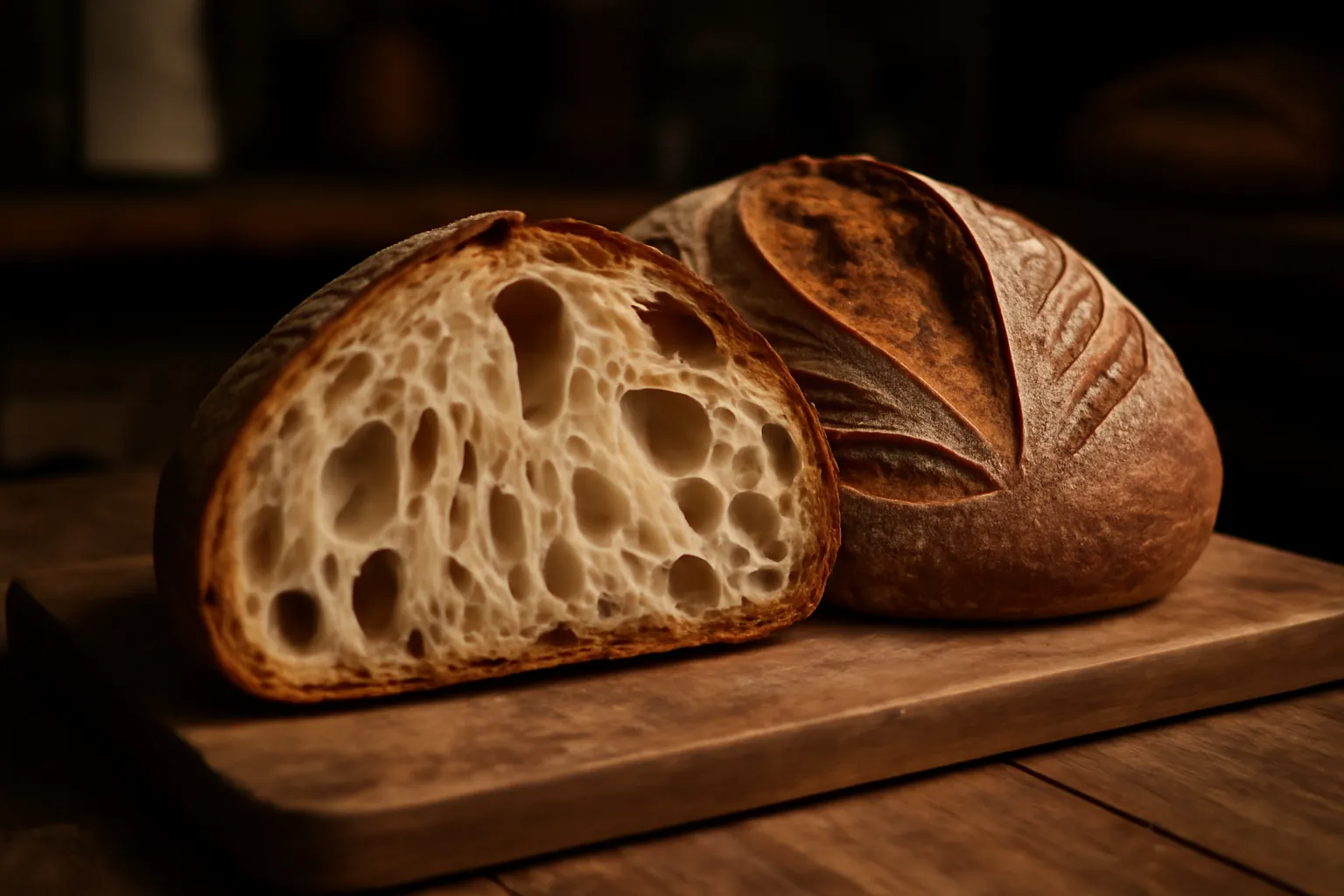
For the first two years I baked sourdough, I only baked on weekends. That was the conventional wisdom — start your levain Friday night, mix Saturday morning, bake Saturday afternoon or Sunday. Clean, contained, no pressure. And honestly, it works great if your life fits that window.
Mine stopped fitting that window when I started my home microbakery. Suddenly I needed loaves ready Monday, Wednesday, and Friday. I needed a sourdough baking schedule weekday that didn’t require me to stay up until midnight or wake up at 4 a.m. — at least not every time. Over three years of baking 40 to 60 loaves a week out of my home kitchen, I rebuilt my entire process around real working hours. What I landed on is what I’m sharing here.
This isn’t a theoretical schedule. It’s the one I actually used, adjusted over hundreds of bakes, and still use now when I want fresh bread mid-week.
Why Weekday Baking Feels Hard (And Why It Doesn’t Have To Be)
The myth is that sourdough is a weekend-only project because it needs constant attention. That’s not accurate. Sourdough needs well-timed attention — there’s a difference. The bulk fermentation and cold proof stages are largely hands-off. What you actually need to be present for is feeding your starter, mixing your dough, shaping, and baking. That’s maybe 90 minutes of real hands-on time spread across two days.
The trick is engineering those 90 minutes to fall at times you’re actually home. For most people with a standard workday, that means a Sunday evening prep, a Monday morning or evening mix, and a Tuesday evening bake. Or some version of that offset. I’ll walk you through exactly how I do it.
The Core Weekday Schedule: Sunday Night Through Tuesday Evening
Sunday Night — Feed Your Starter (5 Minutes)
I keep my starter in the fridge between bakes. On Sunday evening, I pull it out and do a 1:5:5 feeding — 20g starter, 100g flour, 100g water. I use a mix of bread flour and whole wheat at about 90/10. That ratio gives me a strong, predictable rise without overshooting overnight.
By Monday morning, after 8 to 10 hours at room temperature (my kitchen runs around 68–70°F), my starter is peaked and ready. I don’t bake with a starter that hasn’t clearly peaked — domed top, at least doubled, passes the float test. If yours doesn’t reliably do that overnight, your ratios or your flour need adjusting.
Monday Evening — Mix, Autolyse, and Begin Bulk Fermentation (45–60 Minutes Active)
This is the heart of the weekday schedule. When I get home around 6 p.m., I mix my dough. Here’s the exact process:
- 6:00 p.m. — Combine flour and water, autolyse for 30–45 minutes
- 6:45 p.m. — Add levain and salt, mix by hand using Rubaud method for 5 minutes
- 7:00–9:30 p.m. — Bulk fermentation with 4 sets of stretch and folds, every 30 minutes for the first two hours
- 9:30 p.m. — Pre-shape, bench rest 20 minutes, final shape, into the fridge
The dough goes into the refrigerator for a cold retard of 14 to 18 hours. This is what makes the weekday schedule work. Cold retarding overnight gives you complete flexibility on when you bake — you’re not racing a dough that’s proofing at room temperature.
One important note: bulk fermentation timing depends heavily on your kitchen temperature and starter strength. At 70°F with a strong starter, 2.5 to 3 hours is usually right for a 20% levain dough targeting about 50–60% rise in bulk. If your kitchen is colder or your starter is younger, add time. I always go by dough feel and volume, not the clock.
Tuesday Evening — Bake (30–35 Minutes Active)
I preheat my Dutch oven at 500°F for a full 45 minutes before baking. This is non-negotiable for me — cast iron takes longer to fully saturate with heat than most people allow. Score, load, bake covered at 500°F for 20 minutes, uncover and drop to 450°F for 20–25 more minutes.
The loaf that comes out on Tuesday evening was started Sunday night. That’s two full days, almost entirely hands-off, with active work only in the evenings when I’m already home.
Managing the Cold Retard — The Key to Flexibility
One of the biggest lessons from running a microbakery: the cold retard is your scheduling superpower. A shaped dough in the fridge at 38°F will hold for 18 to even 24 hours without significant overproofing in most cases. This means if Tuesday gets crazy and you can’t bake, Wednesday morning before work or Wednesday evening is still very much viable.
I’ve baked loaves retarded for 36 hours that were excellent — actually some of the most flavorful loaves I’ve made. The extended cold fermentation develops acidity and complexity. Tom Cucuzza of The Sourdough Journey has documented similar extended retard results, and my own experience lines up with that.
What I don’t recommend: retarding dough that was underproofed going in. Cold slows fermentation, it doesn’t fix a dough that needed more bulk time. Get bulk right first, then the fridge buys you time.
Starter Maintenance on a Weekday Schedule
If you’re baking once or twice a week on weekdays, keep your starter in the refrigerator and feed it 8 to 12 hours before you need it. I feed mine every 5 to 7 days when I’m baking regularly. I do not feed it daily. There is no scientific basis for feeding a refrigerator-stored starter daily — that’s a myth that leads to a lot of wasted flour and a lot of unnecessarily anxious bakers.
My starter is 11 years old. It’s been neglected for two weeks at a time and come back strong with a single feeding. Mature, well-established starters are more resilient than most baking content suggests.
What I Use
After years of baking large volumes, I’m particular about containers. Here’s what I actually use and recommend:
For individual dough batches and starter storage, I rely on Cambro Food Storage Containers with Lids (BPA-Free) – 4 Quart – Food Grade Buckets with Lids (2 Pack). Cambro is what commercial kitchens use — they’re durable, the markings stay legible, and the translucent walls let you actually see your dough rise without opening the lid. I went through cheap plastic containers before switching and I haven’t looked back.
When I’m doing larger batches or multiple doughs at once, I use the Brod & Taylor Proofing Container with 6L Capacity, Fits Up to 3000 Grams of Dough. The 6-liter size is genuinely useful — you can bulk ferment a double batch in one container and actually see what’s happening. Dishwasher safe, BPA-free, and built to last.
If you’re the type of person who thinks better on paper (I am, even now), The Simple Sourdough Bread Baking Schedule Planner by Caterina Milano is a genuinely useful tool for mapping out your weekday baking timeline. I wish something like this had existed when I was first scaling up my bakes — I used a lot of scrap paper and sticky notes that didn’t survive contact with wet hands.
An Honest Caveat
This schedule works reliably for me in a kitchen that stays between 68°F and 72°F most of the year. If your kitchen runs hotter — say, 76°F or above in summer — your bulk fermentation will move faster and you may need to shorten it or move the bulk retard into the fridge earlier. Temperature is the single biggest variable in sourdough baking, and no schedule survives contact with a 78°F kitchen without adjustment. Get a probe thermometer. Learn your kitchen’s rhythms. The schedule is a framework, not a law.
This post contains affiliate links. As an Amazon Associate I earn from qualifying purchases.
Making It Your Own
The Sunday-Monday-Tuesday structure is what works for my life. You might need a Tuesday-Wednesday-Thursday version, or a Monday evening mix with a Wednesday bake. The logic is the same: feed the night before, mix in the evening, cold retard overnight and into the next day, bake the following evening.
Sourdough fits weekday life when you stop fighting the fermentation timeline and start working with it. Cold retarding isn’t a compromise — it’s a tool. Once I internalized that, weekday baking stopped feeling like a scramble and started feeling like a system. Eleven years in, fresh sourdough on a Tuesday is as normal to me as making dinner. It can be for you too.
The Containers That Finally Let Me Juggle Multiple Doughs Without Losing Track
Weekday baking means you’re often managing multiple doughs at different stages — a levain cold-proofing in the fridge, a bulk fermentation on the counter, a shaped dough waiting for its turn. Without dedicated, clearly labeled containers, I was constantly second-guessing which dough was which and how long each had been fermenting.
What works
- The 4-quart size holds a full batch of dough during bulk fermentation without crowding, so I can actually see fermentation progress through the clear sides instead of lifting the lid every 20 minutes.
- I can stack multiple containers in the fridge without them sliding around, and the tight lids mean no weird fridge smells tainting my dough or vice versa.
- They’re cheap enough that I own four of them, so I always have a clean one ready — no more washing containers between the Monday batch and the Wednesday batch.
What doesn’t
- The lids warp slightly after a few months of thermal cycling between warm counters and cold fridges, so they don’t seal quite as tight as they did at first.
- The plastic scratches easily if you’re not careful with your dough scraper, which means it gets harder to see through them over time.
I almost ditched these containers after the lids started warping, convinced I needed something more expensive, but honestly they still work fine for a home baker on a real schedule. If you’re balancing weekday baking around actual work, grab the Cambro Food Storage Containers with Lids (BPA-Free) – 4 Quart – Food Grade Buckets with Lids (2 Pack).
This post contains affiliate links. As an Amazon Associate, I earn from qualifying purchases at no extra cost to you.