This post contains affiliate links. As an Amazon Associate, I earn from qualifying purchases at no extra cost to you.
If you have ever baked sourdough in a Dutch oven, you know the moment of dread I am talking about. Your beautifully proofed loaf is ready. The Dutch oven is screaming hot. And somehow you have to transfer that wobbly, flour-dusted dough into it without burning yourself, deflating the loaf, or watching it slide off the parchment and hit the oven rack. For the longest time, I wrestled with oversized parchment sheets, awkward folds, and corners that flopped into the bread as it baked. Using parchment paper rounds Dutch oven sourdough inserts — specifically pre-cut rounds with handles — honestly never crossed my mind. I was doing it the hard way, and I did not even realize it.
The breaking point came on a Saturday morning. I had just finished a 36-hour cold ferment on what should have been my best loaf yet. When I went to transfer it, my parchment sling slipped. The dough hit the rim of the Dutch oven. The ear I had scored so carefully collapsed. I pulled out a lopsided loaf that tasted fine but looked like a sad, deflated football. Something had to change.
That afternoon, I fell down a rabbit hole of sourdough forums and baking groups. Dozens of bakers were raving about pre-cut parchment rounds with handles. I had always dismissed them as unnecessary. After that morning, I was ready to try anything.
Why I Chose the Numola Parchment Paper Rounds
There are a surprising number of parchment round options on Amazon. Most of them are simple flat discs — fine for lining cake pans, but not built for Dutch oven sourdough work. What I needed were rounds with actual handles, so I could lower dough in and lift a baked loaf out without a wrestling match. That narrowed my search considerably.
The Numola 9 inch Round Parchment Paper with Handles, Sourdough Bread Sling kept appearing in threads specifically about Dutch oven baking. Bakers mentioned the handles held up under heat without burning or crumbling. The 9-inch diameter fits the most common Dutch oven sizes. The unbleached paper also appealed to me — I prefer to keep my baking as clean as possible, without chlorine bleaching agents near my food.
The 100-pack quantity sealed the deal. At a reasonable price per sheet, I could use a fresh round every single bake without feeling guilty. I also liked that Numola specifically calls this a sourdough bread sling, not just a baking liner. That told me the product was designed with this exact use case in mind.
First Impressions Out of the Box
The package arrived well protected. Inside was a neat stack of 100 rounds, each one cleanly cut and uniform in size. My first thought was how substantial they felt. These were not flimsy, tissue-thin sheets. The paper had a real weight and texture to it — slightly rough on one side, which helps grip the dough without sticking.
The handles were immediately impressive. Each round has two symmetrical tabs extending from opposite sides of the circle. They are wide enough to grip confidently even with oven mitts on. I tested one dry by loading it with a roughly shaped ball of dough I was practicing with. The handles held firm and did not tear. That was encouraging.
Color-wise, the unbleached paper is a warm tan — exactly what you expect from natural, untreated parchment. There was no chemical smell, which I always check for with baking papers. Overall, first impressions were strong. The Numola 9 inch Round Parchment Paper with Handles looked and felt like a product built to do a specific job well.
My Testing Protocol
I committed to using these rounds exclusively for eight weeks, across approximately twelve bakes. My standard setup involves a 5-quart enameled cast iron Dutch oven, preheated at 500°F (260°C) for 45 minutes. I bake covered for the first 20 minutes, then uncover for another 20 to develop the crust.
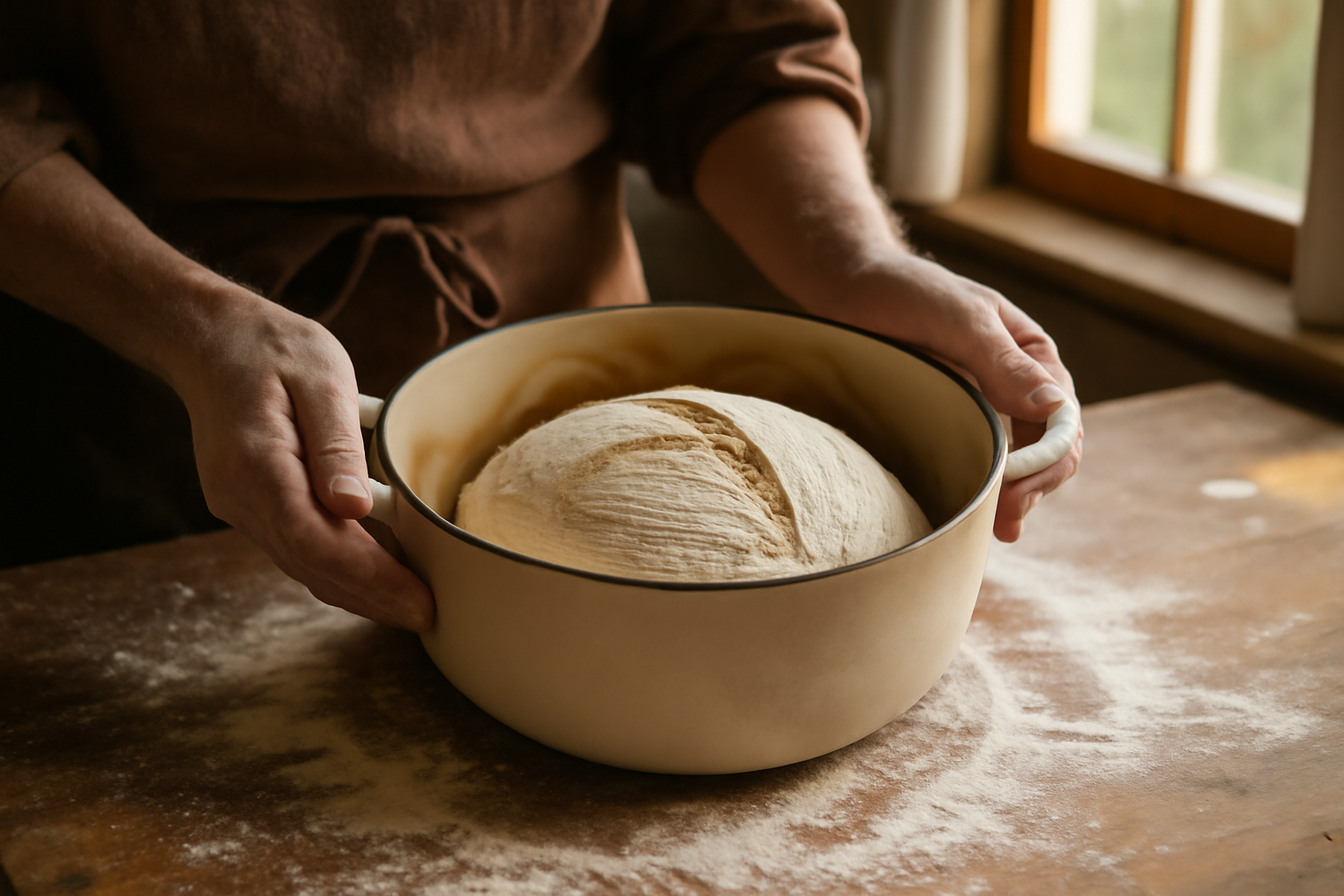
My process became the following routine. After shaping my loaf and placing it seam-side up in the banneton, I would set a parchment round handle-side down over the top of the banneton. Then I would flip the whole thing, so the dough landed centered on the round, ready to score. From there, I could lift the dough directly by the handles and lower it into the screaming-hot Dutch oven cleanly and confidently.
I tested different hydration levels — from a relatively stiff 68% hydration dough up to a slack 80% hydration open-crumb attempt. I also tested the rounds in a cake pan for a focaccia-style bake and in my air fryer for smaller rolls. The versatility of the Numola 9 inch Round Parchment Paper with Handles, Sourdough Bread Sling, Nonstick Baking Paper for Dutch Oven got a genuine workout over those eight weeks.
What Actually Changed in My Baking
The difference was immediate and honestly a little embarrassing. My very first bake with these rounds was cleaner and less stressful than any Dutch oven transfer I had done before. The handles gave me a secure, controlled grip. The dough dropped into the pot centered and undisturbed. My ear bloomed the way it was supposed to.
Here is what concretely improved over eight weeks:
- Transfer consistency: Every single loaf landed centered in the Dutch oven. Not one mishap across twelve bakes.
- Crust quality: Without parchment corners folding over the sides of the loaf, steam circulated more evenly. My crust improved noticeably, with better oven spring and more consistent color.
- Cleanup time: The rounds contain any flour or scoring dust inside the pot. Cleanup dropped from five minutes of scrubbing to a thirty-second wipe.
- Confidence with high-hydration doughs: Slack doughs that used to terrify me at transfer time became manageable. The round supported the dough from underneath the entire time.
- Burn-free removal: Lifting the baked loaf out by the handles — even with the paper slightly crispy after 40 minutes at temperature — worked every time without tearing.
I will admit I had a moment of doubt around bake three. The handles had browned quite deeply and looked almost burnt. I genuinely worried the paper was about to fail mid-bake. However, I checked the temperature rating — these rounds are rated for oven use at typical baking temperatures — and the paper held completely fine. The browning was cosmetic. After that, I stopped worrying about it.
The High-Hydration Test
My 80% hydration bake was the real test. That dough spreads and sticks to everything. Previously, I would practically pour it off a cutting board and pray. Using the round, I shaped the loaf directly on the parchment, scored it in place, and lowered the whole thing smoothly. The dough did not stick to the paper at all during the bake. The bottom crust released cleanly when I lifted the loaf off the round afterward. That bake convinced me these rounds had genuinely earned a permanent spot in my kitchen.
The Downsides Worth Knowing
No product is perfect, and I want to be straightforward here. There are a few genuine limitations to keep in mind.
First, the 9-inch diameter is ideal for most standard loaves and Dutch ovens. However, if you regularly bake larger batards or oblong loaves, the round shape will not support the full length of the dough. These rounds are designed for round boules specifically.
Second, while the handles are genuinely useful, they can be slightly awkward if your Dutch oven has a very narrow opening. The handles splay outward at an angle, which means they sometimes brush the sides of the pot on the way in. It is not a dealbreaker — just something to be aware of and angle accordingly.
Third, these are single-use by design. You could technically reuse a lightly used round once or twice, but after a full bake at 500°F, the paper is usually too stiff and browned to use again reliably. If you bake multiple loaves per week, that 100-pack will go faster than you expect.
Finally, the paper does brown significantly during baking. As I mentioned, it alarmed me at first. It is cosmetically darker than bleached alternatives, and that browning intensifies with heat. If you prefer pristine white paper aesthetics, the unbleached color is not for you — though functionally, it performs exactly as expected.
Final Verdict: Who Should Buy These Parchment Paper Rounds for Dutch Oven Sourdough
After eight weeks and twelve bakes, my verdict is clear. Using parchment paper rounds Dutch oven sourdough-specific rounds — particularly the Numola 9 inch Round Parchment Paper with Handles, Sourdough Bread Sling, Nonstick Baking Paper for Dutch Oven — is one of the simplest, most effective upgrades I have made to my sourdough routine. The improvement in transfer confidence alone is worth every penny.
You should buy these if:
- You bake round boules in a Dutch oven regularly
- You struggle with dough transfer or have burned yourself attempting it
- You work with high-hydration doughs that are difficult to handle
- You want cleaner baking sessions with less scrubbing afterward
- You prefer unbleached, more natural baking materials
You can probably skip these if:
- You primarily bake batards or oblong loaves that need more surface support
- You already have a well-practiced parchment sling technique that works for you
- You bake very infrequently and do not need a 100-pack quantity
For most home sourdough bakers who bake boules weekly, these rounds eliminate one of the most anxiety-inducing moments in the entire process. That is not a small thing.
A Note on the Alternative: SMARTAKE Parchment Rounds
If you bake a very high volume of loaves and want a larger quantity at a lower per-sheet cost, the SMARTAKE 200 Pcs Unbleached Parchment Paper Baking Sheets Round is worth considering. At 200 sheets, it offers more paper for the price. However, these are flat rounds without the extended handles. They work well for lining pans and general baking use, but they do not offer the same Dutch oven sling functionality that makes the Numola rounds so specifically useful for sourdough baking. For straightforward pan lining tasks, SMARTAKE is a solid value pick. For Dutch oven sourdough transfers, the handles on the Numola rounds make a real functional difference.