This post contains affiliate links. As an Amazon Associate, I earn from qualifying purchases at no extra cost to you.
If you’ve ever destroyed a freshly baked sourdough loaf with the wrong knife, you know the specific kind of heartbreak I’m talking about. After months of perfecting my starter and nailing my fermentation timing, I was still ending up with squashed, ragged slices at the cutting board. That’s what finally pushed me into a deep dive on the best bread knife sourdough review content I could find — and eventually toward testing three knives head-to-head on my own loaves.
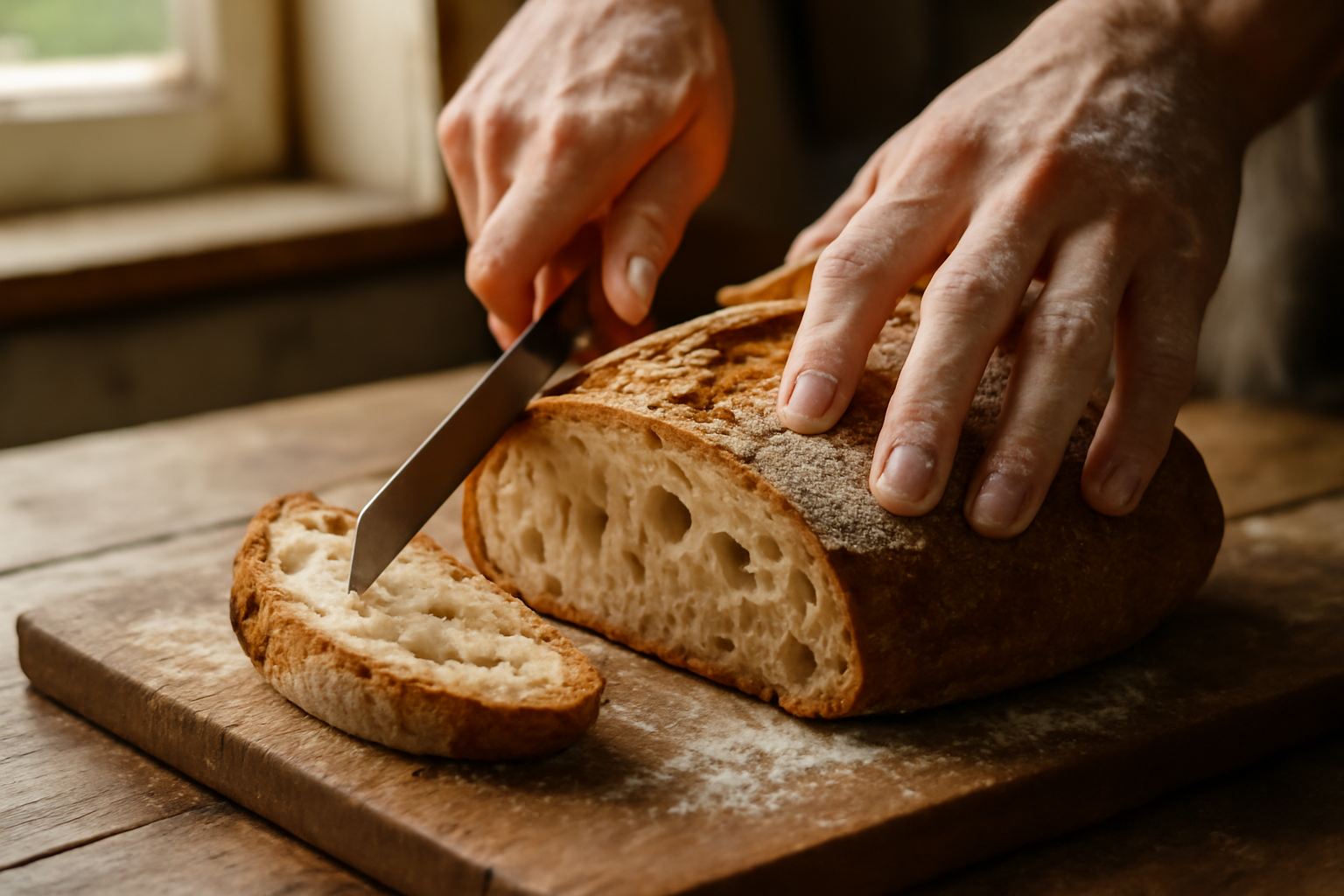
My crust had become genuinely tough. Not in a bad way — in the way that tells you the bake went right. Blistered, caramelized, and crackling. But that crust was absolutely humiliating my old serrated supermarket knife. Every cut dragged and compressed the crumb. My open, airy holes were getting flattened before the slice even hit the plate.
So I bought three knives across different price points and put them through six weeks of real baking. The winner surprised me a little — not because it was expensive, but because it wasn’t. The Mercer Culinary M23210 Millennia Black Handle, 10-Inch Wide Wavy Edge, Bread Knife outperformed knives that cost twice as much. Here’s exactly what happened.
Why I Chose the Mercer After All My Research
Before I ordered anything, I spent an embarrassing amount of time reading forums, watching YouTube comparisons, and asking in sourdough groups. Three names kept coming up: a high-end German blade around $80, a mid-range Japanese-style option around $50, and the Mercer at under $20. My first instinct was to skip the Mercer entirely. Cheap knives have let me down before.
Then I noticed something. Professional bakers kept recommending it. Not hobbyists trying to save money — actual culinary school graduates and bakery owners. The Mercer Culinary Millennia line is standard issue at many culinary programs in the United States. That’s not a marketing claim; it’s something you can verify pretty quickly by looking at culinary school supply lists. That credibility shifted my thinking.
The 10-inch blade length also stood out. Most sourdough boules and batards I bake are wide. A shorter knife forces you to saw back and forth aggressively just to clear the crust. A longer blade lets you draw through in one clean stroke, which protects the crumb structure underneath. That single feature was enough to move it to the top of my test list.
First Impressions Out of the Box
The knife arrived in simple packaging — no fancy box, no velvet sleeve. It came in a thin plastic sleeve with a cardboard backer. Honestly, that was fine. I wasn’t buying it for the unboxing experience.
Picking it up immediately told me something. The balance felt deliberate. The black polypropylene handle has a textured grip that feels secure even when your hands are dusty with flour. It isn’t a heavy knife — it weighs about 5.6 ounces — but it doesn’t feel flimsy either. There’s a reassuring solidity to how it sits in your hand.
The blade itself is stamped rather than forged, which is typical at this price. Stamped blades are thinner and lighter than forged ones. For a bread knife, that’s actually an advantage — less resistance when you’re pulling through a thick crust. The wavy edge serrations are wide and evenly spaced, which is different from the tighter, finer serrations I’ve seen on cheaper knives. Wider serrations tend to cut more aggressively, which matters on tough artisan crusts.
One thing I noticed right away: the spine of the blade has a slight taper toward the tip. That makes precision slicing easier when you’re cutting thinner pieces. First impressions were genuinely positive, though I stayed skeptical until I actually cut something with it.
My Testing Protocol Over Six Weeks
I baked roughly two loaves per week during the testing period. Each loaf went through a cold retard overnight and baked in a Dutch oven at 500°F, then dropped to 450°F. The crust on these loaves is thick and hard — exactly the kind of surface that punishes a weak knife.
Every loaf rested at least one hour before slicing. I sliced each loaf completely, from heel to heel, cutting uniform slices around three-quarters of an inch thick. I kept the cutting board consistent, used the same sawing technique across all three knives, and photographed results for comparison. I also tracked:
- How much pressure I needed to start the cut through the crust
- Whether the crumb compressed under the blade
- How clean the slice face looked after cutting
- How much bread debris was left on the board
- General fatigue after slicing a full loaf
I also tested all three knives on a day-old baguette and a whole-grain sandwich loaf, just to see how they handled softer breads. That gave me a broader picture of versatility.
The Other Two Knives I Tested
For context: the second knife was a well-known German brand at around $75, with a forged blade and fine serrations. The third was a mid-range option around $45 with an offset handle design. Both have strong reputations. Neither is a bad knife. I just want to be honest about what I was comparing the Mercer against.
What Actually Changed When I Switched to the Mercer
The first cut told me something significant. The Mercer Culinary M23210 Millennia Black Handle, 10-Inch Wide Wavy Edge, Bread Knife bit into the crust immediately. I barely applied downward pressure. The serrations grabbed the surface and started pulling through without any of the frustrating skating that cheap knives do on hard crusts.
My crumb stopped compressing. That sounds like a small thing, but it genuinely matters if you’ve worked hard on building an open structure. Every slice came out looking like it should — full of irregular holes, with clean edges rather than smashed, torn ones. The difference was visible in the photos I took.
By week two, I noticed I was finishing each loaf faster. Less back-and-forth sawing, less repositioning, less fighting. Slicing a full loaf went from feeling like a chore to feeling almost satisfying.
How It Compared to the More Expensive Options
Here’s where it got interesting. The $75 German knife performed extremely well on the soft sandwich loaf. Its fine serrations were almost elegant on softer crumb. However, it struggled slightly more on the thick artisan crust — not badly, but I could feel more resistance compared to the Mercer.
The $45 offset knife was comfortable to use and minimized knuckle contact with the cutting board. That’s a real ergonomic advantage if you bake in high volume. On raw cutting performance through crusty sourdough specifically, though, it trailed the Mercer by a noticeable margin.
I’ll admit I had a moment of doubt around week three. The Mercer’s stamped blade made me wonder whether it would dull quickly. I sliced roughly 24 loaves before reassessing the edge. It still cut cleanly. That isn’t a lifetime guarantee, but it was reassuring enough for me to stop worrying about it in the short term.
The Downsides I Won’t Pretend Don’t Exist
No product review is honest without real negatives. Here are mine.
The handle material feels functional rather than premium. It gets the job done, and the grip is secure. But if you’re used to high-end knives with bolsters and full-tang construction, the Mercer will feel noticeably more utilitarian. That’s a fair trade at this price, but it’s worth knowing.
Long-term edge retention is an open question. Stamped blades generally don’t hold an edge as long as forged ones under heavy use. I haven’t baked with this knife long enough to give you a one-year durability verdict. What I can say is that after six weeks of regular use, the edge still performs well. But if you’re a high-volume home baker producing five-plus loaves per week, you may eventually need to replace it — rather than re-sharpen it, since serrated edges are much harder to sharpen at home.
The knife is also hand-wash recommended. That’s standard for quality kitchen knives, but worth noting if you rely on a dishwasher. Repeated dishwasher cycles would likely accelerate dulling and handle wear.
Finally, the lack of an offset handle means your knuckles do come close to the cutting board on a full-depth cut through a tall loaf. It’s not a dealbreaker, but the offset design of the alternative product I’ll mention below does solve that specific issue.
Final Verdict: Best Bread Knife Sourdough Review Conclusion
After six weeks of real testing, the Mercer Culinary M23210 Millennia Black Handle, 10-Inch Wide Wavy Edge, Bread Knife is the knife I reach for every time I bake. It’s not the flashiest option on the market. It doesn’t have a forged blade or a beautiful walnut handle. What it has is exceptional cutting performance on crusty artisan sourdough at a price that’s genuinely hard to argue with.
Buy This Knife If:
- You bake artisan sourdough with hard, thick crusts regularly
- You want a professional-grade cutting experience without a premium price tag
- You’re tired of compressing your crumb with an underperforming knife
- You don’t mind hand-washing your knives
Consider Skipping It If:
- You prioritize premium materials and build aesthetics in your kitchen tools
- You bake exclusively soft sandwich loaves, where fine serrations may perform better
- Knuckle clearance is a specific concern for you due to your cutting style or board height
For most home sourdough bakers, this is simply the best value decision you can make in bread knives right now. I’m confident enough in that to say it directly.
Worth Considering: The Offset Alternative
If knuckle clearance is genuinely important to you — or you bake very tall, wide loaves on a low cutting surface — the Mercer Culinary M23890 Millennia Black Handle, 9-Inch Offset Wavy Edge, Bread Knife is worth a look. The offset handle drops the blade below your grip line, which gives your knuckles clearance on deep cuts. It’s slightly shorter at 9 inches, which worked well enough on my standard boules.
The offset version didn’t outperform the 10-inch straight blade on raw cutting power through hard crusts in my testing. However, it’s an ergonomic improvement for bakers who find standard handles uncomfortable. Both knives come from the same Mercer Millennia line, so build quality and price point are comparable. It really comes down to whether that offset design solves a problem you actually have.
Either way, you’re making a solid choice. The Mercer line has earned its reputation in working kitchens for a reason — and after six weeks of sourdough testing, I understand exactly why.